


Traffic in Digital Marketing: Key Concepts
Traffic is a business term used to describe the movements on the internet. Higher traffic means the site is more frequently visited by users.
5 min read
DigitalMarketing
AffiliateMarketing
+5

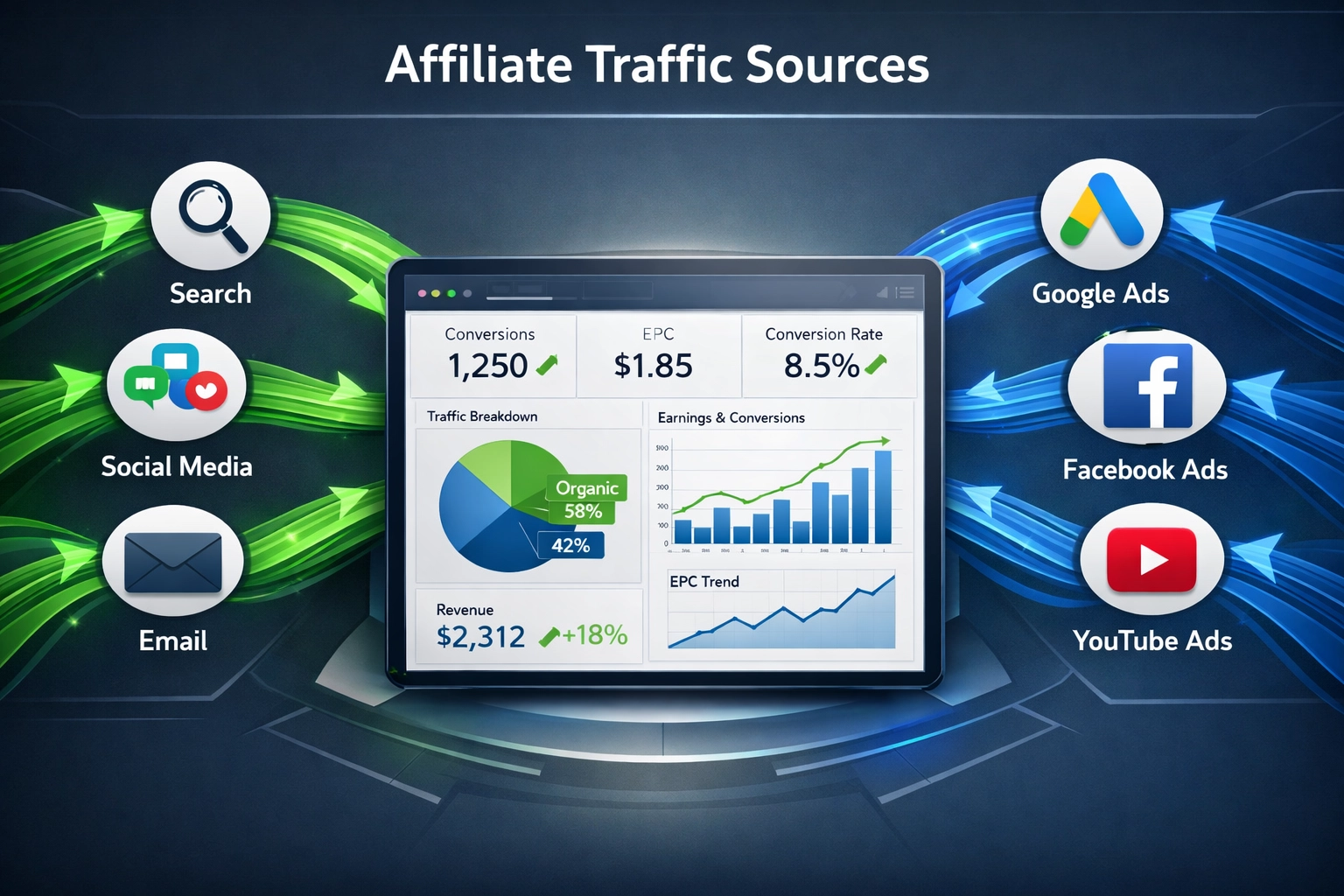
Learn about organic and paid affiliate traffic sources, their impact on conversion rates, and how to build a hybrid strategy for profitability.
Affiliate traffic refers to the visitors and customers you drive to a merchant’s website through your promotional efforts, and it’s the lifeblood of any successful affiliate marketing program. The quality and source of your traffic directly impact your conversion rates, earnings per click (EPC), and overall profitability as an affiliate marketer. Understanding the different types of traffic available to you is crucial because each channel has distinct characteristics, costs, and performance metrics that can make or break your affiliate business. There are two primary categories of affiliate traffic: organic traffic (earned through content and relationships) and paid traffic (purchased through advertising platforms), and mastering both will significantly expand your earning potential.
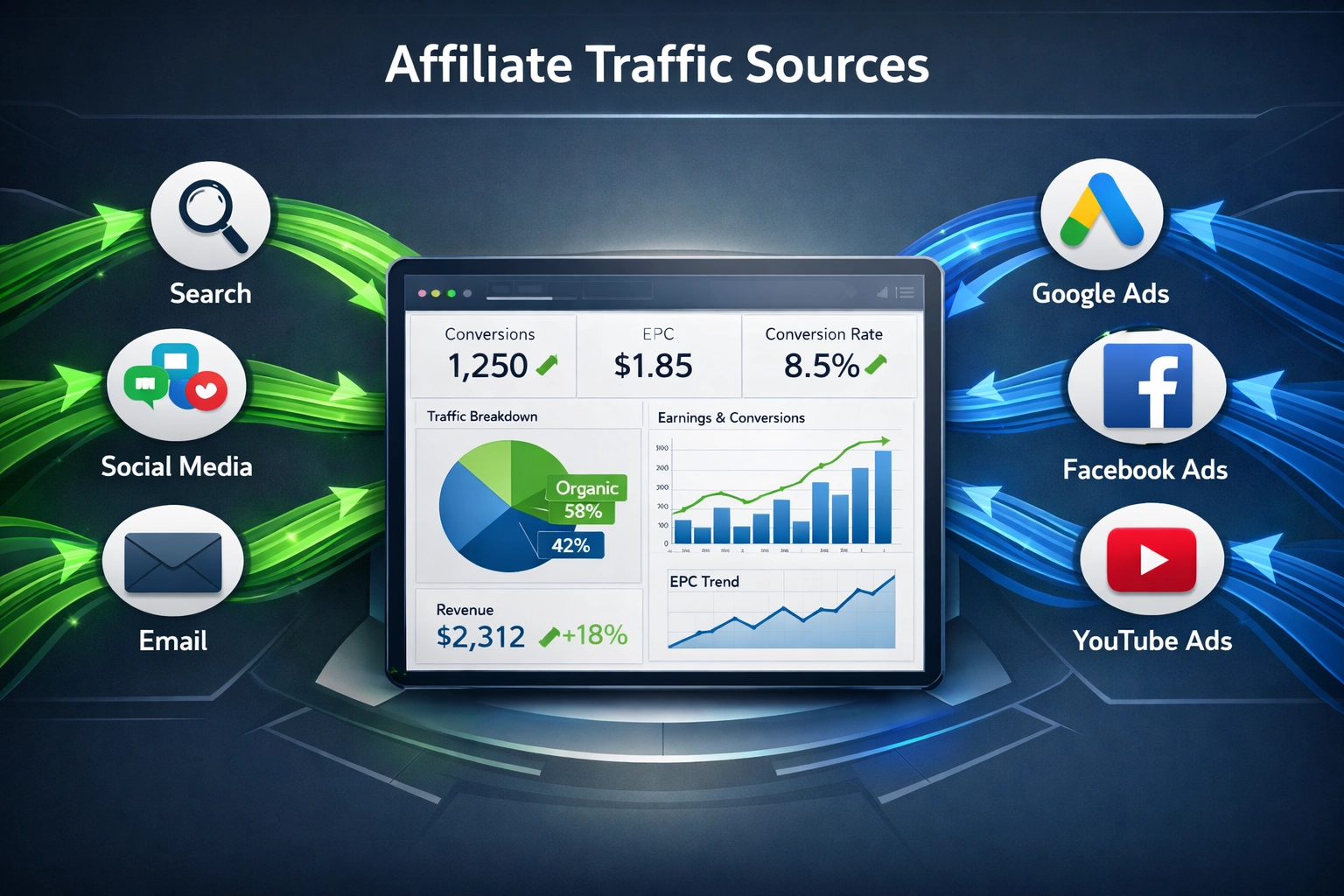
Organic traffic is the free or low-cost visitors you attract through search engines, social media, email lists, and content marketing—traffic that comes to you without direct advertising spend. The benefits of organic traffic are substantial: it’s essentially free or near-free once your content is published, it compounds over time as your content continues to generate views and conversions months or years after creation, and it builds credibility and trust with your audience since they discover you through genuine recommendations rather than paid ads. According to ClickBank affiliate data, organic traffic converts at 0.94% with an EPC of $0.93, making it a reliable long-term income stream. However, organic traffic comes with significant challenges—it requires substantial time investment to create quality content, build authority, and grow an audience, and you’re vulnerable to algorithm changes from Google, YouTube, or social platforms that can dramatically reduce your visibility overnight. Here’s how organic traffic sources compare to paid channels:
| Traffic Source | Conversion Rate | EPC | Cost | Timeline |
|---|---|---|---|---|
| Organic Search | 0.94% | $0.93 | Free | 3-12 months |
| Email Marketing | 0.36% | $0.32 | Low | Immediate |
| YouTube Ads | 1.13% | $1.08 | Paid | Immediate |
| Facebook Ads | 1.16% | $1.47 | Paid | Immediate |
| Google Ads | 1.34% | $0.80 | Paid | Immediate |
| Native Ads | 0.65% | $0.82 | Paid | Immediate |
The most successful affiliate marketers build organic traffic through SEO-optimized blog content, YouTube channels, email newsletters, and social media communities, understanding that while the upfront effort is substantial, the long-term ROI is unmatched.

Set up advanced tracking in minutes. No credit card required.
Paid traffic is the opposite approach—you purchase visitors directly from advertising platforms like Google Ads, Facebook, YouTube, and native ad networks, paying either per click (PPC) or per impression to get your affiliate links in front of potential customers. Paid traffic sources include search ads (Google Ads, Bing), social media ads (Facebook, Instagram, TikTok), video ads (YouTube pre-roll), native advertising (sponsored content on publisher networks), and email advertising (sponsored emails to third-party lists). The primary advantages of paid traffic are immediate results—you can start generating conversions within hours of launching a campaign—precise targeting capabilities that let you reach specific demographics, interests, and behaviors, and unlimited scalability since you can increase your budget to drive more traffic whenever you identify profitable campaigns. ClickBank data shows that paid channels deliver strong performance: Facebook Ads convert at 1.16% with $1.47 EPC, Google Ads at 1.34% with $0.80 EPC, and YouTube Ads at 1.13% with $1.08 EPC. The critical challenge with paid traffic is cost management—you must carefully track your cost per acquisition (CPA) against your EPC to ensure profitability, and you’ll face refund rates and chargebacks that can eat into your margins if you’re not promoting quality products to the right audience. Successful paid traffic campaigns require disciplined budget allocation, continuous A/B testing of creatives and landing pages, and a deep understanding of your break-even point to scale profitably.
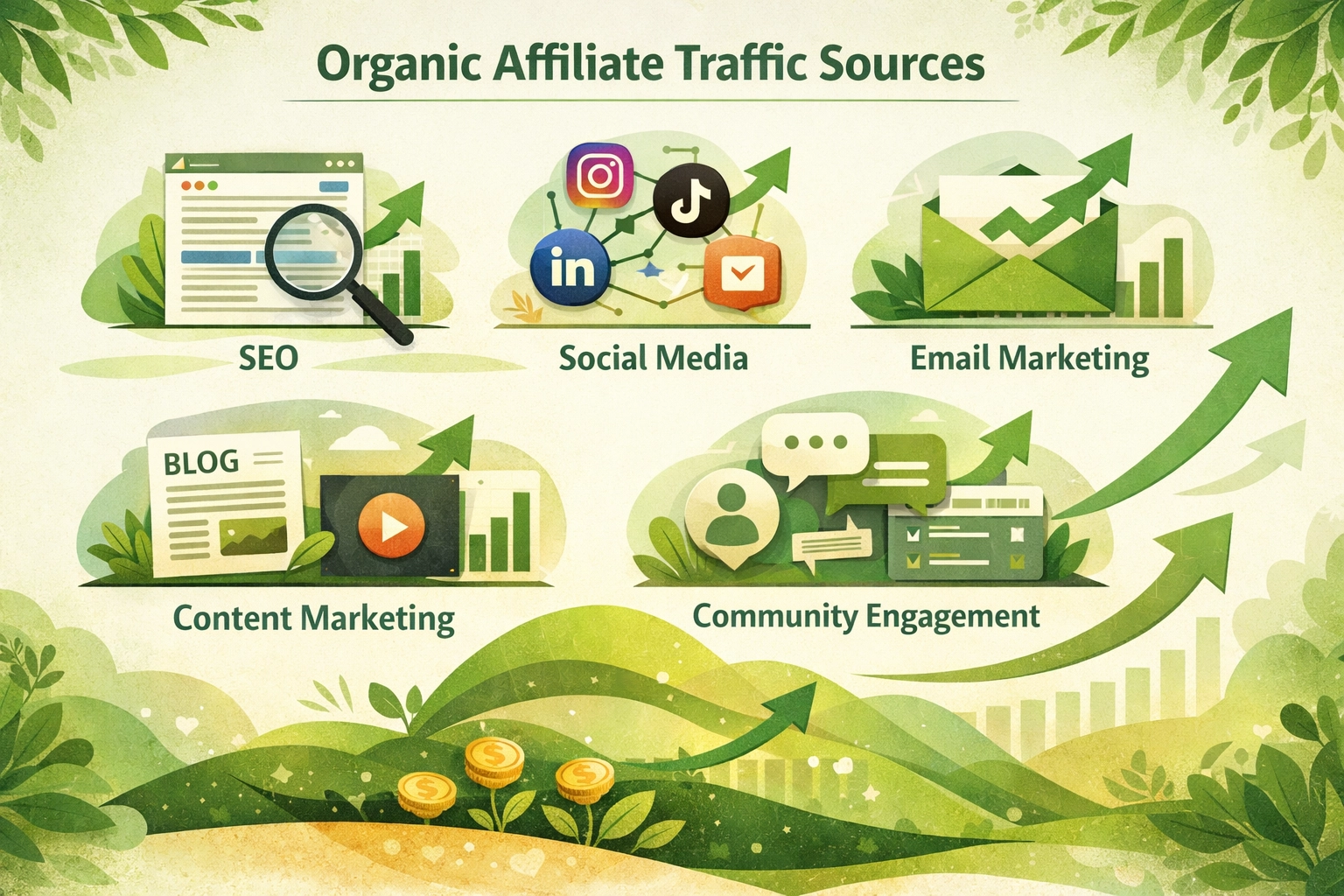
Building sustainable affiliate revenue requires understanding the most effective organic traffic sources available to marketers. Unlike paid channels, organic sources develop gradually but create long-term assets that continue generating commissions with minimal ongoing investment. The following five organic sources represent the most reliable pathways to consistent affiliate income without continuous ad spend.
SEO (Search Engine Optimization): Ranking for high-intent keywords positions your content directly in front of prospects actively searching for solutions. With an average 0.94% conversion rate and $0.93 EPC, organic search traffic delivers steady, qualified visitors who are already motivated to purchase. The investment in SEO pays dividends over months and years, creating a compounding effect as your content authority grows.
Social Media Marketing: Building engaged communities on platforms like Instagram, TikTok, and LinkedIn creates authentic touchpoints with potential customers. Organic social reach allows you to share valuable content, build trust, and recommend products naturally without platform algorithm penalties. This approach generates lower-cost traffic while establishing your personal brand as a trusted authority in your niche.
Email Marketing: Your email list represents one of your most valuable assets, delivering exceptional $42 ROI per $1 spent with a 0.36% conversion rate. Regular email campaigns nurture relationships with subscribers who have already expressed interest in your content and recommendations. This channel offers unmatched profitability because you own the relationship and aren’t dependent on algorithm changes or platform policies.
Content Marketing: Publishing valuable blog posts, guides, videos, and resources attracts organic traffic while establishing expertise and credibility. Quality content naturally earns backlinks, improves search rankings, and creates multiple entry points for potential customers discovering your recommendations. This approach builds a sustainable traffic engine that compounds over time as your content library grows.
Community Engagement: Participating authentically in forums, Reddit communities, Slack groups, and niche communities builds relationships and establishes authority without aggressive promotion. Strategic participation where you provide genuine value creates opportunities to recommend relevant products when appropriate. This organic approach generates highly qualified traffic from people who already respect your insights and recommendations.
Be the first to know about new features and product updates.
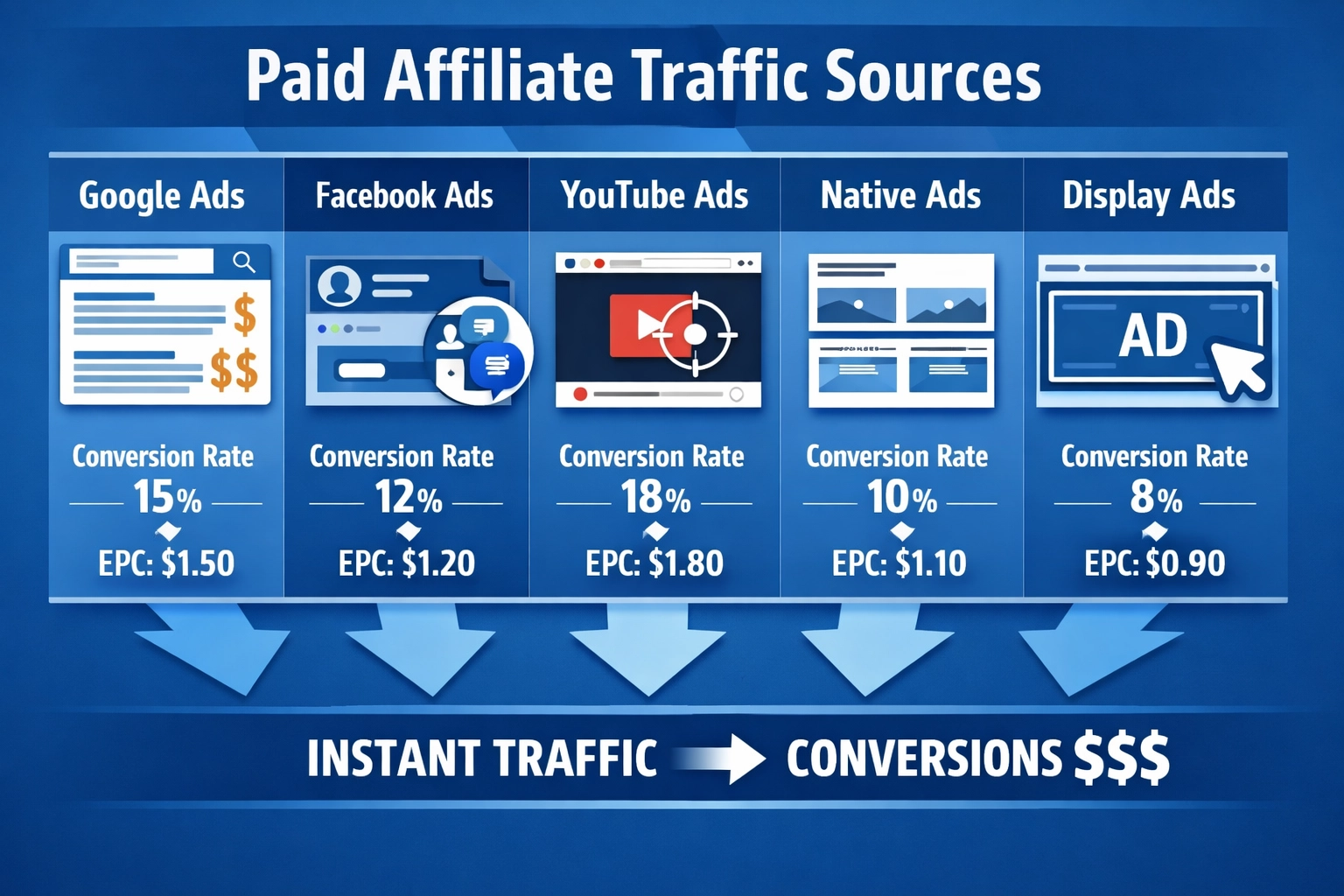
Paid traffic channels offer immediate visibility and scalable reach, making them ideal for affiliates who want to accelerate revenue growth and test new offers quickly. While paid sources require continuous investment, they provide predictable traffic volumes and allow precise targeting of high-intent audiences. Understanding the performance metrics of each paid channel is essential for allocating your advertising budget effectively.
Google Ads: Google’s search network captures high-intent keywords with a 1.34% conversion rate and $0.80 EPC, making it ideal for targeting prospects actively searching for solutions. The platform’s sophisticated targeting options and quality score system reward relevant ads with lower costs and better placement. Google Ads works exceptionally well for affiliate marketers promoting products that solve specific problems searchers are actively trying to solve.
Facebook Ads: Facebook’s detailed audience targeting capabilities deliver impressive results with a 1.16% conversion rate, $1.47 EPC, and $135.24 average payout per successful conversion. The platform’s visual format and retargeting options allow you to build awareness and convert interested prospects across multiple touchpoints. Facebook’s lower cost-per-click compared to Google makes it excellent for testing new offers and scaling profitable campaigns.
YouTube Ads: Video advertising on YouTube reaches audiences during content consumption with a 1.13% conversion rate and $1.08 EPC. YouTube’s targeting options based on interests, keywords, and viewing behavior allow precise audience selection for affiliate offers. The platform’s skippable ad format means you only pay for engaged viewers, making it cost-effective for affiliate promotions.
Native Ads: Native advertising platforms blend promotional content seamlessly into editorial environments, achieving a 0.65% conversion rate and $0.82 EPC. These ads feel less intrusive than traditional display advertising, resulting in higher engagement rates and better user experience. Native ads work particularly well for affiliate offers targeting broad audiences across multiple content categories and websites.
Display Ads: Display advertising networks reach audiences across millions of websites with visual banner ads, offering broad reach and retargeting capabilities. While display ads typically generate lower conversion rates than search-based channels, their low cost-per-impression makes them valuable for building awareness and retargeting warm audiences. Display networks excel at reaching prospects in the early stages of the buying journey before they’re ready to convert.
Choosing between organic and paid traffic sources requires analyzing profitability metrics beyond simple conversion rates, including margins, refund rates, and long-term sustainability. Paid channels typically experience 3-5% higher refund rates than organic sources, meaning customers acquired through paid ads are more likely to request refunds, directly impacting your bottom line. Email marketing stands out as the most profitable channel with its exceptional $42 ROI per dollar spent, while Facebook Ads offers the highest EPC at $1.47, making it ideal for scaling profitable campaigns quickly.
Organic sources like SEO and content marketing require significant upfront investment in time and resources but generate compounding returns with minimal ongoing costs and lower refund rates. Paid channels provide immediate traffic and faster revenue but demand continuous budget allocation and careful optimization to maintain profitability. The optimal strategy combines both approaches: use paid traffic to quickly validate offers and generate immediate revenue, while simultaneously building organic assets through SEO and email list growth that will sustain your business long-term. For affiliate marketers with limited budgets, prioritize email marketing and organic social media to build your foundation, then reinvest profits into paid channels like Facebook Ads once you’ve proven offer profitability. Established affiliates should maintain a balanced portfolio allocating 40% to organic growth, 40% to proven paid channels, and 20% to testing new traffic sources and offers.
Selecting the right traffic sources for your affiliate program requires a deep understanding of your niche, target audience, and business objectives. Fashion and lifestyle affiliates thrive with visual platforms like Instagram, Pinterest, and TikTok, where influencer partnerships and user-generated content drive authentic engagement. B2B software affiliates, conversely, should focus on LinkedIn, industry forums, and specialized publications where decision-makers actively research solutions. Health and wellness niches benefit from YouTube tutorials, health blogs, and email marketing, where trust and credibility are paramount. Consider your audience’s behavior patterns—are they scrolling social media, reading blogs, or searching for solutions on Google? Match your traffic sources to where your ideal customers naturally congregate, and prioritize channels that align with your niche’s content consumption habits. Testing multiple sources simultaneously allows you to identify which channels deliver the highest-quality leads before scaling your investment.
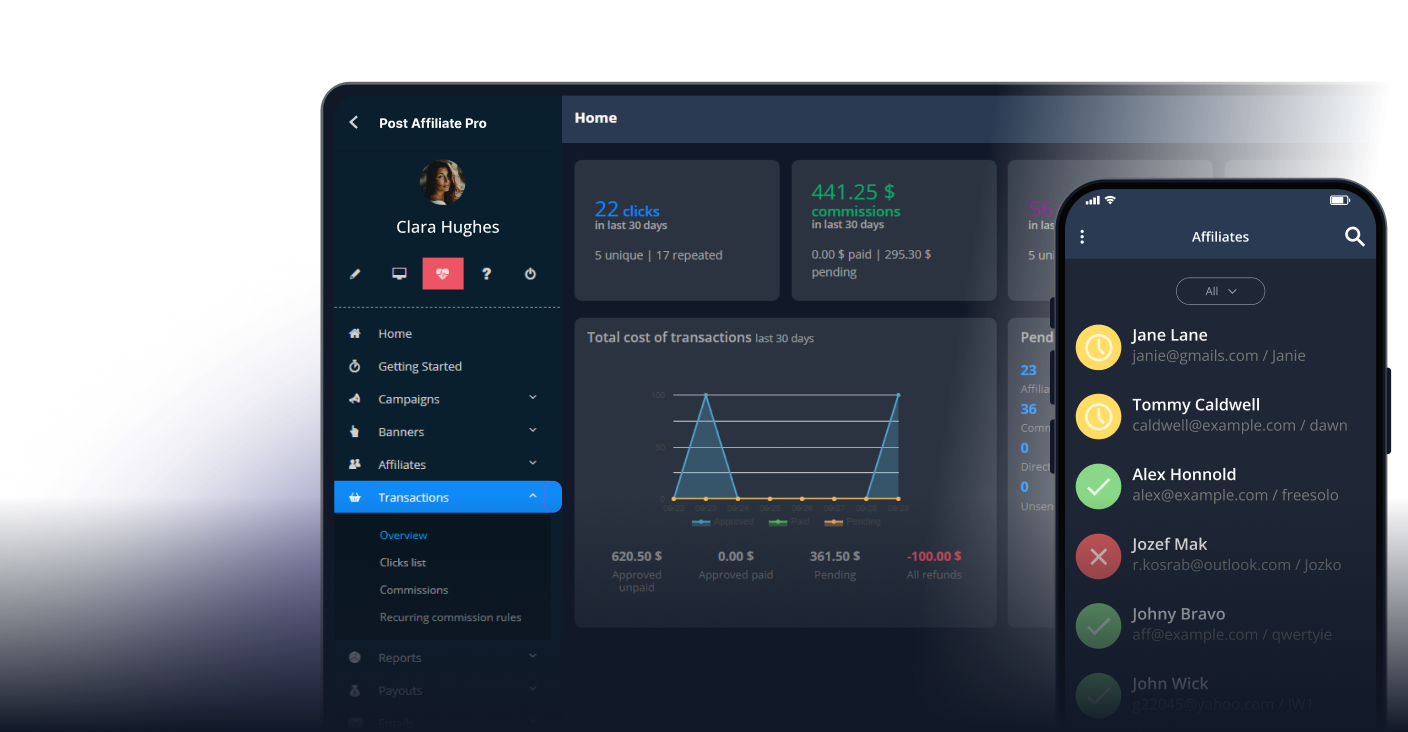
Not all traffic is created equal, and low-quality traffic can devastate your affiliate program’s profitability and reputation. Implement rigorous monitoring of key performance metrics including click-through rate (CTR), conversion rate, cost per acquisition (CPA), and return on ad spend (ROAS) to identify suspicious patterns early. Watch for red flags such as unusually high click volumes with zero conversions, traffic spikes from suspicious geographic locations, or bot-like behavior that indicates click fraud. PostAffiliatePro provides comprehensive tracking and fraud detection tools that monitor affiliate traffic in real-time, allowing you to identify and block fraudulent sources before they drain your budget. Establish clear quality thresholds for each traffic source—if a channel’s conversion rate drops below your baseline or CPA exceeds acceptable limits, investigate immediately or pause the campaign. Regular audits of your affiliate network, combined with advanced analytics, ensure you’re only paying for genuine, conversion-ready traffic. By maintaining strict quality controls, you protect your brand reputation and maximize the ROI of every marketing dollar spent.
The most successful affiliate programs combine organic and paid traffic to create a resilient, diversified marketing engine that captures customers at every stage of the buyer’s journey. Organic traffic from SEO, content marketing, and social media provides sustainable, long-term growth with lower acquisition costs, while paid traffic from PPC, display ads, and sponsored content delivers immediate results and allows precise audience targeting. Start by establishing a strong organic foundation—publish high-quality content, optimize for search engines, and build genuine community engagement—then layer paid campaigns on top to accelerate growth during peak seasons or product launches. For example, a fashion affiliate might drive organic traffic through style guides and trend articles while running Pinterest ads to capture high-intent shoppers; a B2B marketer could combine LinkedIn organic posts with targeted LinkedIn ads to reach decision-makers. Allocate your budget strategically: invest 60-70% in proven paid channels while reserving 30-40% for organic initiatives that build long-term authority and reduce future acquisition costs. Monitor the performance of each channel independently, then analyze how they work together—organic traffic often improves conversion rates for paid visitors through social proof and brand familiarity. This integrated approach maximizes reach, reduces dependency on any single traffic source, and creates compounding returns as your organic presence strengthens over time.
Optimizing your affiliate traffic strategy is an ongoing process that requires strategic planning, continuous monitoring, and willingness to adapt based on performance data. The key takeaways are clear: match traffic sources to your niche and audience, maintain strict quality controls to prevent fraud, and build a hybrid strategy that combines organic and paid channels for sustainable growth. Start by auditing your current traffic sources against the metrics that matter most—CTR, conversion rate, CPA, and ROAS—then identify underperforming channels to eliminate or optimize. Next, develop a testing plan to explore new traffic sources in your niche while scaling what’s already working, and establish clear quality thresholds to protect your program from fraudulent activity. PostAffiliatePro empowers you to manage this entire process with advanced tracking, real-time fraud detection, and comprehensive analytics that give you complete visibility into every affiliate and traffic source. Take action today: implement the strategies outlined in this guide, leverage PostAffiliatePro’s powerful tools to monitor and optimize your traffic, and watch your affiliate program transform into a high-performing revenue engine that drives sustainable growth for your business.
Organic traffic is free or low-cost visitors you earn through SEO, content marketing, social media, and community engagement. Paid traffic is purchased directly from advertising platforms like Google Ads and Facebook. Organic traffic takes longer to generate but compounds over time with lower refund rates, while paid traffic delivers immediate results but requires continuous budget allocation.
Email marketing delivers the highest ROI at $42 per $1 spent, while Facebook Ads offers the highest EPC at $1.47. The most profitable approach combines both: use email marketing and organic channels for sustainable, long-term revenue with high margins, and paid channels like Facebook Ads for rapid scaling and testing new offers.
Organic traffic typically takes 3-12 months to generate meaningful results, depending on your niche competitiveness and content quality. However, once established, organic traffic compounds over time—a blog post or YouTube video published today can continue generating conversions months or years later with minimal additional investment.
Cost per click varies significantly by platform and niche. Google Ads averages around $0.80 EPC, Facebook Ads around $1.47 EPC, and YouTube Ads around $1.08 EPC. Native ads cost approximately $0.82 EPC. Your actual costs depend on your niche competitiveness, targeting precision, and ad quality score.
Absolutely—in fact, combining organic and paid traffic is the optimal strategy. Start with organic foundations through SEO and content marketing, then layer paid campaigns on top to accelerate growth. This hybrid approach maximizes reach, reduces dependency on any single source, and creates compounding returns as your organic presence strengthens.
Monitor key metrics including CTR, conversion rate, CPA, and ROAS to identify suspicious patterns. Watch for red flags like high click volumes with zero conversions or traffic spikes from suspicious locations. Use affiliate tracking software like PostAffiliatePro to detect fraudulent sources in real-time and establish clear quality thresholds for each traffic channel.
Beginners should start with organic traffic sources like SEO and email marketing, which require time investment but have minimal financial risk. Once you've built an audience and proven offer profitability, reinvest earnings into paid channels like Facebook Ads. This approach builds sustainable foundations while minimizing upfront costs.
Track metrics including click-through rate (CTR), conversion rate, cost per acquisition (CPA), earnings per click (EPC), and return on ad spend (ROAS). Use affiliate tracking software to monitor these metrics across all traffic sources, identify underperforming channels, and optimize your campaigns based on data-driven insights.
PostAffiliatePro provides comprehensive tracking, fraud detection, and analytics to help you monitor and optimize every traffic source in your affiliate program. Get complete visibility into your affiliate performance and maximize your ROI.
Traffic is a business term used to describe the movements on the internet. Higher traffic means the site is more frequently visited by users.
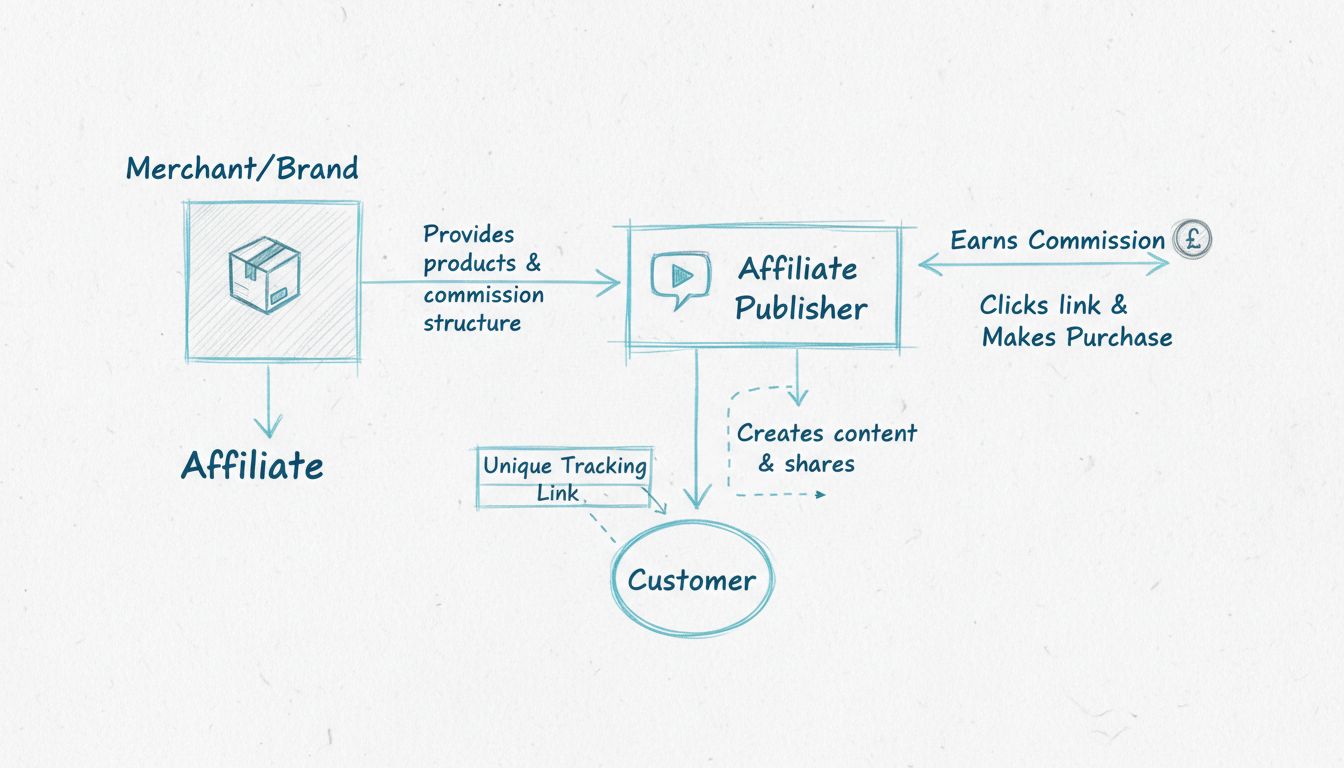
Learn what affiliate marketing means with our comprehensive guide. Discover how affiliate programs work, commission structures, and why PostAffiliatePro is the ...
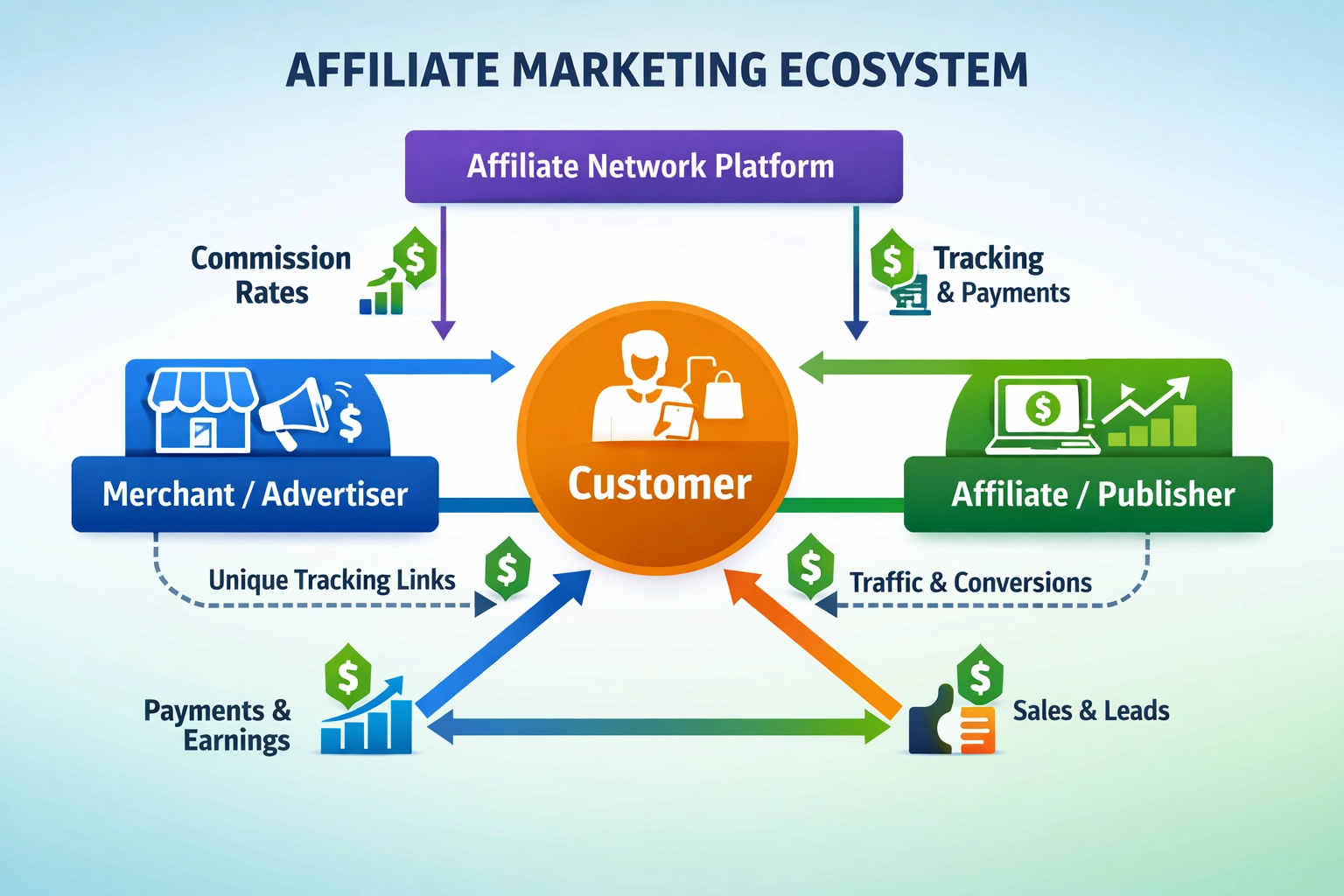
Learn what affiliate marketing is, how it works, commission models, and proven strategies to earn passive income. why 80% of brands use affiliate programs.
Join our community of happy clients and provide excellent customer support with Post Affiliate Pro.



Cookie Consent
We use cookies to enhance your browsing experience and analyze our traffic. See our privacy policy.