


Privacy Policy Explained
A privacy policy is a legal document that states what the company can do with customer data. Learn about its importance, core components, and relevance for affi...
4 min read
Privacy
AffiliateMarketing
+4

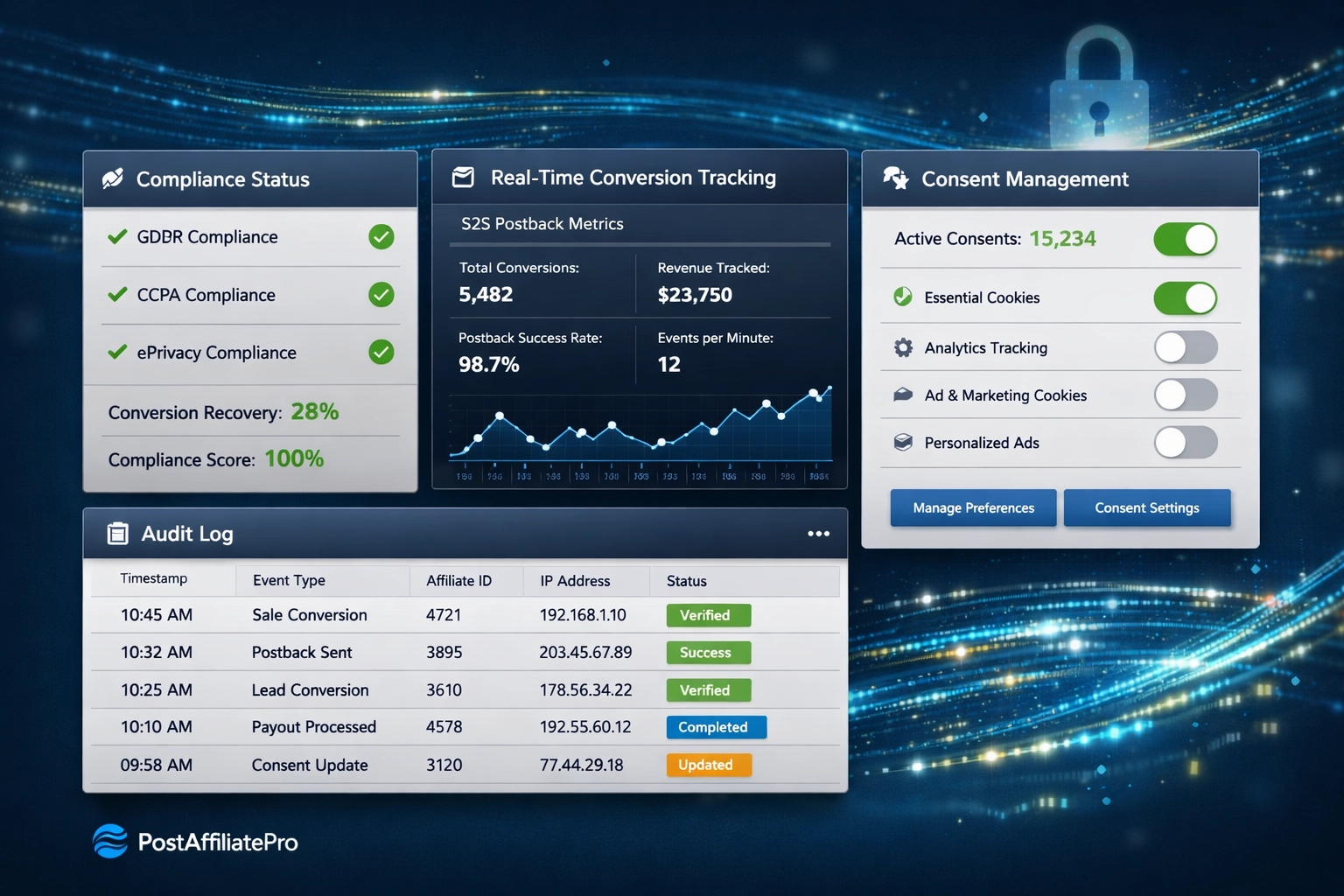
Discover how modern affiliate software ensures GDPR compliance and implements cookie-less tracking. Learn about S2S tracking and consent management.
The regulatory environment governing affiliate marketing has undergone a seismic shift over the past five years, with GDPR (General Data Protection Regulation), CCPA (California Consumer Privacy Act), and the ePrivacy Directive establishing stringent requirements for data collection and processing. These regulations fundamentally changed how affiliate programs operate, requiring explicit consent before tracking users and imposing substantial penalties—up to €20 million or 4% of global revenue under GDPR—for non-compliance. The traditional affiliate marketing model, which relied heavily on third-party cookies for cross-domain tracking, has become increasingly untenable as browsers implement stricter privacy controls and regulators demand greater transparency. This regulatory pressure has catalyzed a strategic shift toward first-party data collection, where brands and affiliates build direct relationships with customers and collect data with explicit consent. The transition to first-party data fundamentally impacts affiliate tracking accuracy, requiring sophisticated server-side solutions that can maintain attribution integrity while respecting user privacy and regulatory requirements.

GDPR compliance for affiliate programs extends far beyond simple cookie consent banners, encompassing a comprehensive framework of data subject rights that must be actively supported by affiliate software infrastructure. Affiliates and merchants must facilitate six critical rights: the right to access personal data, the right to rectification of inaccurate information, the right to erasure (the “right to be forgotten”), the right to data portability (receiving data in machine-readable format), the right to restrict processing, and the right to object to processing activities. Explicit consent mechanisms must be implemented before any tracking occurs, with clear, granular options allowing users to consent to specific purposes rather than blanket acceptance of all data processing. Data Processing Agreements (DPAs) must be established between merchants, affiliates, and software providers, clearly defining roles, responsibilities, and data handling procedures. Additionally, organizations must implement data minimization principles, collecting only the information necessary for attribution purposes, and employ encryption and security measures to protect personal data throughout its lifecycle.
| GDPR Compliance Requirement | Implementation in Affiliate Software | Responsibility |
|---|---|---|
| Data Subject Rights | Access, rectification, erasure, portability, restriction, objection functionality | Merchant + Software Provider |
| Explicit Consent | Pre-tracking consent collection with granular options | Merchant + Affiliate |
| Data Minimization | Collect only necessary tracking parameters | Affiliate + Software Provider |
| Data Processing Agreements | Formal DPA documentation between all parties | Merchant + Software Provider |
| Security & Encryption | End-to-end encryption, secure data storage, access controls | Software Provider |
| Audit Trails | Complete logging of data access and processing activities | Software Provider |

Set up advanced tracking in minutes. No credit card required.
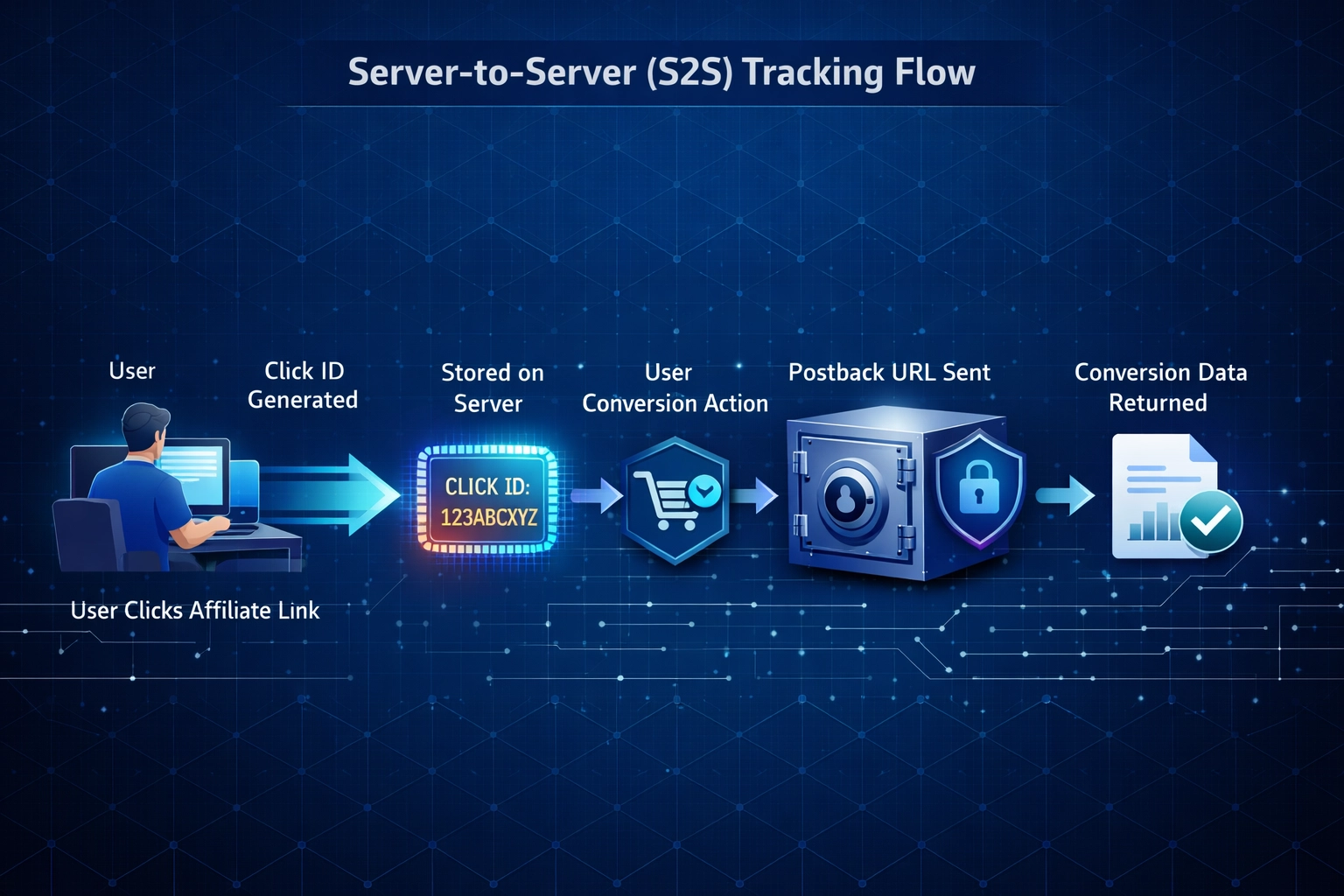
Server-to-Server (S2S) tracking represents the most robust and privacy-compliant approach to affiliate attribution in the post-cookie era, operating by transmitting conversion data directly between merchant servers and affiliate software platforms without relying on browser-based cookies. The mechanism begins when an affiliate generates a unique click ID for each user interaction, which is stored securely on the affiliate software’s servers rather than in browser storage; when a conversion occurs, the merchant’s server sends a postback request containing this click ID along with conversion details, enabling precise attribution without exposing user data to third-party tracking scripts. This server-to-server architecture provides 15-35% conversion recovery compared to cookie-based tracking, as it bypasses browser privacy protections, ad blockers, and cookie deletion that plague traditional methods. S2S tracking demonstrates superior accuracy because it operates independently of browser capabilities, cookie policies, or user privacy settings—a critical advantage as Safari, Firefox, and Chrome continue implementing stricter privacy defaults. Beyond accuracy, S2S tracking provides exceptional fraud prevention capabilities, as click IDs can be cryptographically signed and validated, making it virtually impossible for fraudsters to fabricate conversions or manipulate attribution data. The approach also ensures universal browser compatibility, functioning identically across all devices, browsers, and platforms without requiring JavaScript execution or cookie storage. PostAffiliatePro’s S2S infrastructure exemplifies this approach, offering immutable click tokens, secure postback mechanisms, and comprehensive fraud detection that maintains attribution integrity while achieving full GDPR and cookie-less compliance.
The distinction between first-party data (collected directly from users by the organization they interact with) and third-party data (collected by intermediaries across multiple websites) has become foundational to compliant affiliate marketing strategy. Zero-party data—information users voluntarily provide through surveys, preference centers, and account settings—represents the highest-quality data source, as it comes with explicit consent and provides rich behavioral insights without privacy concerns. Consent Management Platforms (CMPs) serve as the critical infrastructure enabling this transition, providing centralized systems for collecting, storing, and managing user consent preferences across all tracking and marketing activities. Effective CMPs deliver several essential capabilities for affiliate compliance:
Integration between CMPs and affiliate software platforms ensures that consent preferences automatically restrict affiliate tracking, preventing unauthorized data collection and eliminating compliance violations.
Be the first to know about new features and product updates.
As third-party cookies face extinction, affiliate marketers must embrace alternative tracking methodologies that maintain attribution accuracy while respecting privacy regulations and user preferences. Contextual targeting analyzes page content, search queries, and user behavior within a single session to infer interests without storing persistent identifiers, enabling relevant affiliate recommendations without privacy concerns. Device fingerprinting—creating unique identifiers based on device characteristics like browser type, operating system, and screen resolution—offers persistent tracking capabilities, though it operates in a regulatory gray area and requires explicit consent in many jurisdictions. Local storage and IndexedDB provide browser-based alternatives to cookies, storing data on users’ devices rather than third-party servers, though they remain subject to browser privacy controls and user deletion. Google Analytics 4 (GA4) incorporates privacy-first features including behavioral modeling to estimate conversions from users who haven’t been tracked, and consent mode that automatically adjusts tracking based on user consent preferences. Anonymized analytics approaches aggregate user behavior into cohorts and segments without tracking individual users, enabling performance optimization while maintaining privacy. Federated Learning of Cohorts (FLoC) and similar privacy-preserving technologies promise to enable interest-based targeting through on-device processing rather than server-side user profiling, though adoption remains limited pending standardization and regulatory clarity.

Leading affiliate software platforms must provide built-in compliance infrastructure that enables merchants and affiliates to operate within regulatory requirements without requiring extensive custom development or third-party integrations. Automated consent management features integrate with CMPs to respect user consent preferences, automatically suppressing affiliate tracking when users haven’t provided appropriate permissions. Data retention policies allow organizations to define automatic deletion schedules for personal data, ensuring compliance with data minimization principles and reducing liability exposure. Audit logging and reporting capabilities maintain comprehensive records of all data access, processing activities, and consent changes, providing the documentation necessary for regulatory audits and demonstrating good-faith compliance efforts. Integration capabilities with leading CMPs, analytics platforms, and security tools ensure that compliance features work seamlessly within existing marketing technology stacks. PostAffiliatePro exemplifies the affiliate software solution purpose-built for the privacy-first era, offering native S2S tracking, immutable click tokens, granular consent controls, automated data retention, and comprehensive audit trails that enable merchants and affiliates to achieve full GDPR compliance while maintaining attribution accuracy and fraud prevention.
Transitioning from cookie-based to cookie-less attribution requires systematic planning and execution to ensure tracking continuity and compliance throughout the migration process. Organizations should follow this structured approach:
This phased approach minimizes disruption while ensuring that tracking accuracy and compliance are maintained throughout the transition.
Major affiliate networks have adopted varying approaches to cookie-less tracking, with significant differences in implementation maturity and compliance capabilities. Awin launched its Conversion Protection Initiative, implementing S2S tracking and click ID validation to reduce fraud and improve attribution in a cookie-less environment, though adoption varies across its network. CJ Affiliate developed its Event ID system, enabling server-to-server conversion tracking with cryptographic validation, providing strong fraud prevention and cookie-less compatibility. Partnerize built a comprehensive tracking hub supporting multiple attribution models and S2S postbacks, offering flexibility for networks managing diverse merchant requirements. Impact and Rakuten have implemented robust S2S infrastructure with click token validation and fraud detection, positioning themselves as leaders in cookie-less readiness. However, practical implementation requirements vary significantly across networks, with some requiring custom development, others offering plug-and-play integrations, and many still maintaining legacy cookie-based tracking as their primary method.
| Affiliate Network | Cookie-less Solution | Implementation Approach | S2S Support | Fraud Prevention |
|---|---|---|---|---|
| Awin | Conversion Protection Initiative | Network-wide mandate | Yes | Click ID validation |
| CJ Affiliate | Event ID System | Merchant-specific setup | Yes | Cryptographic signing |
| Partnerize | Tracking Hub | Flexible, multi-model | Yes | Token validation |
| Impact | S2S Infrastructure | Native platform feature | Yes | Advanced analytics |
| Rakuten | S2S Postbacks | Integrated system | Yes | Behavioral analysis |
Implementing secure and compliant affiliate tracking requires adherence to technical and procedural best practices that protect user privacy while maintaining attribution integrity and fraud prevention. Organizations should implement these essential practices:
These practices, when implemented systematically through platforms like PostAffiliatePro, create a robust foundation for affiliate marketing that balances business performance with regulatory compliance and user privacy protection.
GDPR (General Data Protection Regulation) applies to organizations processing data of EU residents and imposes strict requirements including explicit consent, data subject rights, and penalties up to €20 million or 4% of global revenue. CCPA (California Consumer Privacy Act) applies to California residents and provides similar rights but with different enforcement mechanisms and lower penalties. Both require explicit consent before tracking and comprehensive data protection measures.
Server-to-server (S2S) tracking bypasses browser limitations, ad blockers, and cookie deletion that plague traditional methods, recovering 15-35% more conversions. By transmitting data directly between servers using cryptographically signed click IDs, S2S tracking eliminates dependencies on browser capabilities and user privacy settings, ensuring accurate attribution regardless of device, browser, or privacy configuration.
Yes, in most jurisdictions including the EU and UK, affiliate cookies are considered non-essential and require explicit user consent before placement. Users must take an affirmative action to consent (opt-in), and pre-checked consent boxes are not permitted. However, some jurisdictions like the UK are introducing limited exemptions for specific, low-risk affiliate tracking that doesn't enable profiling.
A Data Processing Agreement is a legal contract between data controllers (merchants) and data processors (affiliate software providers) that defines roles, responsibilities, and data handling procedures. DPAs are mandatory under GDPR and ensure that all parties comply with data protection requirements, clearly specify what data is processed, how it's protected, and how long it's retained.
Migration involves: (1) auditing current tracking infrastructure, (2) implementing S2S tracking with click ID generation, (3) integrating consent management platforms, (4) updating affiliate network integrations with new postback URLs, (5) establishing validation protocols, (6) monitoring performance metrics, and (7) conducting compliance audits. This phased approach minimizes disruption while ensuring tracking accuracy and compliance.
GDPR penalties are severe: up to €20 million or 4% of global annual revenue for the most serious violations (like processing without legal basis), and up to €10 million or 2% of global revenue for other violations. Additionally, organizations face reputational damage, loss of customer trust, and potential lawsuits from affected individuals. Compliance is not optional.
PostAffiliatePro provides native S2S tracking with immutable click tokens, granular consent controls integrated with CMPs, automated data retention policies, comprehensive audit trails, and built-in encryption. The platform supports all GDPR data subject rights, maintains detailed compliance documentation, and enables merchants and affiliates to operate with full regulatory confidence.
First-party data is collected directly by an organization from users who interact with their website or app, providing high-quality insights with explicit consent. Third-party data is collected by intermediaries across multiple websites without direct user interaction, making it less reliable and increasingly restricted by privacy regulations. First-party data is the sustainable foundation for compliant affiliate marketing.
PostAffiliatePro provides comprehensive GDPR compliance tools, cookie-less tracking, and consent management features to keep your affiliate program secure and compliant.
A privacy policy is a legal document that states what the company can do with customer data. Learn about its importance, core components, and relevance for affi...
Post Affiliate Pro is committed to privacy, security, compliance, and transparency. It is fully compliant with the GDPR regulation.

Comprehensive guide to privacy policy requirements for betting affiliates including GDPR, CCPA, FTC compliance, data protection
Join our community of happy clients and provide excellent customer support with Post Affiliate Pro.




Cookie Consent
We use cookies to enhance your browsing experience and analyze our traffic. See our privacy policy.