




Key Affiliate Marketing Statistics
Discover the latest affiliate marketing statistics for 2026: market size, growth trends, ROI metrics, and industry insights to optimize your program.
6 min read

Get your
33% off
+ free AI Agent

See how big the affiliate marketing industry really is in 2026-2027, from market size and growth statistics to the trends shaping 2027 and beyond.
Picture someone recommending a product they genuinely love, sharing a link with their audience, and earning a small commission every time that recommendation turns into a sale. That simple idea, built on trust and a shared link, has grown into one of the biggest revenue engines in digital commerce. If you are still getting familiar with what affiliate marketing actually is , this is the perfect moment to understand just how large and how fast this industry is actually growing.
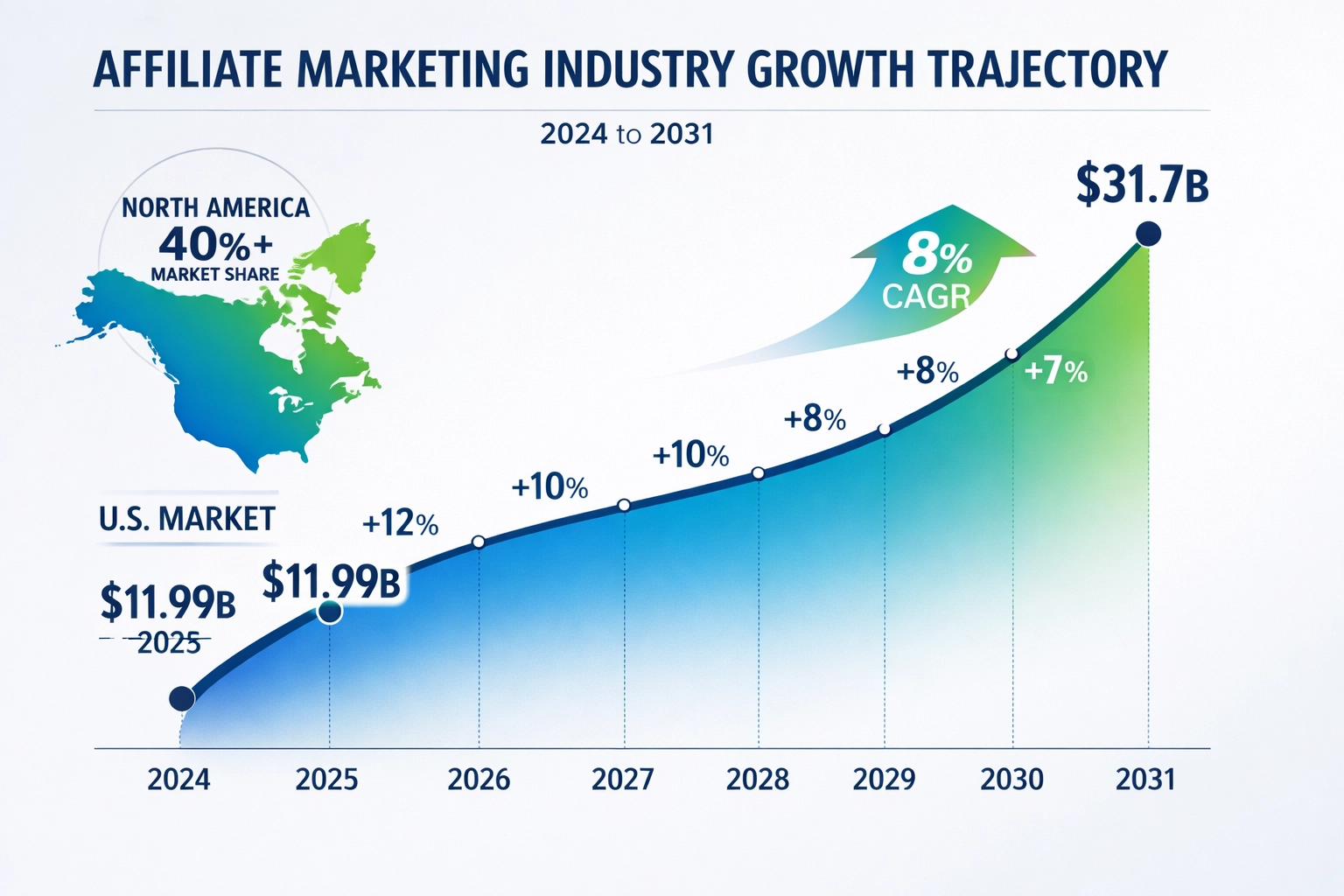
The affiliate marketing industry size tells a striking story. Globally, the market is valued at just over $20 billion in 2026 (Business Research Insights ), up from $17 to $18.5 billion in 2025 (Market Reports World ). Looking ahead, the market is projected to reach $27.78 billion by 2027 (Demand Sage ), and to keep growing at a steady 15.2 percent compound annual growth rate (CAGR) toward $82.64 billion by 2035 (Business Research Insights ), a figure that simply means the market keeps expanding by about that percentage every single year. In the United States, businesses are already spending $13.81 billion on affiliate marketing in 2026, up 11.3 percent from $12.42 billion in 2025 (eMarketer ), a figure on track to reach nearly $16 billion by 2028 (eMarketer ).
Perhaps the clearest sign of where this is all heading is adoption. A growing majority of ecommerce businesses now run an affiliate program, and 84 percent of brands already have one in place (Demand Sage ). What used to be a niche tactic for bloggers and coupon sites has become a core growth channel that most online businesses now rely on. If you’re ready to join them, here’s how to set up your affiliate program step by step , and once you’re ready to pick a platform, see how the top affiliate tracking software options compare .
Affiliate marketing does not grow evenly across the globe, and looking at the regional picture helps explain where the next wave of opportunity is likely to come from.
| Region | Global Market Share | 2024 Value | CAGR (2024-2031) |
|---|---|---|---|
| North America | 40%+ | $7.40B | 6.2% |
| Europe | 30%+ | $5.55B | 6.5% |
| Asia-Pacific | 23% | $4.26B | 10.0% |
| Latin America | 5%+ | $0.93B | 7.4% |
| Middle East & Africa | ~2% | $0.37B | 7.7% |
(Regional figures: Cognitive Market Research )
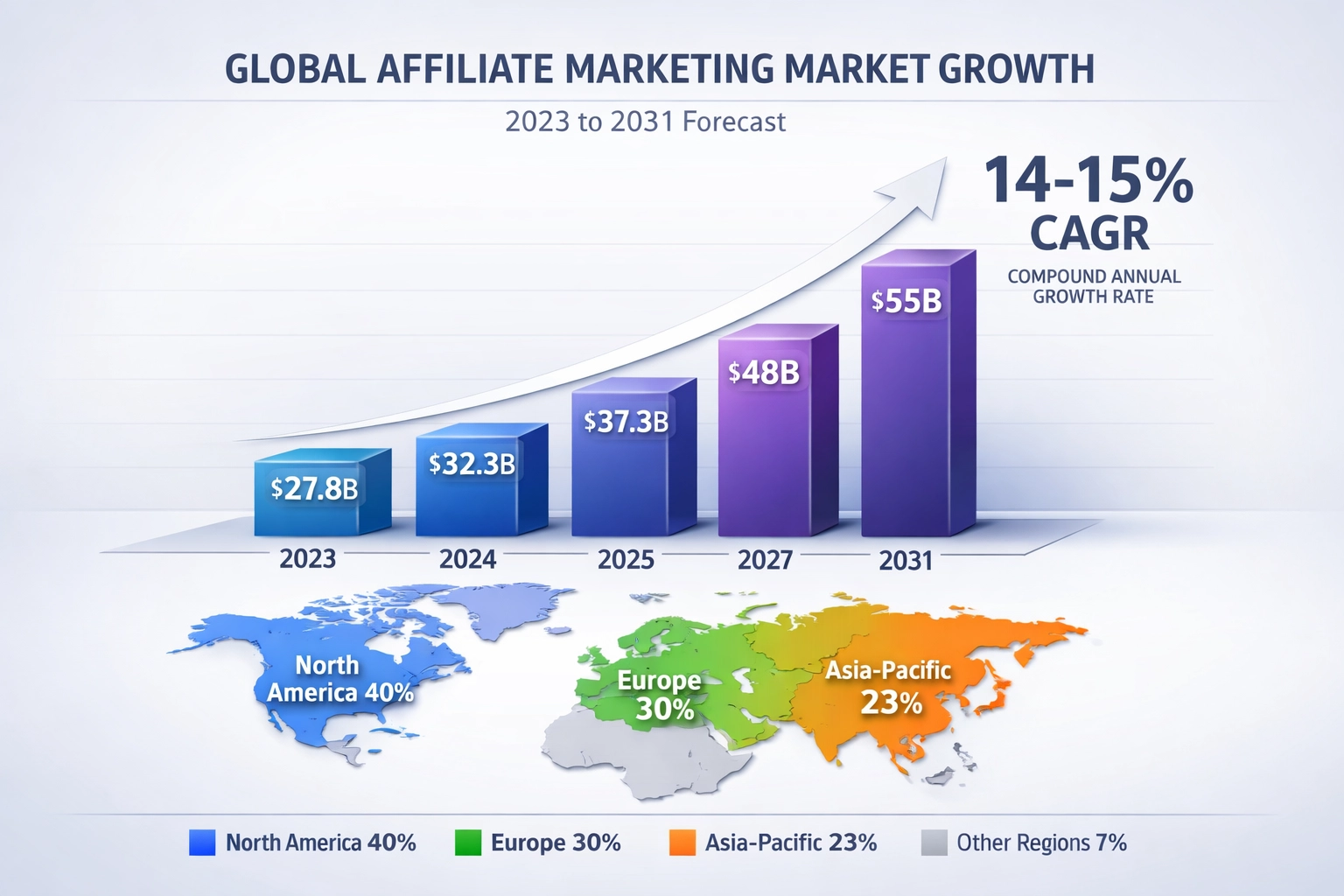
North America still holds the largest slice of the market at over 40 percent, thanks to mature ecommerce infrastructure and highly experienced advertisers across the US and Canada. Europe follows with over 30 percent, anchored by the UK, Germany, and France, where strong regulatory frameworks give affiliate programs a stable environment to grow in.
The real story, though, belongs to Asia Pacific. Even though the region currently holds a smaller 23 percent share, it is growing faster than anywhere else, at a 10 percent CAGR (Cognitive Market Research ), fueled by explosive ecommerce adoption across China and India, where mobile commerce already accounts for the majority of online shopping activity. Latin America and the Middle East and Africa remain smaller pieces of the pie today, but both are growing at a healthy clip (Cognitive Market Research ), and a meaningful share of affiliate transactions now cross international borders, letting affiliates build income from audiences well beyond their home market.

Set up advanced tracking in minutes. No credit card required.
The explosive growth behind these affiliate marketing industry statistics comes down to simple economics: advertisers get paid results, and publishers get a share of the upside. 81 percent of advertisers now actively use affiliate marketing, while 84 percent of publishers run affiliate programs to monetize their traffic and content (Rakuten Advertising , citing Forrester Consulting). Affiliate channels already drive 16 percent of all ecommerce orders (Demand Sage ), and many marketers continue to increase their affiliate budgets, a clear signal of confidence in the channel’s return.
Much of this growth is happening on phones. 50 percent of affiliate traffic now originates from mobile devices (Demand Sage ), and over 70 percent of conversions now happen on mobile devices (WeCanTrack ). Influencer driven campaigns are adding fuel to the fire too, as brands lean into the authenticity that creators bring. Put together, rising advertiser demand, growing publisher supply, and mobile first shopping habits are exactly why affiliate networks and platforms are thriving right now.
If there is one number that explains why affiliate marketing keeps winning budget, it is return on investment. Affiliate marketing consistently delivers one of the strongest returns of any digital channel: roughly 65 percent of retailers report generating up to 20 percent of their annual revenue through affiliate programs (Demand Sage ), and some major brands attribute 5 to 25 percent of their online sales to affiliate partnerships alone (Demand Sage ).
That performance shows up in how marketers rank the channel too. Affiliate marketing is regularly named among the top customer acquisition channels by marketing professionals, and 20 percent call it their single most successful channel overall (Demand Sage ). For performance driven teams looking to grow revenue without a heavy upfront marketing spend, it is easy to see why affiliate marketing has become indispensable.
Be the first to know about new features and product updates.
So what does this mean for the person actually doing the promoting? Earnings vary enormously depending on experience, niche, and strategy, and the spread is wider than most beginners expect. Established, mature affiliates can earn a solid full-time income, and 35 percent of active affiliates make at least $20,000 a year from their programs (Demand Sage ). At the top end, 15 percent of affiliates earn between $80,000 and $1 million annually, and the very top 1 percent clear over $1 million a year (Demand Sage ).
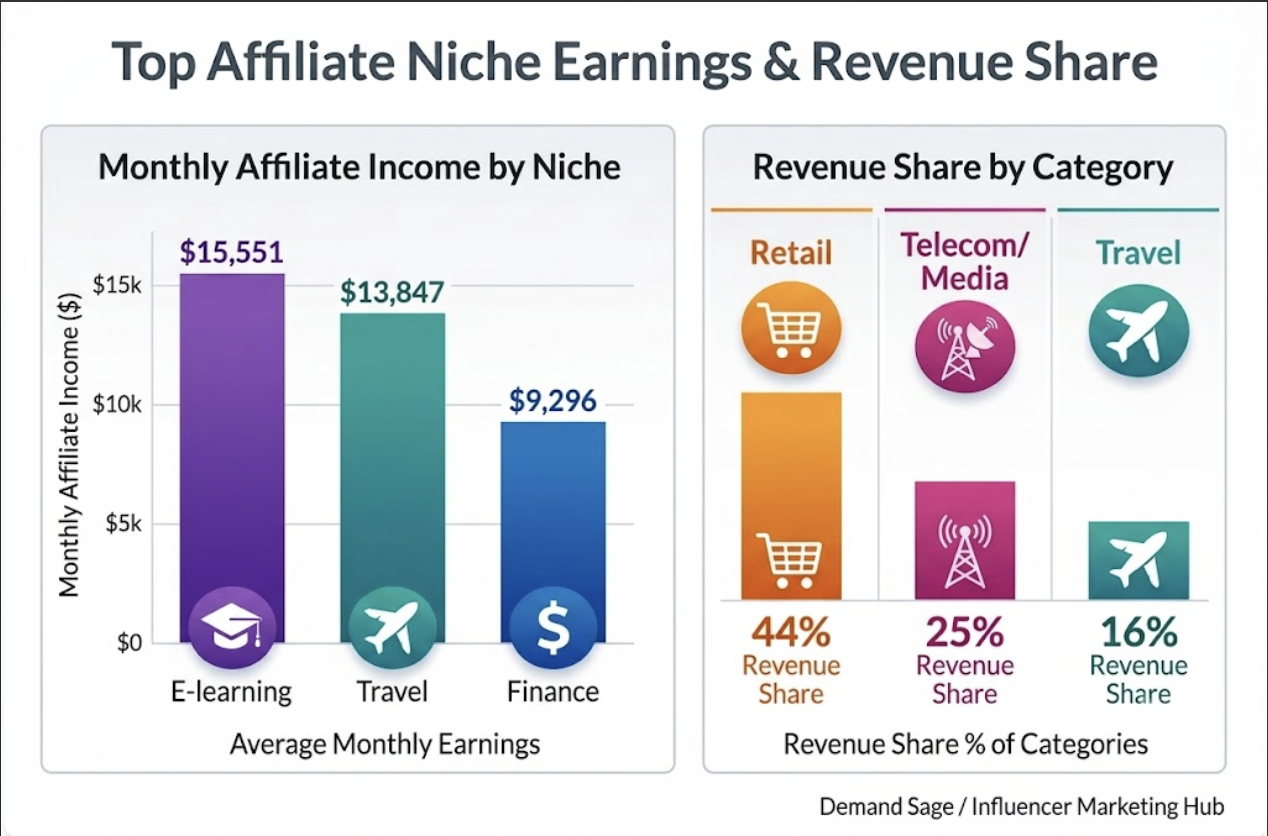
It would not be honest to skip the harder truth here. 95 percent of beginners fail or quit (Demand Sage ), which is exactly why training, niche selection, and platform support matter so much when starting out. Despite that steep drop off, the top performing 10 percent of affiliates generate about 90 percent of all affiliate revenue (GrowSurf , citing CJ Affiliate), a pattern that shows up again and again in performance marketing. Niche choice makes a real difference too: e-learning affiliates average $15,551 a month, travel affiliates earn $13,847 monthly, and finance affiliates bring in $9,296 monthly (Demand Sage ), well above niches that pay only single digit monthly amounts.
Not every niche offers the same opportunity, and success tends to concentrate in categories with strong commissions, steady demand, and healthy margins.
These categories lead the pack because they combine several things at once: strong purchase intent, healthy profit margins that allow for generous commissions, and often recurring revenue. Finance and SaaS attract top tier affiliates because their commission structures reward performance so directly, while e-learning’s profitability comes from high customer lifetime value and how easily digital products scale. Travel and retail keep performing thanks to seasonal demand and broad appeal, and fashion’s dominance reflects just how much influencer marketing and social commerce have merged. Understanding these dynamics helps affiliates choose programs that actually fit their audience and expertise, rather than chasing whatever niche looks trendiest.
Two forces are quietly rewriting the rules of affiliate marketing: the phone in everyone’s pocket and the rise of AI tools. Affiliate traffic is increasingly mobile, and over 70 percent of conversions now happen on mobile devices (WeCanTrack ), which makes mobile optimization non negotiable for anyone serious about this channel.
On the technology side, 79 percent of affiliates are already using AI tools to produce more content, sharpen their messaging, and personalize recommendations faster than ever before (Hostinger ). In app promotions and mobile wallet integrations are creating even more touchpoints for affiliates to influence a purchase, and interest in blockchain based transparency tools is growing as networks look for new ways to catch fraud before it costs anyone money.
No growth story is without its challenges, and affiliate marketing has a real one in fraud. Affiliate fraud accounted for 17 percent of all affiliate traffic and cost the industry an estimated $3.4 billion in 2022 alone (CHEQ, via PR Newswire ), with fraud tactics growing more sophisticated every year. It is no surprise that 63 percent of marketers say they are seriously concerned about affiliate fraud (Demand Sage ), which makes affiliate fraud detection and prevention a genuine investment priority rather than an afterthought.
Competition is rising too, pushing up customer acquisition costs and squeezing margins for mid tier affiliates while consolidating traffic toward top performers. Algorithm changes at Google, Meta, and TikTok can disrupt affiliate traffic overnight, forcing constant adaptation. On top of that, regulators are paying closer attention, with the FTC continuing to step up enforcement against deceptive affiliate practices. None of this is a reason to avoid affiliate marketing, but it does mean fraud prevention and compliance deserve a real seat at the table.
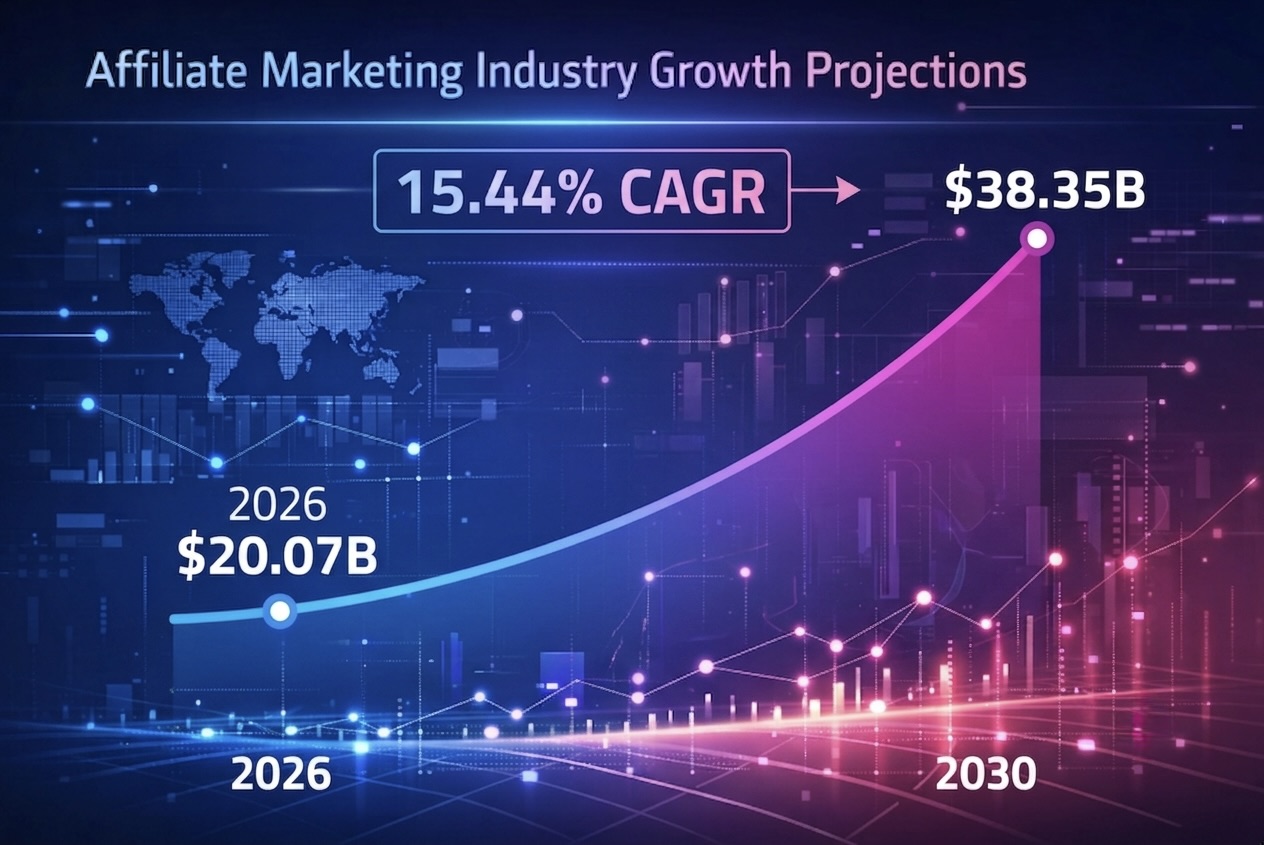
Looking further ahead, the affiliate marketing industry outlook for 2027 and beyond points to sustained growth rather than a passing trend. The market is projected to grow at roughly a 15.44 percent CAGR, reaching $38.35 billion by 2030 (Demand Sage ), a pace that outpaces most traditional marketing channels. Micro and nano influencers are emerging as one of the fastest growing segments of the creator economy, as brands discover just how much trust smaller, highly engaged creators can build, and the line between the two is worth understanding in more depth in affiliate marketing vs. influencer marketing .
B2B affiliate programs are catching up too, as software and SaaS companies realize how efficiently affiliate channels can reach decision makers. Creator driven affiliate revenue has already doubled from $570 million in 2021 to $1.1 billion in 2024 (Digiday, citing eMarketer ), a sign of how thoroughly influencer marketing and affiliate economics have merged into one model. Taken together, these numbers point to affiliate marketing as a resilient, still expanding channel that will keep attracting advertiser budgets and publisher participation well into the next decade.
The affiliate marketing industry in 2026 and 2027 is a genuinely compelling opportunity, whether you are an advertiser hoping to add a new acquisition channel or someone hoping to build an income stream from scratch. With a global market already worth just over $20 billion and still climbing toward nearly $40 billion by 2030, the numbers make one thing clear: affiliate marketing is not a passing trend, it is a channel worth building on seriously.
Getting there still requires the right tools, strategy, and partner. If you’re brand new to any of this, our academy walks through what affiliate marketing actually is and how to start an affiliate program as a beginner . PostAffiliatePro provides the affiliate management platform needed to launch, scale, and optimize a program with confidence, from automated commission tracking and fraud detection to real time analytics and affiliate recruitment tools. And if you already have a program running, our affiliate program renewal checklist is worth running through before your next budget cycle, or if something feels off before then, these 7 signs your program has stopped growing are worth a quick read.
The opportunity is real, the data backs it up, and the businesses and affiliates who act on it now are the ones set to benefit most.
PostAffiliatePro is the leading affiliate management software trusted by thousands of businesses worldwide. Manage your entire affiliate program with powerful tracking, commission automation, and fraud detection.
Discover the latest affiliate marketing statistics for 2026: market size, growth trends, ROI metrics, and industry insights to optimize your program.

the top 35 affiliate marketing statistics for 2026 to help you optimize your campaigns. about industry growth, influencer impact, brand adoption, top channels
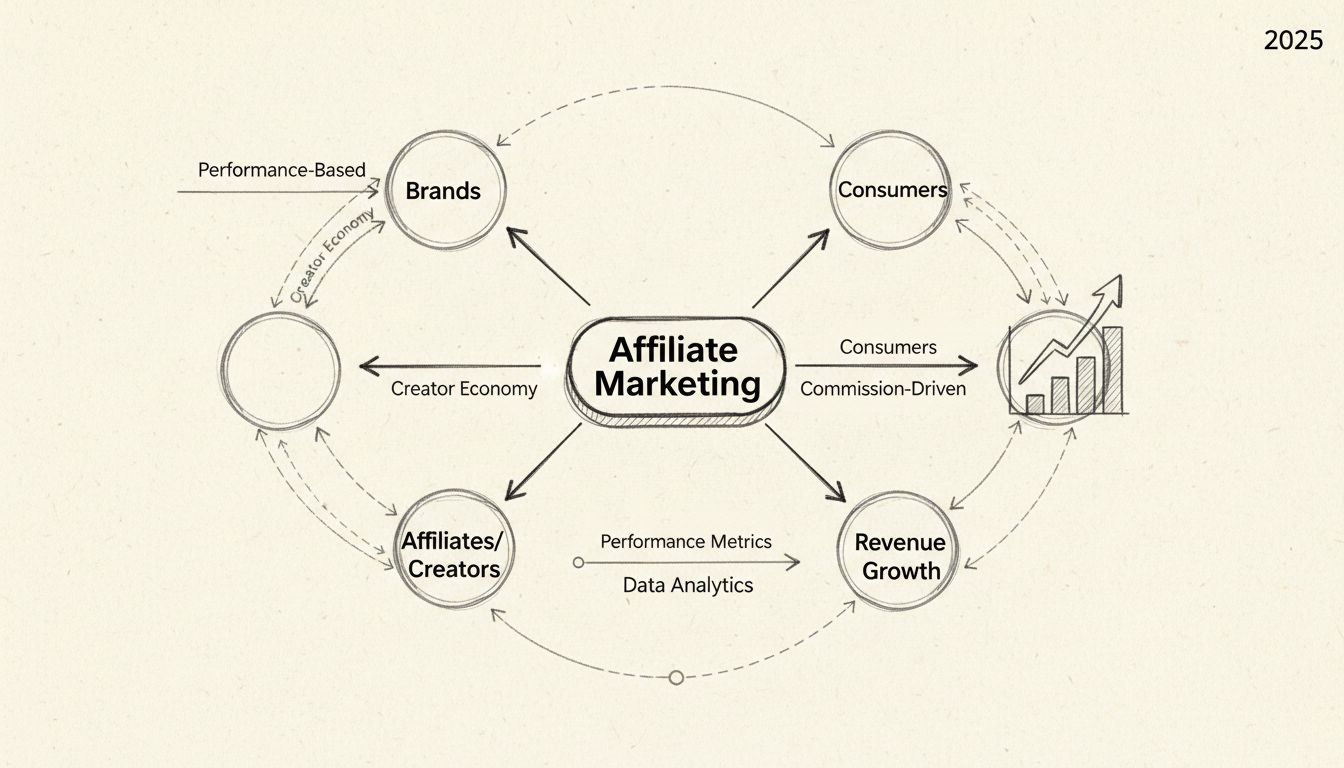
Discover why affiliate marketing isn't dead but thriving. Learn the latest trends, statistics, and strategies for success in 2025.
Join our community of happy clients and provide excellent customer support with Post Affiliate Pro.




Cookie Consent
We use cookies to enhance your browsing experience and analyze our traffic. See our privacy policy.