


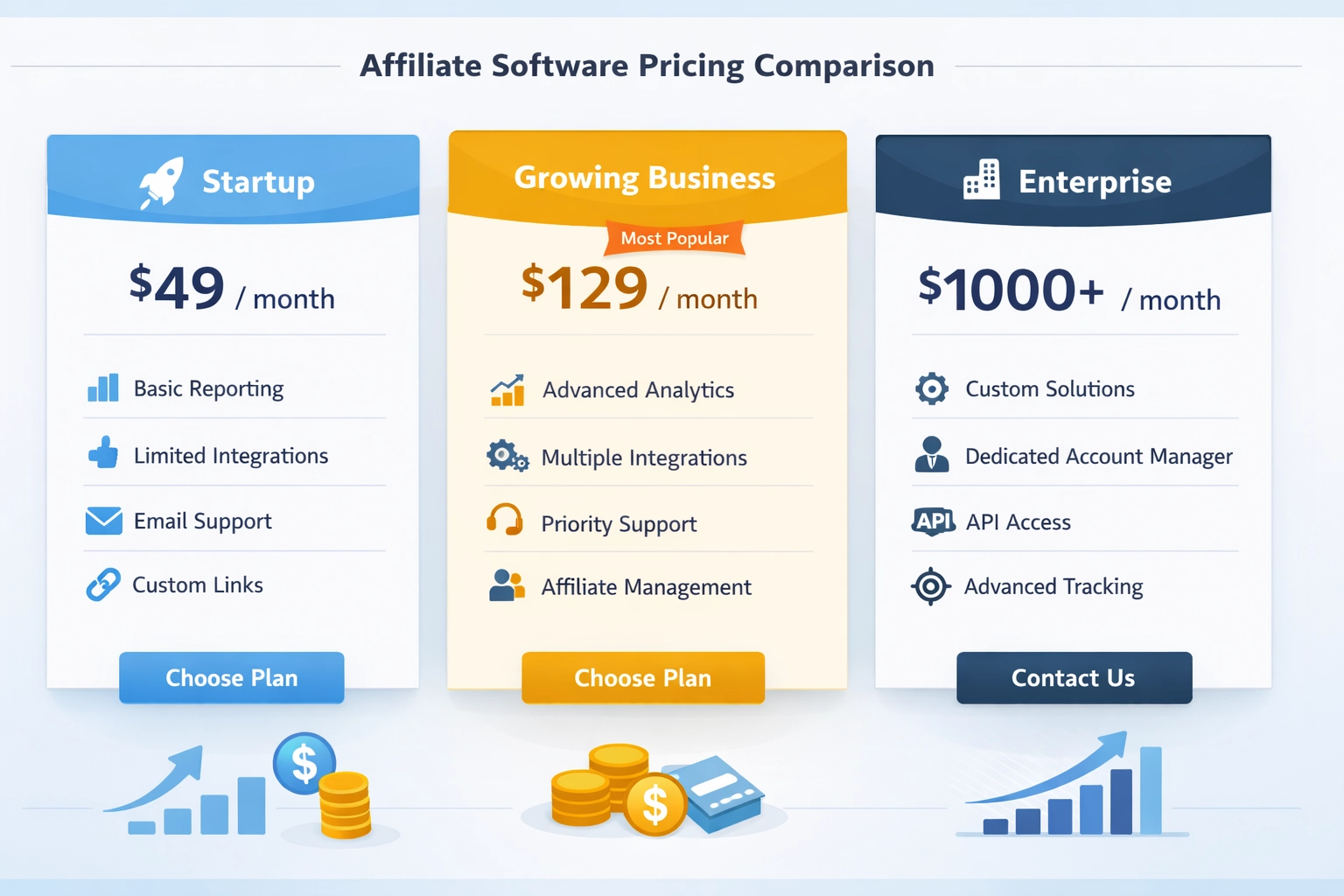
How Pricing Affects Affiliate Software Choice
How affiliate software pricing models impact your choice. Compare costs, features, and ROI across platforms from $12.50 to $1000+/month for your budget.
9 min read


Compare affiliate agency pricing models, costs, and commission rates. Learn about flat fees, percentage-based, and hybrid structures.
Affiliate agency pricing varies significantly depending on the specific services offered, the agency’s experience level, and the complexity of your affiliate program. Some agencies charge a flat monthly fee, while others take a percentage of the sales generated through their affiliate program, and many use a hybrid approach combining multiple pricing models. Understanding these different structures is essential for budgeting and selecting the right partner for your business. The cost of affiliate agencies can range from a few hundred dollars per month for startups to tens of thousands for enterprise-level programs, making it crucial to understand what you’re paying for and what value you’ll receive in return.
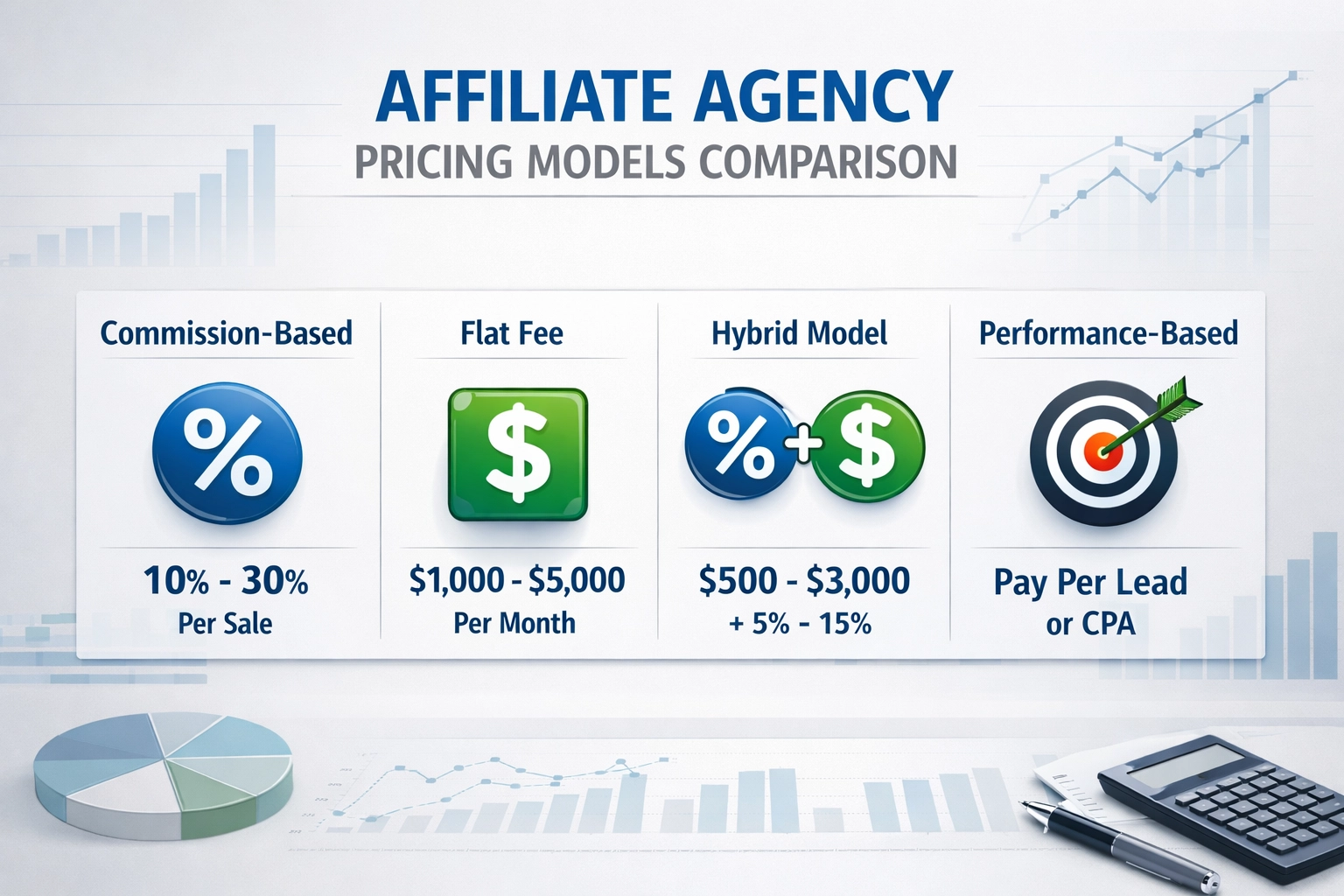
Affiliate agencies typically employ one of four primary pricing models, each with distinct advantages and cost implications. Understanding these models helps you evaluate which approach aligns best with your business goals and budget constraints. The choice between these models significantly impacts your overall program costs and the incentive structure for your affiliate partners.
| Pricing Model | Description | Typical Cost Range | Best For |
|---|---|---|---|
| Commission-Based | Agency earns a percentage of sales generated through affiliate referrals | 5-30% of sales | High-volume programs with strong margins |
| Flat Fee | Fixed monthly or project-based fee regardless of performance | $1,000-$10,000/month | Predictable budgeting and smaller programs |
| Hybrid Model | Combination of base fee plus commission on sales or performance | $500-$5,000 + 5-15% commission | Balanced risk and reward alignment |
| Performance-Based | Payment tied to specific KPIs like leads, conversions, or revenue targets | Variable based on metrics | Results-driven programs with clear objectives |

Set up advanced tracking in minutes. No credit card required.
Commission-based pricing remains the most common affiliate agency model, with rates typically ranging from 5% to 30% of each sale depending on your industry and profit margins. Retail and fashion brands often pay on the higher end of this spectrum due to competitive markets and higher customer lifetime values, while electronics and B2B products lean toward lower rates due to tighter profit margins. The beauty of commission-based pricing is that it aligns the agency’s incentives directly with your business results—they only earn more when you earn more. However, this model requires careful calculation of your profit margins to ensure the commission rates remain sustainable. Industries with higher-value products or services can often support higher commission rates, making this model particularly effective for SaaS, digital products, and premium services where margins are substantial.
Flat fee pricing offers predictability and simplicity, with agencies typically charging between $1,000 and $10,000 per month depending on the scope of services and program complexity. Many agencies also charge one-time setup fees ranging from $1,000 to $5,000 to cover initial program configuration, affiliate recruitment, and system integration. Hybrid models have gained significant traction in recent years, combining a base monthly retainer with a smaller commission percentage (typically 5-15%) on sales generated. This approach provides agencies with baseline revenue while maintaining performance incentives, and it gives businesses more predictable costs while still rewarding results. Hybrid models work particularly well for growing programs where you want to balance cost control with performance motivation, creating a win-win partnership structure that encourages both parties to invest in program success.
Be the first to know about new features and product updates.
Several critical factors determine how much you’ll pay for affiliate agency services, and understanding these drivers helps you negotiate better rates and select the right partner:
Your business size and affiliate program maturity significantly impact your total investment. Startups and small businesses typically allocate $300 to $1,000 per month for basic affiliate management, often using DIY approaches with minimal external support or entry-level agency services. Small to mid-sized businesses (SMBs) generally invest $5,000 to $15,000 per month, which covers partial in-house management combined with agency support, better technology platforms, and more sophisticated affiliate recruitment strategies. Enterprise and high-growth brands typically spend $20,000 to $60,000+ per month on comprehensive affiliate programs, including dedicated internal teams, premium agency partnerships, advanced technology stacks, and sophisticated performance optimization. These investments reflect not just the cost of management but also the value of expertise, technology, and the scale of affiliate networks these larger programs can access and manage effectively.
Beyond agency management fees, you’ll need to invest in affiliate tracking and management software. Basic affiliate platforms cost between $50 and $150 per month and provide essential tracking, link generation, and basic reporting capabilities. Mid-tier platforms range from $300 to $700 per month and include advanced features like fraud detection, multi-touch attribution, custom dashboards for affiliates, and international payout support. Enterprise platforms often exceed $1,000 per month and offer comprehensive solutions including API access, custom integrations, advanced analytics, and dedicated support. These technology investments are essential for program success, as they provide the infrastructure for accurate tracking, timely payouts, and the data insights needed to optimize your affiliate program continuously. The right platform can actually reduce overall costs by automating processes and preventing fraud, which can eat up 9% of total affiliate spend on average.
If you choose to manage your affiliate program in-house, you’ll need to budget for personnel. A dedicated in-house affiliate manager in the United States typically commands a salary of $55,000 to $80,000 annually, plus benefits and overhead costs that can add another 25-30% to the total compensation package. Outsourced program management through agencies or outsourced program managers (OPMs) typically costs $2,000 to $10,000 per month, depending on the scope of services including affiliate recruitment, campaign management, creative development, and performance optimization. Many growing businesses find a hybrid approach most cost-effective—maintaining a part-time internal coordinator while outsourcing specialized functions like influencer management or international expansion. The decision between in-house and outsourced management depends on your program’s complexity, your team’s bandwidth, and your need for direct control over affiliate relationships and strategy.
Understanding the return on your affiliate program investment is critical for justifying costs and making strategic decisions. Cost-per-acquisition (CPA) is calculated by dividing total affiliate program costs by the number of new customers acquired, helping you compare affiliate marketing to other channels. Revenue-to-cost ratio (RCR) measures how much revenue your program generates for every dollar spent; healthy affiliate programs typically achieve a 4:1 to 5:1 ratio or better. Customer lifetime value (CLV) is particularly important for affiliate programs, as research shows 81% of brands report higher lifetime value from affiliate-acquired customers compared to other paid channels, meaning affiliate customers stay longer and spend more over time. In mature affiliate programs, incremental sales account for approximately 35% of total affiliate revenue, representing customers who wouldn’t have converted through other channels. These metrics demonstrate that while affiliate agency costs may seem substantial upfront, the long-term value and profitability often exceed those of traditional paid advertising channels.

Affiliate marketing often provides superior cost-efficiency compared to traditional paid advertising channels. PPC advertising typically costs 10-30% of ad spend in management fees plus the cost of the ads themselves, with no guarantee of profitability, whereas affiliate marketing only charges on actual results. SEO services require monthly retainers of $2,500 to $10,000+ with results taking 3-6 months to materialize, while affiliate programs can generate immediate revenue. Social media management costs $1,000 to $7,000 monthly but doesn’t directly tie to sales, making ROI harder to measure. Email marketing services range from $1,500 to $5,000 monthly but require building your own list, whereas affiliates bring their existing audiences. The key advantage of affiliate marketing is its performance-based nature—you pay primarily for results, not for effort or impressions, making it inherently more cost-efficient than channels requiring upfront investment with uncertain returns.
Reducing affiliate program costs while maintaining quality requires strategic planning and smart negotiations. Negotiate tiered commission structures where rates increase as affiliate performance improves, aligning incentives and controlling costs during the growth phase. Focus on quality over quantity by recruiting fewer high-performing affiliates rather than managing hundreds of low-volume partners, reducing management overhead significantly. Implement performance-based bonuses instead of flat rate increases, rewarding exceptional results without permanently raising baseline costs. Use technology to automate routine tasks like payouts, reporting, and fraud detection, reducing the need for manual management and associated labor costs. Regularly audit your affiliate roster to identify and remove underperforming partners, ensuring your budget focuses on partners generating real value. Negotiate better rates with agencies by demonstrating your program’s potential, offering longer contracts, or bundling services—agencies often provide discounts for committed partnerships.
Rather than paying expensive agencies 5-30% of your affiliate revenue or thousands monthly in management fees, PostAffiliatePro enables you to manage your entire affiliate program in-house with enterprise-grade software at a fraction of the cost. Our platform provides all the tools traditional agencies charge premium rates for—advanced tracking, fraud detection, automated payouts, custom reporting, and affiliate dashboards—without the ongoing agency overhead. With PostAffiliatePro, you maintain complete control over your affiliate relationships, commission structures, and program strategy while keeping the majority of your affiliate revenue within your organization. Businesses using PostAffiliatePro report significant cost savings compared to traditional agencies, often recovering their software investment within the first month of affiliate sales. Whether you’re launching your first affiliate program or scaling an existing one, PostAffiliatePro provides the technology and flexibility to build a profitable program without the expense of traditional agency partnerships.
Affiliate agency costs vary widely based on services and program complexity. Small businesses typically spend $300-$1,000 monthly, SMBs invest $5,000-$15,000 monthly, and enterprises spend $20,000-$60,000+ monthly. Most agencies charge either a flat fee ($1,000-$10,000/month), a commission percentage (5-30% of sales), or a hybrid combination of both.
Affiliate agency fees typically cover affiliate recruitment and onboarding, campaign management and optimization, creative asset development, performance tracking and reporting, and payout management. Some agencies also include fraud detection, multi-touch attribution, and strategic consulting. The specific services included depend on your chosen pricing model and agency tier.
Commission rates typically range from 5-30% depending on industry profit margins and competitiveness. Retail, fashion, and beauty brands often pay 15-30% due to higher margins, while electronics and B2B products typically pay 5-15%. Digital products and SaaS often offer 20-50% commissions due to high profit margins and lower fulfillment costs.
Yes, affiliate software like PostAffiliatePro is significantly more cost-effective than traditional agencies. While agencies charge 5-30% of sales or $2,000-$10,000+ monthly, affiliate software typically costs $50-$700 monthly plus your internal management time. You maintain control and keep more revenue, though you'll need to invest time in program management.
Healthy affiliate programs typically achieve a revenue-to-cost ratio of 4:1 to 5:1 or better, meaning you generate $4-$5 in revenue for every dollar spent on the program. Additionally, 81% of brands report higher customer lifetime value from affiliate-acquired customers compared to other channels, making affiliate marketing one of the highest-ROI marketing channels available.
Negotiate tiered commission structures that increase with performance, offer longer contracts in exchange for discounts, bundle multiple services for better rates, demonstrate your program's revenue potential, and focus on quality partnerships rather than volume. Many agencies offer 10-20% discounts for committed annual contracts or for programs with strong growth potential.
Watch for setup fees ($1,000-$5,000), platform subscription costs ($50-$700/month), fraud detection fees, custom reporting charges, payment processing fees, and affiliate recruitment costs. Additionally, budget for creative asset development, affiliate training materials, and contingency for underperforming affiliates that require replacement or additional support.
PostAffiliatePro provides enterprise-grade affiliate management software at a fraction of agency costs. Instead of paying 5-30% of sales or $2,000-$10,000+ monthly to agencies, you get advanced tracking, fraud detection, automated payouts, and custom reporting for $50-$700 monthly. You maintain complete control over your program and keep significantly more revenue while having the flexibility to scale as your program grows.
Stop paying expensive agencies 5-30% of your affiliate revenue. PostAffiliatePro gives you enterprise-grade affiliate management software at a fraction of the cost, with complete control over your program.
How affiliate software pricing models impact your choice. Compare costs, features, and ROI across platforms from $12.50 to $1000+/month for your budget.
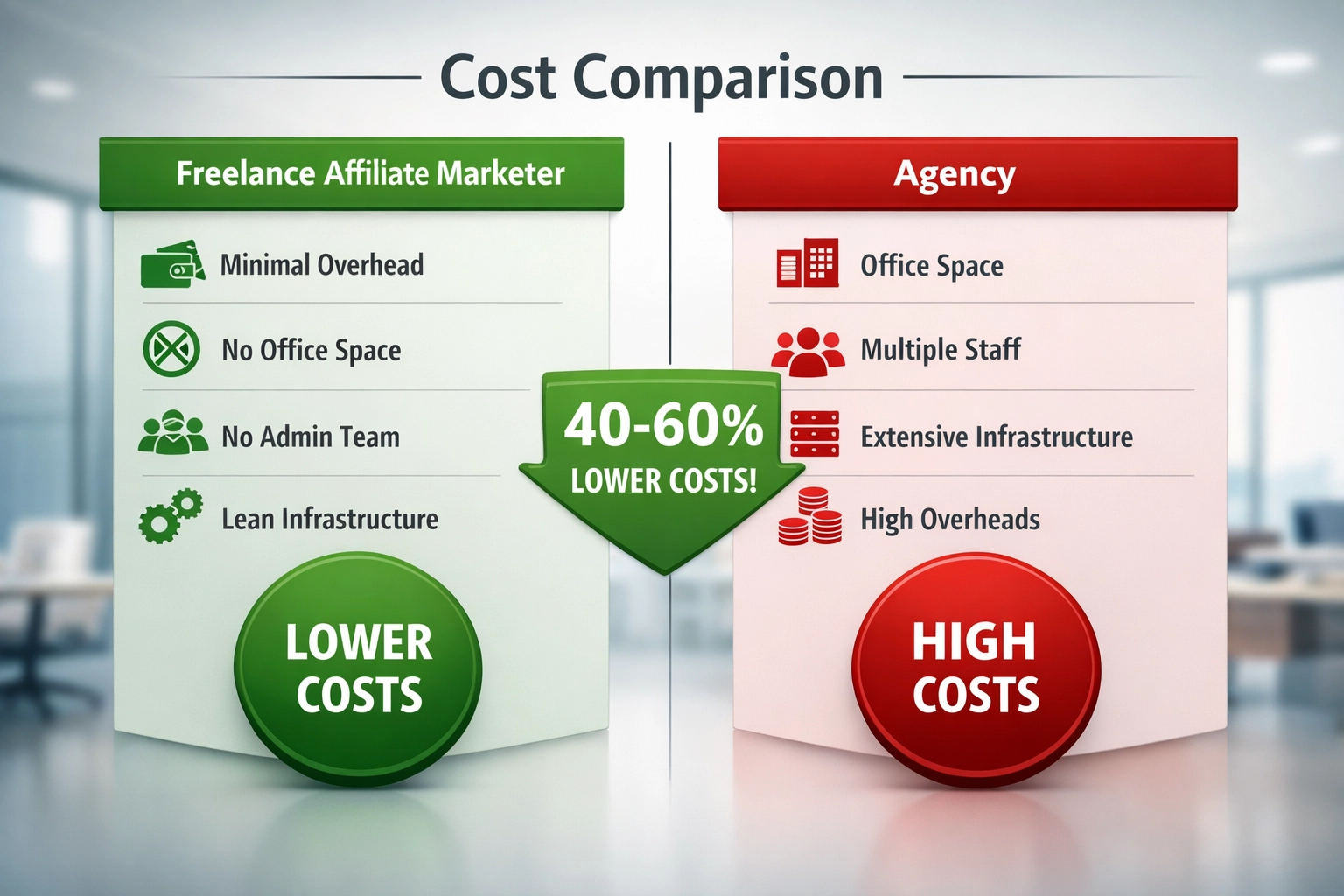
Discover key advantages of hiring a freelance affiliate marketer instead of an agency. Learn about cost savings, flexibility, and specialized expertise.

how tech startups can leverage affiliate marketing for cost-effective growth, brand credibility, and scalable customer acquisition.
Join our community of happy clients and provide excellent customer support with Post Affiliate Pro.




Cookie Consent
We use cookies to enhance your browsing experience and analyze our traffic. See our privacy policy.