
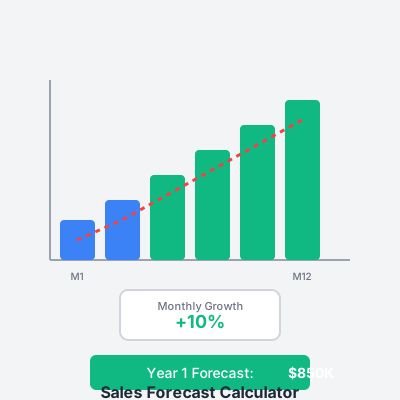
Sales Forecast Calculator - Predict Revenue & Plan Growth
Free sales forecast calculator to project future revenue, plan inventory and staffing, and set realistic sales targets. Use historical data and growth rates to ...
7 min read
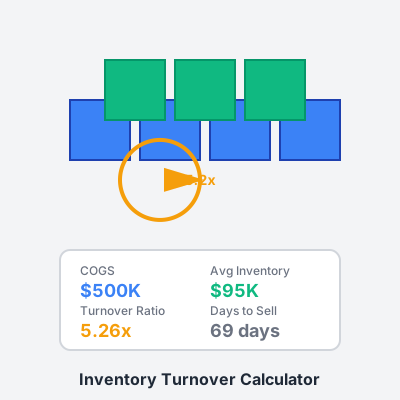
Calculate inventory turnover ratio and days sales of inventory to optimize stock levels, improve cash flow, and reduce carrying costs. Understand how efficiently your inventory converts to sales.
Turnover Ratio Fundamentals - The inventory turnover ratio reveals how many times you completely sell through your inventory in a period. A ratio of 6 means you cycle through your entire inventory six times annually, or roughly every 60 days. This metric indicates both sales strength and inventory efficiency. Calculate it regularly to track trends and compare performance across time periods, product categories, or business units. Improving turnover often provides the quickest path to freeing working capital and improving profitability.
Days Sales of Inventory - This complementary metric shows how many days of sales your current inventory represents. Calculate: 365 / Turnover Ratio. A turnover of 5 equals 73 days of inventory. Lower days means faster turnover. This metric feels more intuitive than turnover ratio for operational planning. If you have 45 days of inventory and supplier lead time is 30 days, you need to reorder at 30 days to avoid stockouts. Days sales inventory directly informs reorder points and safety stock calculations.
Working Capital Impact - Inventory represents cash converted to products awaiting sale. Excessive inventory ties up working capital that could fund marketing, expansion, or generate returns elsewhere. Example: reducing inventory from $200K to $150K frees $50K in cash without changing sales. If you’re paying 8% on a line of credit, this saves $4K annually in interest alone. Every turnover improvement reduces average inventory and frees capital. This is why inventory optimization often generates immediate financial benefits.
The 80/20 Rule - Typically, 20% of SKUs generate 80% of sales. These A items deserve tight management, frequent reordering, and high in-stock rates. The remaining 80% of SKUs (C items) generate only 20% of sales but consume storage space, capital, and management attention. Reducing or eliminating slow-moving C items dramatically improves overall turnover without impacting sales significantly. Many businesses discover they can cut total SKUs by 30-40% while maintaining 95%+ of revenue.
Seasonal Inventory Management - Seasonal products complicate turnover analysis. A swimsuit retailer might turn inventory 8x in summer but 0.5x in winter for annual average of 3x. This masks the reality of needing high turnover in season and aggressive liquidation off-season. Plan seasonal inventory buildup to peak just before peak sales, not months early. Use pre-season sales to test demand before full inventory commitment. Post-season, discount aggressively - carrying seasonal inventory through the off-season costs more than aggressive markdowns.
Just-In-Time Principles - Reduce average inventory by ordering smaller quantities more frequently. Instead of one quarterly order of 300 units (average inventory: 150 units), make monthly orders of 100 units (average inventory: 50 units). This triples turnover and frees 67% of inventory capital. Obstacles: minimum order quantities, shipping costs, supplier relationships. Solutions: negotiate smaller minimums, consolidate orders across products, use multiple suppliers, or accept slightly higher unit costs for dramatic working capital improvements. The cash flow benefit often outweighs slightly higher per-unit costs.
Dynamic Reordering - Traditional fixed reorder points assume stable demand. Dynamic reordering adjusts to actual demand signals: increase order frequency and quantity when sales accelerate, decrease when sales slow, factor in promotions and seasonality, and respond to market trends. Inventory management software with demand forecasting automates this. Manual operations should review top-selling items weekly and adjust orders based on recent sales velocity. This responsiveness prevents both stockouts (lost sales) and overstock (excess capital).
Categorize inventory by value contribution. A items: top 20% of SKUs, 70-80% of revenue, manage daily, maintain 98%+ in-stock, invest in demand forecasting, quick replenishment. B items: next 30% of SKUs, 15-20% of revenue, manage weekly, maintain 90-95% in-stock, standard replenishment. C items: bottom 50% of SKUs, 5-10% of revenue, manage monthly, maintain 80-90% in-stock or consider elimination. Focus your attention where it matters most. Many businesses waste effort managing C items while A items stockout.
Safety stock protects against demand variability and supply delays but increases average inventory and reduces turnover. Calculate optimal safety stock: enough to prevent stockouts during lead time, not so much you’re overstocked. Factors: demand variability, lead time variability, desired service level, cost of stockout. High-margin products justify higher safety stock. Commodities with many alternatives need minimal safety stock. Review safety stock quarterly and adjust based on actual stockout history.
Eliminate inventory for slow-moving or expensive items through dropshipping. Manufacturer ships directly to customer, you never hold inventory. This dramatically improves turnover on those items (technically infinite) while freeing capital. Hybrid approach: stock fast-moving A items for quick fulfillment, dropship slow-moving C items to minimize inventory investment. Trade-offs: lower margins, less control over fulfillment, potential quality issues. But capital and turnover benefits often outweigh these concerns for appropriate products.
Negotiate supplier terms that support inventory management goals. Extended payment terms (Net 60 vs. Net 30) give you more time to sell before paying, improving cash flow. Consignment arrangements (supplier owns inventory until you sell) eliminate inventory investment entirely. Dating terms (payment due after season) align cash outflow with cash inflow. Conversely, early payment discounts (2/10 Net 30) might justify faster payment if discount percentage exceeds your capital cost.
Slow-moving inventory destroys cash and turnover. Implement aggressive markdown strategies: first markdown at 90 days (20-30% off), second markdown at 120 days (40-50% off), third markdown at 150 days (60-70% off), liquidation at 180 days (any price). The goal: move inventory before it becomes obsolete. Taking a 40% markdown at 120 days is better than holding 12+ months hoping for full-price sales. The freed cash and storage generates more value deployed in fast-moving inventory.
Accurate forecasting prevents both overstock and understock. Use historical sales data, adjust for trends and seasonality, factor in promotions and market conditions, and consider product lifecycle stage (launch, growth, maturity, decline). Forecasting software automates this for large catalogs. For smaller operations, focus forecasting energy on A items (highest impact) and use simple methods for B and C items. Update forecasts monthly or weekly for A items. Forecast accuracy directly determines inventory turnover.
Multiple locations (warehouses, stores, regions) complicate inventory management. Calculate turnover by location to identify underperformers. Implement inventory balancing: transfer inventory from slow locations to fast locations rather than ordering new stock. Central distribution with rapid replenishment often outperforms scattered inventory. However, some businesses need local inventory for customer expectations. Balance inventory centralization (efficiency, turnover) against distribution (service level, speed).
Some suppliers offer to manage your inventory: they monitor your stock levels, automatically replenish as needed, you pay only for what sells. This transfers inventory management burden and cost to supplier while improving your turnover (they keep their inventory, not yours). Works best with major suppliers of fast-moving items. Negotiation leverage helps - high-volume customers can demand VMI. Trade-off: less control over inventory decisions, but superior turnover and working capital benefits.
Turnover varies by product lifecycle stage. Launch phase: low turnover, building initial inventory, focus on availability. Growth phase: increasing turnover, scale inventory carefully, avoid stockouts. Maturity phase: peak turnover, optimize replenishment. Decline phase: declining turnover, reduce inventory aggressively, stop reordering early. Many businesses overstock declining products hoping for sales recovery. Recognize decline early and exit gracefully through markdowns rather than holding obsolete inventory.
Inventory management software dramatically improves turnover through: real-time tracking (know what you have), automated reordering (never forget to order), demand forecasting (buy right amount), reporting (identify slow movers quickly), and multi-channel sync (avoid overselling). Cloud-based solutions start under $100/month. The investment returns quickly through improved turnover. Even basic systems prevent the manual errors and delays that create excess inventory. Technology doesn’t guarantee good inventory management, but it makes good practices much easier to execute consistently.
Inventory turnover measures how many times you sell and replace inventory in a period. Formula: Cost of Goods Sold / Average Inventory. A turnover of 6 means you sell through your entire inventory 6 times annually (every 2 months). High turnover indicates strong sales and efficient inventory management. Low turnover suggests overstocking, slow sales, or obsolescence. Turnover directly impacts cash flow, storage costs, and profitability. Retailers typically aim for 5-10 turns, while grocers need 15-30.
Inventory Turnover Ratio = Cost of Goods Sold (COGS) / Average Inventory Value. Example: $600,000 annual COGS, average inventory of $100,000 = 6x turnover. Average Inventory = (Beginning Inventory + Ending Inventory) / 2. Use cost values, not retail prices. Calculate annually for overall performance or monthly/quarterly to track trends. Convert to Days Sales of Inventory: 365 / Turnover Ratio. A 6x turnover = 60.8 days of inventory on hand. Both metrics reveal inventory efficiency from different perspectives.
Good turnover varies by industry. Grocery/food: 15-30 (perishables require fast movement). Fashion/apparel: 4-6 (seasonal nature, style changes). Electronics: 6-8 (technology obsolescence). Home furnishings: 3-5 (expensive, slow-moving). Auto parts: 4-6. Jewelry: 1-2 (high value, slow movement). Compare your ratio to industry benchmarks, not across industries. Improving turnover by 1-2x can free substantial cash and reduce carrying costs. However, very high turnover might indicate understocking and lost sales.
Improvement strategies: 1) Optimize purchasing (smaller, more frequent orders reduce average inventory), 2) Implement just-in-time ordering, 3) Improve sales through marketing and pricing, 4) Clear slow-moving items aggressively (discount, bundle, liquidate), 5) Improve inventory forecasting (avoid overstocking), 6) Focus on fast-moving products, 7) Negotiate better supplier terms (shorter lead times, smaller minimums), 8) Use inventory management software for real-time tracking, 9) Implement ABC analysis (focus on top-selling items), 10) Consider dropshipping for slow movers.
Inventory carrying costs typically run 20-30% of inventory value annually. Components: storage costs (warehouse rent, utilities, equipment), capital costs (cash tied up earning no return - opportunity cost), insurance, obsolescence and shrinkage (theft, damage, expiration), taxes on inventory, handling and movement, depreciation. Example: $100K inventory with 25% carrying cost = $25K annual expense. Every turnover improvement reduces average inventory and these costs. A 4x to 6x turnover improvement might save $8K-12K annually on $100K inventory.
High turnover strategies: lower margins, higher volumes, minimal storage, reduced capital requirements, lower obsolescence risk, fast-moving commodities. Examples: grocery stores, discount retailers. Low turnover strategies: higher margins, lower volumes, significant storage investment, higher capital requirements, luxury positioning, specialized products. Examples: jewelry stores, car dealerships. Neither is inherently better - they're different business models. Match your turnover target to your business model, not industry averages if your model intentionally differs.
Seasonal businesses show dramatic turnover variations. Retail toy stores might have 2x annual turnover, but 8x in Q4 and 0.5x in Q1-Q3. Calculate turnover both annually (overall efficiency) and monthly/quarterly (seasonal patterns). Plan inventory buildup for peak seasons and aggressive liquidation post-season. Carrying costs spike during inventory buildup periods. Some seasonal businesses use the slower season to build inventory economically. Model seasonality explicitly - annual averages mask operational realities of seasonal businesses.
Most affiliates don't hold inventory (merchant advantage), but understanding merchant inventory health affects affiliate success. Healthy inventory turnover indicates: strong product demand (easier to promote), good merchant operations (reliable fulfillment), sustainable business (unlikely to disappear), and ability to maintain commission rates. As an affiliate, monitor merchant stockout frequency (may indicate too-high turnover/understocking), clearance frequency (might signal overstocking), and product launch cadence (turnover influences new product timing). Choose merchants with healthy inventory management.
Not always increase. Optimal turnover balances inventory efficiency against sales and service levels. Too high turnover can mean: frequent stockouts and lost sales, inability to meet demand spikes, reduced bulk-buying discounts, higher ordering costs, customer dissatisfaction from unavailability. Too low turnover means: excess capital tied up, high carrying costs, obsolescence risk, reduced profitability. Goal: highest turnover that maintains 95-98% in-stock rates on core products. Test incrementally - reduce inventory 10-15%, monitor sales impact, adjust.
Perform ABC analysis: A items (top 20% of products generating 80% of revenue) need high turnover and careful management, monitor daily, never stockout. B items (middle 30% of products, 15% of revenue) manage weekly, maintain moderate stock. C items (bottom 50% of products, 5% of revenue) manage monthly, consider eliminating, minimize stock. Calculate turnover for each product/category separately. This reveals which products drive overall performance and which drag it down. Many businesses discover their overall turnover is pulled down by excessive C-item inventory.
Manage multiple affiliate programs and improve your affiliate partner performance with Post Affiliate Pro.
Free sales forecast calculator to project future revenue, plan inventory and staffing, and set realistic sales targets. Use historical data and growth rates to ...
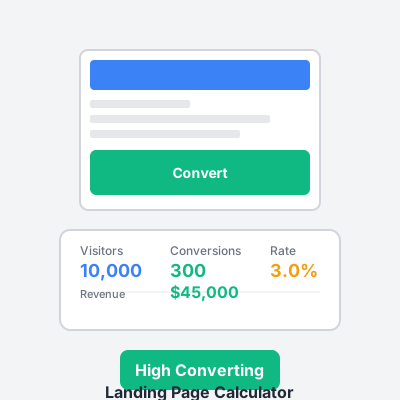
Free landing page calculator to analyze conversion rates, calculate revenue per visitor, and optimize landing page performance. Measure traffic, conversions, an...
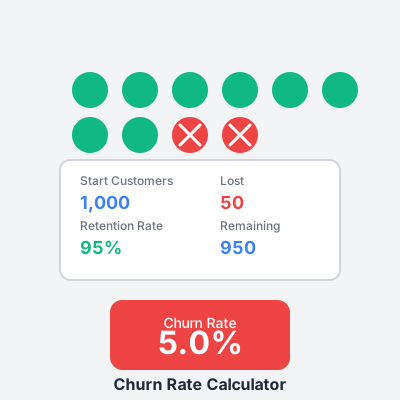
Free churn rate calculator for SaaS and subscription businesses. Calculate customer churn, revenue churn, net revenue retention (NRR), and analyze retention met...
Join our community of happy clients and provide excellent customer support with Post Affiliate Pro.




Cookie Consent
We use cookies to enhance your browsing experience and analyze our traffic. See our privacy policy.