How to Win Back Abandoned Cart Customers with Retargeting & Personalized Offers
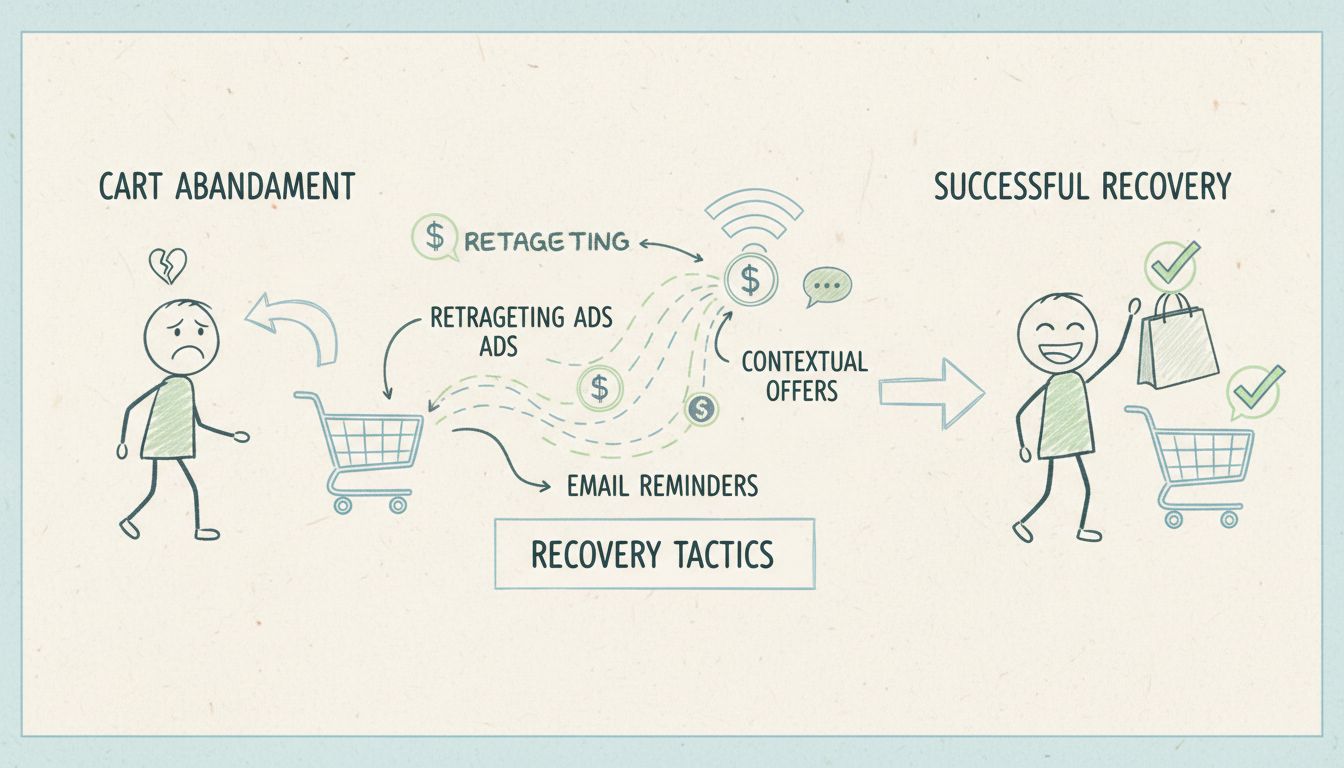
Master abandoned cart recovery with retargeting ads, contextual offers, and personalized messaging. Learn proven strategies to reduce cart abandonment and boost...
Calculate the true cost of cart abandonment and identify revenue recovery opportunities. Analyze abandonment rates, estimate lost revenue, and project potential gains from cart recovery strategies.
The Hidden Revenue Leak - Cart abandonment represents one of the largest revenue opportunities in e-commerce. With average abandonment rates of 70%, three out of every four potential customers leave without purchasing. For a store with $1 million in annual revenue, abandoned carts likely represent an additional $2-3 million in potential sales. Even small improvements in abandonment rate or modest recovery programs can add six figures to annual revenue without increasing traffic or marketing spend.
Why Customers Abandon - Understanding abandonment psychology helps prioritize solutions. Unexpected costs surprise and frustrate customers who’ve invested time browsing and selecting products. Complex checkout creates friction and decision fatigue. Account requirements feel like unnecessary barriers. Security concerns make customers hesitant to enter payment information. Comparison shopping means customers intend to return but often forget. Address the highest-impact causes first rather than trying to fix everything simultaneously.
The Compounding Effect - Reducing abandonment improves multiple metrics simultaneously. Lower abandonment increases conversion rate, improving marketing ROI and making customer acquisition more profitable. It increases revenue per visitor, maximizing value from existing traffic. It improves customer experience, potentially increasing repeat purchase rates. These compounding benefits make checkout optimization one of the highest-ROI activities in e-commerce, often generating 10-20X return on optimization investment.
Lost Revenue Quantification - Most stores underestimate abandonment cost because they focus on completed sales rather than initiated purchases. Calculate: Abandoned Carts × Average Cart Value = Total Abandoned Revenue. A store with 10,000 monthly visitors, 30% add-to-cart rate, $100 average cart value, and 70% abandonment abandons $2.1 million annually. Even recovering 10% adds $210,000 in revenue. This calculation transforms abandonment from abstract metric to concrete business priority.
Realistic Recovery Potential - Not all abandoned carts are recoverable. Some customers never intended to purchase (browsing only), lack budget, or face insurmountable barriers (product unavailable in their location). Realistic recovery rates: 5-15% through email recovery campaigns, 10-20% improvement through checkout optimization, 5-10% through remarketing/retargeting. Combined, these strategies can recover 20-35% of abandoned carts. Use this calculator to model conservative, moderate, and aggressive recovery scenarios and set realistic revenue targets.
Checkout Step Analysis - Most abandonment happens at specific stages. Use analytics to identify your biggest drop-off points: 40-50% abandon at shipping cost reveal, 20-30% at account creation requirement, 15-25% at payment information entry, 10-15% at review/confirmation. Fix the highest-abandonment step first for maximum impact. Even reducing one step’s abandonment by 20% significantly improves overall conversion. Sequential optimization (fix biggest issue, measure, fix next biggest) outperforms trying to improve everything at once.
Mobile Optimization - With mobile representing 60-70% of e-commerce traffic but 85%+ abandonment, mobile checkout optimization is critical. Mobile-specific issues: tiny form fields, complex payment entry, poor button sizing, slow page loads, lack of autofill support, payment wallet absence. Implementing Apple Pay, Google Pay, and Shop Pay alone can reduce mobile abandonment by 20-30%. Test your entire checkout process on actual mobile devices weekly to identify friction points.
Automated email sequences are the most cost-effective recovery method. First email (1-2 hours after abandonment): simple reminder with cart contents, 30-40% open rate, 8-12% recovery. Second email (24 hours): add urgency (low stock, popular item, expiring cart), 20-30% open rate, 5-8% recovery. Third email (3 days): final reminder, potentially with incentive for high-value carts, 15-20% open rate, 3-5% recovery. Include product images, one-click checkout link, and clear value proposition.
Detect when customers attempt to leave checkout and present targeted offers or assistance. Effective popup strategies: offer help (live chat connection), address common objections (display shipping, security badges), provide small incentive (free shipping threshold), collect email to enable cart recovery if they leave anyway. Exit-intent popups can reduce abandonment by 10-15% when implemented strategically. Avoid aggressive popups that create negative experience.
Unexpected shipping costs cause nearly half of all abandonments. Strategies: free shipping above threshold (drives higher order values), flat-rate shipping (predictability), show shipping costs early (shopping cart page), competitive shipping (subsidize if necessary), regional shipping tiers, or build shipping into product prices. Many stores find offering free shipping on orders over 1.5X average order value increases conversion enough to offset shipping subsidy.
Account creation requirements cause 25% of abandonments. Implement guest checkout as default option with optional account creation after purchase. This reduces friction while still capturing customer data. Post-purchase account creation converts 30-40% of guest checkouts into accounts when presented with benefits (order tracking, saved addresses, faster future checkout, exclusive offers). Never force account creation before allowing purchase.
Limited payment options cause 8-12% of abandonments. Offer diverse payment methods: all major credit cards, digital wallets (PayPal, Apple Pay, Google Pay, Shop Pay), buy now pay later (Affirm, Klarna, Afterpay), and region-specific methods. Digital wallets reduce mobile checkout time by 60-70%, significantly reducing mobile abandonment. More payment options increase conversion even if many customers don’t use them - availability builds confidence.
Security concerns cause 15-20% of abandonments. Display trust signals throughout checkout: SSL badges (secure connection), payment security logos (PCI compliance), money-back guarantee, free/easy returns policy, customer reviews, contact information prominently, business verification badges. Position trust elements near payment entry where security concerns peak. Trust signals increase conversion 5-10% despite seeming like minor details.
Multi-step checkout without progress indication increases abandonment. Clear progress indicators (Step 2 of 3, visual progress bar) reduce abandonment by setting completion expectations. Customers are more likely to complete when they know how many steps remain. Ideal checkout: 2-3 steps maximum, with clear progression, ability to edit previous steps, and mobile-optimized navigation. Minimize required fields - every additional field increases abandonment 5-10%.
Offering real-time help during checkout reduces abandonment 10-15%. Implement: proactive chat invitations when customers pause, checkout-specific help (answer payment/shipping questions quickly), visible phone number for immediate assistance, and FAQ links for common questions. Even if few customers use support, its availability builds confidence. Train support staff specifically on checkout assistance rather than general customer service.
Allow customers to save carts and receive reminders. Implement: persistent carts (carts save automatically across sessions), email cart reminders (ask for email early, send reminder if abandoned), mobile app push notifications, and SMS reminders for high-value carts. Make saved carts accessible across devices. Some customers genuinely intend to return but forget - simple reminders recover 5-10% without any incentives or pressure.
Use paid advertising to bring back abandoners. Facebook/Instagram dynamic product ads showing abandoned cart items, Google Display remarketing, platform-specific retargeting, and sequential messaging (escalating urgency). Remarketing converts 2-5% of abandoners at cost-per-acquisition often 50-70% lower than cold traffic. Exclude customers who completed purchase to avoid annoying them. Set frequency caps to prevent ad fatigue.

Cart abandonment occurs when shoppers add items to their online shopping cart but leave without completing the purchase. Average abandonment rates range from 60-80% across industries. Common causes: unexpected shipping costs (48%), account creation requirements (24%), complex checkout process (18%), security concerns (17%), comparison shopping (16%), slow delivery times (12%), lack of payment options (8%), and website errors or crashes. Even small improvements in abandonment rate significantly impact revenue.
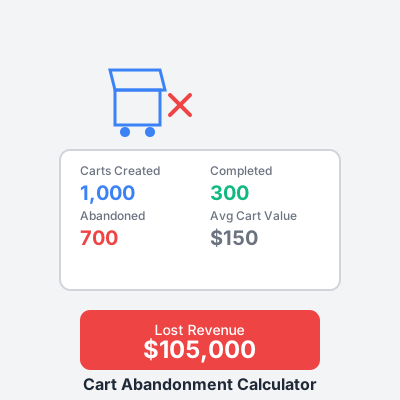
Cart Abandonment Rate = (1 - Completed Purchases / Initiated Checkouts) × 100. Example: 1,000 people start checkout, 300 complete purchase. Abandonment rate = (1 - 300/1,000) × 100 = 70%. Track this metric weekly or monthly to identify trends. Segment by traffic source, device type, new vs returning customers, and product category to identify specific problem areas. Abandonment rates vary by industry: retail averages 72%, travel 81%, fashion 68%, electronics 77%.
Calculate lost revenue: Average Cart Value × Abandoned Carts × Expected Recovery Rate. Example: $100 average cart, 10,000 abandoned carts per month, 15% potential recovery = $150,000 monthly opportunity. Even recovering 10-20% of abandoned carts dramatically increases revenue without additional traffic. The calculator shows both total abandoned revenue and realistic recoverable amounts based on industry benchmarks, helping you set achievable targets and prioritize optimization efforts.
Top strategies: 1) Show total costs (including shipping) early in checkout, 2) Offer guest checkout without account requirement, 3) Provide multiple payment options including digital wallets, 4) Display security badges and trust signals, 5) Simplify checkout to 2-3 steps maximum, 6) Optimize mobile checkout experience, 7) Offer live chat support during checkout, 8) Show clear delivery timeframes, 9) Provide cart save/email reminder functionality, 10) A/B test every element of checkout process. Address highest-impact issues first.
Abandoned cart emails are highly effective: 40-45% open rates, 10-15% click-through rates, and 5-11% conversion rates (recovering 5-11% of abandoned carts). Timing matters: send first email within 1-2 hours, second after 24 hours, third after 3 days. Effective emails: personalize with customer name and cart contents, include product images, create urgency (limited stock, expiring cart), offer incentives cautiously (can train customers to abandon for discounts), make checkout one-click from email, test subject lines and content variations.
Discounts can recover carts but risk training customers to abandon intentionally to receive discounts. Better approaches: 1) Reserve discounts for high-value carts only (over $200), 2) Offer value-adds instead (free shipping, free gift), 3) Use urgency (limited stock) rather than discounts, 4) Test discounts on random sample only (A/B test discount vs no discount), 5) Delay discount until second or third email, 6) Make discounts unique codes that expire quickly. Many abandonments recover without incentives if you simply remind customers.
Mobile has significantly higher abandonment (85-90%) versus desktop (70-75%) due to smaller screens, slower load times, form-fill difficulty, payment entry complexity, and distraction-prone environment. Tablet abandonment (75-80%) falls between. Optimize mobile checkout: use autofill and payment wallets (Apple Pay, Google Pay), minimize form fields, use large touch-friendly buttons, implement progress indicators, allow thumb-friendly navigation, test on actual devices. Mobile-first checkout design reduces abandonment and captures growing mobile commerce.
Affiliates drive traffic but can't control merchant checkout experience. High abandonment hurts affiliate earnings despite generating clicks. As a merchant: 1) Share abandonment data with affiliates, 2) Provide abandoned cart follow-up attribution (credit affiliates when abandoned customers return), 3) Optimize checkout to improve affiliate conversions, 4) Offer affiliate-specific recovery campaigns. As an affiliate: 1) Promote merchants with low abandonment/optimized checkout, 2) Set realistic conversion expectations based on merchant checkout quality, 3) Focus traffic on merchants with smooth purchase experiences.
Average rates range 60-80%, so reducing yours to 60% or below puts you in top quartile. Realistic improvement targets: reduce abandonment by 5-10 percentage points through checkout optimization, recover 5-15% of abandoned carts through email campaigns, combined improvement of 10-20% in completed purchases. Don't expect zero abandonment - some is inevitable (comparison shopping, browsing, distractions). Focus on addressing fixable issues: unexpected costs, complex checkout, lack of payment options, mobile friction, and security concerns.
Essential metrics to track: overall abandonment rate, abandonment by checkout step (identify where customers drop off), abandonment by traffic source, device type, new vs returning, product category, and cart value. Use Google Analytics Enhanced E-commerce, your e-commerce platform's built-in analytics, or dedicated cart recovery tools (Klaviyo, Rejoiner, Barilliance). Set up funnel visualization to see exact drop-off points. Monitor trends over time and measure impact of optimization changes. Segment data to identify highest-value improvement opportunities.
Manage multiple affiliate programs and improve your affiliate partner performance with Post Affiliate Pro.

Master abandoned cart recovery with retargeting ads, contextual offers, and personalized messaging. Learn proven strategies to reduce cart abandonment and boost...
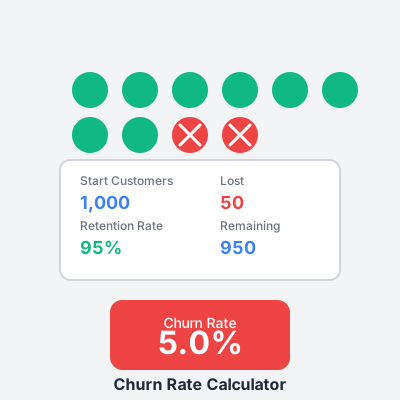
Free churn rate calculator for SaaS and subscription businesses. Calculate customer churn, revenue churn, net revenue retention (NRR), and analyze retention met...
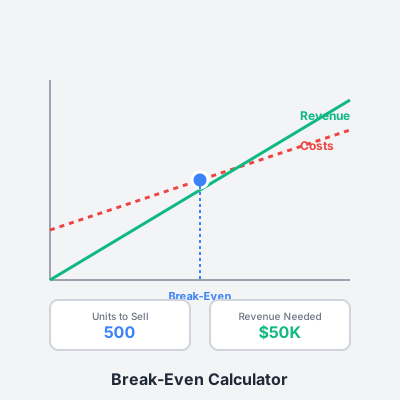
Free break-even calculator to determine sales volume needed to cover costs. Plan pricing strategies, analyze profitability, and make informed business decisions...