
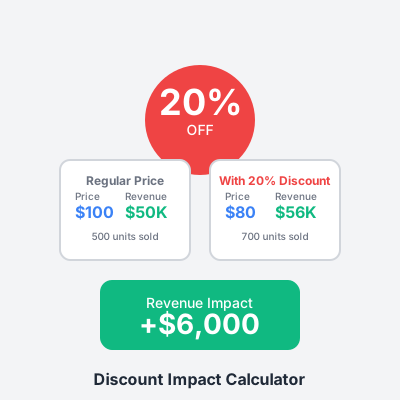
Discount Impact Calculator - Calculate True Discount Profitability
Free discount impact calculator to analyze how discounts affect profit margins, revenue, and profitability. Calculate break-even volume increases and make data-...
6 min read
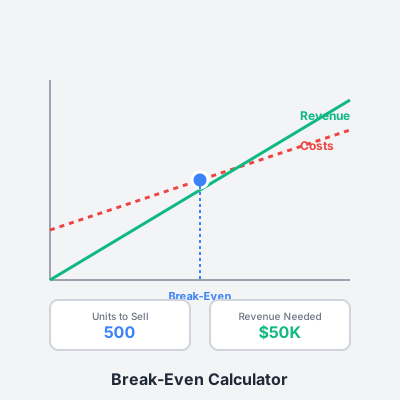
Calculate the sales volume needed to cover all costs and start making profit. Analyze contribution margins, plan pricing strategies, and make informed business decisions with detailed break-even analysis.
Break-even analysis is one of the most fundamental financial planning tools for businesses. It answers the critical question: “How many units must I sell to cover all costs?” This metric is essential for startups validating business models, established businesses launching new products, affiliates evaluating product viability, and entrepreneurs planning pricing strategies.
The break-even point calculation combines fixed costs (expenses that don’t change with volume like rent, insurance, base salaries) and variable costs (expenses that scale with units sold like materials, packaging, shipping) with your selling price to determine exactly when revenue equals total costs.
Contribution margin represents how much each unit sale contributes to covering fixed costs and generating profit. It’s calculated as Selling Price minus Variable Cost Per Unit. For example, if you sell a product for $100 and variable costs are $60, your contribution margin is $40 per unit.
Understanding contribution margin is crucial because it determines how quickly you can cover fixed costs. A product with a $40 contribution margin and $12,000 in fixed costs needs 300 sales to break even. Increase the margin to $50, and you only need 240 sales. This insight drives strategic decisions about pricing, cost management, and product mix optimization.
Safety margin measures how far your current sales exceed break-even, expressed as a percentage. If you’re selling 500 units monthly and break-even is 300 units, your safety margin is 40% ((500-300)/500). This means sales can drop by 40% before you start losing money.
Maintaining adequate safety margins is critical for business resilience. Industries with volatile demand need higher safety margins (50%+) to weather downturns. Stable, predictable businesses can operate with lower margins (20-30%). Monitor safety margin trends - shrinking margins signal the need for corrective action before problems become critical.
Break-even analysis informs numerous business decisions. When evaluating price increases, calculate the break-even volume reduction - if a 10% price increase requires 8% fewer sales, it’s likely worthwhile. For new product launches, determine if projected sales volumes exceed break-even points within acceptable timeframes.
Cost reduction initiatives can be evaluated by modeling their impact on break-even points. If reducing fixed costs by $2,000/month lowers your break-even by 50 units, quantify whether that’s worth the implementation effort. For expansion decisions, calculate break-even for new locations, product lines, or markets to assess viability before committing resources.
Use break-even analysis to create realistic financial projections for investors. Show how much capital is needed to reach break-even, how long until profitability, and what sales volumes are required. Investors scrutinize break-even assumptions - conservative estimates build credibility.
Calculate monthly cash burn (fixed costs + startup expenses) and units needed per month to break even. This reveals runway (months until you need additional funding) and validates whether your business model is viable. If break-even requires 10,000 monthly sales but your market research shows 2,000 is realistic, rethink the business model before launching.
Before launching new products, perform break-even analysis to assess viability. Calculate development costs (treated as fixed costs to be recovered), ongoing fixed costs (inventory, marketing, support), variable costs per unit, and realistic selling price based on market research.
If break-even requires 5,000 units but you can only reach 3,000 potential customers, the product isn’t viable at current costs or pricing. This analysis prevents costly launches of products that can never achieve profitability. Run sensitivity analysis - what if costs are 20% higher or prices 15% lower than projected?
Break-even analysis reveals pricing flexibility and constraints. Calculate break-even points at different price levels to understand volume/price trade-offs. A premium pricing strategy requires lower volume but may limit market size. Value pricing increases volume requirements but expands addressable market.
Test discount strategies by calculating how many additional units must be sold to compensate for reduced margins. A 20% discount reducing contribution margin from $40 to $32 requires 25% more unit sales just to maintain the same profit. Discount economics often surprise business owners expecting volume increases to compensate for lower margins.
Break-even analysis identifies which cost reductions have the greatest impact. Reducing fixed costs lowers break-even points proportionally - cutting $1,000 monthly fixed costs at a $25 contribution margin reduces break-even by 40 units. Reducing variable costs increases contribution margin, compounding benefits.
For example, reducing variable costs from $60 to $55 at a $100 selling price increases contribution margin from $40 to $45 (12.5% increase), but reduces break-even units from 300 to 267 (11% reduction). These compounding effects make variable cost reduction particularly powerful for improving profitability.
Affiliates can use break-even analysis to evaluate product promotion viability. Calculate your costs (time investment valued at hourly rate, advertising spend, tool subscriptions) as fixed costs. Estimate variable costs per conversion (if any). Commission per sale is your “selling price.”
If setup requires 20 hours at $50/hour ($1,000 fixed cost) and commissions are $30/sale, you need 34 sales to break even. Factor in expected conversion rates and traffic costs to determine required visitor volume. If you need 10,000 visitors at $0.20 CPC to generate 34 sales, total cost is $3,000 - your actual break-even is 100 sales, not 34. Accurate cost accounting prevents unprofitable affiliate campaigns.
When selling multiple products, calculate individual break-even points and weighted average contribution margins. Products with higher contribution margins subsidize those with lower margins. Analyze whether low-margin products serve strategic purposes (customer acquisition, upsell leads) or should be discontinued.
Calculate break-even for your product mix: sum all fixed costs, calculate weighted average contribution margin based on sales mix, determine combined break-even. Then ensure your sales mix achieves the weighted average. If high-margin products underperform, you won’t hit break-even despite meeting overall unit targets.
Perform break-even analysis under different scenarios: best case (higher prices, lower costs), expected case (realistic assumptions), worst case (lower prices, higher costs). This reveals business resilience and identifies critical assumptions that must hold true for viability.
Create contingency plans tied to break-even triggers. If sales fall 20% below break-even, implement cost reduction plan A. If 40% below, implement more aggressive plan B. Having predetermined responses to break-even shortfalls enables faster corrective action instead of crisis management.
Break-even analysis provides credible financial metrics for external communication. Investors, lenders, and partners want to see clear paths to profitability. Present break-even units, timeline to break-even based on sales projections, sensitivity analysis showing impact of assumption changes, and safety margins at projected sales levels.
Frame business performance relative to break-even: “We’re currently at 180% of break-even with a 44% safety margin” is more meaningful than raw profit numbers, especially for early-stage businesses. It shows financial health and sustainability rather than just current profit levels.
The break-even point is the sales volume (in units or revenue) at which total costs equal total revenue, resulting in neither profit nor loss. It's the minimum sales needed to cover all fixed costs (rent, salaries) and variable costs (materials, labor per unit). Knowing your break-even point helps set realistic sales targets, evaluate pricing strategies, and assess business viability.
Break-Even Units = Fixed Costs ÷ (Selling Price - Variable Cost Per Unit). The denominator (Selling Price - Variable Cost) is the contribution margin - how much each unit sale contributes to covering fixed costs. Example: $10,000 fixed costs, $50 selling price, $20 variable cost per unit = 10,000 ÷ (50-20) = 334 units needed to break even.
Fixed costs remain constant regardless of production volume (rent, insurance, salaries, equipment leases). You pay these whether you sell 0 or 10,000 units. Variable costs change with production volume (materials, packaging, shipping, sales commissions). Each additional unit sold increases variable costs. Understanding this distinction is crucial for break-even analysis and pricing decisions.
Contribution margin is the amount each unit sale contributes to covering fixed costs and generating profit (Selling Price - Variable Cost). A $50 product with $20 variable cost has a $30 contribution margin. Higher margins mean fewer units needed to break even. If contribution margin is 40%, you need 40% less in fixed costs to break even. It's a key metric for pricing and product mix decisions.
Lower your break-even point by: 1) Reducing fixed costs (renegotiate rent, automate processes, outsource non-core functions), 2) Lowering variable costs (negotiate supplier discounts, improve production efficiency, reduce waste), 3) Increasing selling price (add value, improve positioning, target less price-sensitive segments), 4) Improving product mix (focus on higher-margin products). Even small improvements compound significantly.
Safety margin measures how far current sales exceed break-even: ((Current Sales - Break-Even Sales) / Current Sales) × 100. A 40% safety margin means sales can drop 40% before losing money. Higher margins provide buffer against market downturns, competitive pressures, or seasonal fluctuations. Businesses with <20% safety margins are vulnerable, while >50% indicates strong financial health.
Use the time frame matching your cost structure and planning horizon. Monthly analysis works for businesses with monthly rent, salaries, and consistent cash flow. Quarterly suits seasonal businesses or those with quarterly expense cycles. Annual analysis helps strategic planning and investor presentations. Most businesses benefit from monthly tracking with quarterly reviews and annual strategic assessment.
Break-even analysis reveals pricing's impact on required sales volume. Testing different price points shows: at $45 selling price, need 400 units; at $55, need only 286 units. This quantifies the trade-off between price and volume. It also shows minimum viable pricing (variable cost + proportional fixed cost allocation) and helps evaluate discount strategies' profitability impact.
Time to break-even varies by business type. E-commerce stores: 6-18 months. SaaS startups: 18-36 months (longer runway for product development). Retail locations: 12-24 months. Service businesses: 6-12 months (lower startup costs). Franchises: 18-36 months (higher initial investment). Plan for 1.5x your estimated break-even timeline to account for unexpected challenges and ramp-up time.
Evaluate affiliate products by estimating the merchant's break-even point. Products with healthy margins can sustain better commission rates long-term. Calculate: if commission is $25/sale and you need 1,000 sales to recover setup costs ($25,000), that's your affiliate break-even. Factor in traffic costs, conversion rates, and time to assess viability. Merchants operating near their break-even may reduce commissions during downturns.
Manage multiple affiliate programs and improve your affiliate partner performance with Post Affiliate Pro.
Free discount impact calculator to analyze how discounts affect profit margins, revenue, and profitability. Calculate break-even volume increases and make data-...

Free online percentage calculator with 12+ calculation modes. Calculate percentages, discounts, tips, margins, VAT, commissions, and more. Instant results with ...
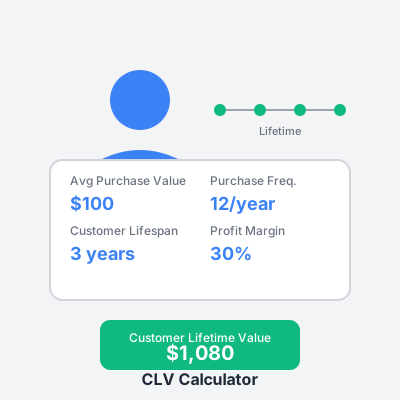
Free CLV calculator to determine total customer value. Calculate simple, predictive, and subscription CLV. Analyze CLV:CAC ratios and improve customer profitabi...
Join our community of happy clients and provide excellent customer support with Post Affiliate Pro.




Cookie Consent
We use cookies to enhance your browsing experience and analyze our traffic. See our privacy policy.