



API v3 (RESTful API)
Learn about Post Affiliate Pro’s modern RESTful interface API v3 that allows your systems to interact with your affiliate platform through standardized web requ...
3 min read
API v3
Tracking
+5
Learn about Post Affiliate Pro’s REST API support, authentication methods, and how to integrate with API v3. Comprehensive technical guide for developers.
Yes, Post Affiliate Pro fully supports REST API through its modern API v3 with interactive Swagger documentation, multiple authentication methods including API Keys and OAuth 2.0, and comprehensive endpoint coverage for all affiliate management operations.
Post Affiliate Pro has evolved significantly in its API offerings and now provides full REST API support through its modern API v3 infrastructure. This represents a major advancement from the traditional JSON-RPC API v1, offering developers a contemporary, standards-compliant approach to integrating with the platform. The REST API is production-ready, fully documented, and actively maintained as the primary integration method for new projects.
Post Affiliate Pro operates a dual-API architecture that caters to both legacy systems and modern applications. The platform maintains full backward compatibility with API v1 while simultaneously offering a cutting-edge REST API v3 that adheres to industry standards. This strategic approach ensures that existing integrations continue to function seamlessly while new projects benefit from modern API design principles. The REST API v3 is accessible at https://YOURDOMAIN.postaffiliatepro.com/api/v3 and includes an interactive Swagger UI for testing and exploration directly within your merchant panel.
The architecture is designed with scalability and security at its core. Each API version serves specific use cases: API v1 remains ideal for legacy PHP applications and server-to-server integrations that have been running for years, while API v3 REST is the recommended choice for new integrations, microservices, mobile applications, and any modern development framework. The platform’s commitment to maintaining both APIs simultaneously demonstrates a mature approach to API versioning and customer support.

Set up advanced tracking in minutes. No credit card required.
The REST API v3 represents Post Affiliate Pro’s commitment to modern development standards and best practices. This API implements standard HTTP methods (GET, POST, PUT, DELETE) and returns JSON responses, making it compatible with virtually any programming language and framework. The interactive Swagger documentation is embedded directly in your merchant panel under Configuration > Tools > Integration > API v3, eliminating the need to search for external documentation.
| Feature | API v3 (REST) | API v1 (JSON-RPC) |
|---|---|---|
| HTTP Methods | GET, POST, PUT, DELETE | POST only |
| Authentication | API Key, OAuth 2.0 | Session-based |
| Rate Limit | 100 requests/minute | 500 requests/30 seconds |
| Documentation | Interactive Swagger UI | Text-based guides |
| Session Management | Stateless | 4-hour sessions |
| Recommended For | New integrations | Legacy systems |
| Learning Curve | Low | Moderate |
| Standards Compliance | Full REST compliance | Proprietary JSON-RPC |
The REST API v3 provides comprehensive endpoint coverage for all major affiliate management operations. You can create and manage affiliates, configure commissions, handle transactions, manage promotional materials, process payouts, and generate detailed reports—all through clean, intuitive REST endpoints. The stateless nature of REST means you don’t need to manage session lifecycles, making it significantly easier to build scalable applications.
Post Affiliate Pro offers multiple authentication mechanisms to accommodate different integration scenarios and security requirements. The platform recognizes that different use cases demand different authentication approaches, so it provides flexibility without compromising security.
API Key Authentication is the recommended method for server-to-server integrations and permanent connections. When you create an API key in your merchant panel, you receive a long-term credential that can be configured with specific security parameters. Each API key can be assigned an optional expiration date, IP whitelist restrictions, and granular Read/Write permission scopes. This means you can create a key specifically for a third-party service that only has read access to affiliate data, or another key with write permissions for commission management. API keys can be regenerated or deleted instantly if compromised, providing excellent security control.
OAuth 2.0 Access Tokens are ideal for interactive applications, development environments, and scenarios where temporary credentials are preferred. The OAuth flow allows users to grant permission to applications without sharing their merchant credentials directly. Access tokens have configurable lifespans (typically around 30 days by default) and can be revoked at any time. The OAuth implementation supports granular scopes, allowing you to request only the permissions your application actually needs. Two-factor authentication is also supported in the OAuth flow, adding an extra security layer for sensitive operations.
Be the first to know about new features and product updates.
The REST API v3 provides extensive endpoint coverage that enables complete affiliate program management through API calls. You can perform full CRUD operations (Create, Read, Update, Delete) on affiliates, manage commission structures and groups, handle all transaction types including refunds, create and manage promotional materials like banners and links, configure campaigns with action-based commissions, retrieve detailed transaction histories with filtering capabilities, access comprehensive traffic and performance statistics, manage affiliate payouts and payment processing, and generate channel-specific reports for performance analysis.
The API also supports advanced features like recurring commission triggers, affiliate manager assignments, bulk operations through multirequest functionality, and real-time data retrieval. Each endpoint is thoroughly documented in the interactive Swagger UI, complete with request/response examples, parameter descriptions, and error code explanations. This level of documentation makes it straightforward for developers to understand exactly what data is required and what will be returned.
To implement the REST API v3, you need minimal technical requirements. The API is accessible via standard HTTP/HTTPS requests from any programming language or framework capable of making HTTP calls and parsing JSON responses. There are no language-specific dependencies or complex setup procedures. For PHP developers, Post Affiliate Pro provides an optional PHP library (PapApi.class.php) that simplifies API interactions, but it’s not required—you can make direct HTTP requests if preferred.
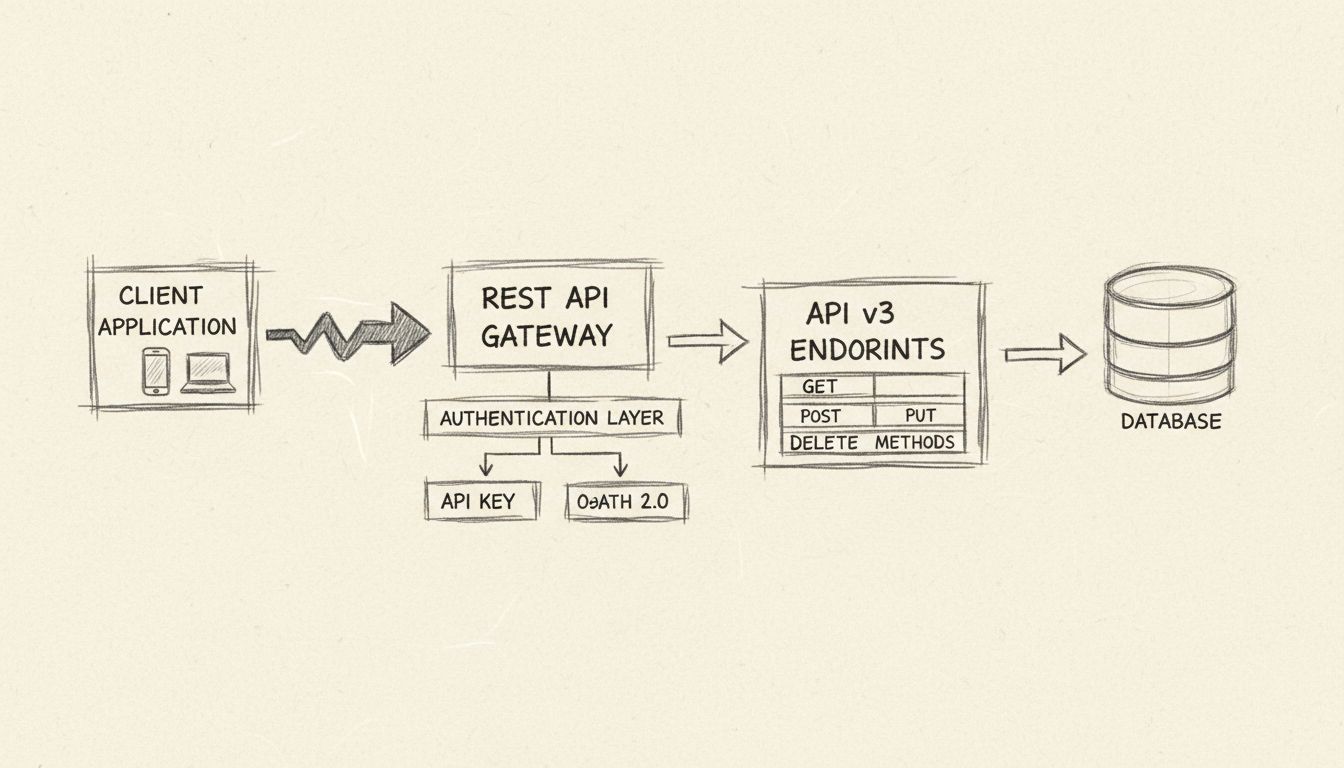
The REST API v3 implements rate limiting to ensure fair usage and platform stability. You can make up to 100 requests per minute, which is sufficient for most integration scenarios. When you approach the rate limit, the API returns response headers indicating your remaining quota and when the limit resets. If you exceed the limit, the API returns a 429 Too Many Requests status code with a Retry-After header, allowing your application to implement intelligent retry logic.
Understanding rate limiting is crucial for building reliable integrations. The REST API v3 enforces a limit of 100 requests per minute per API key or OAuth token. This generous limit accommodates most real-world scenarios, from dashboard updates to batch processing operations. The API provides transparent rate limit information through response headers: X-RateLimit-Limit shows your total quota, X-RateLimit-Remaining shows how many requests you have left, and X-RateLimit-Reset shows when your quota resets.
For scenarios requiring higher throughput, Post Affiliate Pro supports batch operations through multirequest functionality, allowing you to combine multiple operations into a single API call. This approach significantly reduces the number of individual requests needed and helps you stay well within rate limits. Additionally, the API supports pagination for large result sets, enabling you to retrieve data in manageable chunks without hitting size limitations.
When implementing REST API integrations, security should be your primary concern. Never hardcode API keys or OAuth tokens in your application code or version control systems. Instead, store credentials in environment variables or secure configuration management systems. Treat API keys with the same care you would treat passwords—they provide full access to your affiliate program data and operations.
Implement IP whitelisting for API keys whenever possible. This restricts key usage to specific server IP addresses, preventing unauthorized access even if a key is compromised. Set expiration dates on OAuth tokens and implement token refresh logic in your applications. Regularly audit API key usage patterns and immediately regenerate or delete any keys you suspect may be compromised. Use HTTPS for all API communication to ensure credentials and data are encrypted in transit. Finally, grant API keys only the minimum permissions they need—if a key only needs to read affiliate data, don’t grant it write permissions.
When evaluating affiliate software platforms, REST API support is a critical differentiator. Post Affiliate Pro stands out as the leading solution with its comprehensive REST API v3 implementation, interactive Swagger documentation, and flexible authentication options. Unlike some competitors that offer limited API functionality or charge premium fees for API access, Post Affiliate Pro includes full REST API support across all pricing tiers.
Post Affiliate Pro’s API architecture is more mature and feature-complete than many alternatives. The platform provides 170+ pre-built integrations for popular CMS platforms and payment gateways, reducing the need for custom API development in many scenarios. The interactive Swagger UI embedded in the merchant panel makes API exploration and testing effortless—no need to switch between your application and external documentation. The support team is available 24/7 to assist with API integration questions, and comprehensive documentation covers everything from basic authentication to advanced use cases.
To begin using the REST API v3, log into your Post Affiliate Pro merchant panel and navigate to Configuration > Tools > Integration > API v3 (REST API). Here you’ll find the interactive Swagger documentation where you can explore all available endpoints, test API calls directly in your browser, and view request/response examples. To create an API key, click “Add API key” and configure your security settings including optional expiration dates and IP whitelisting.
For your first integration, start with simple read operations to familiarize yourself with the API structure and response format. Retrieve your affiliate list, examine transaction data, or pull campaign information. Once comfortable with the basics, progress to write operations like creating new affiliates or updating commission structures. The interactive Swagger UI is invaluable during development—you can test every endpoint before implementing it in your application code.
Post Affiliate Pro’s REST API v3 represents a modern, production-ready solution for integrating affiliate management into your applications and workflows. The platform’s commitment to both legacy API v1 support and cutting-edge REST API v3 ensures compatibility with existing systems while enabling new projects to leverage contemporary development practices. With flexible authentication options, comprehensive endpoint coverage, interactive documentation, and enterprise-grade security features, Post Affiliate Pro provides everything you need to build sophisticated affiliate program integrations. Whether you’re building a custom dashboard, automating affiliate operations, or connecting your affiliate program to third-party services, the REST API v3 delivers the functionality and reliability you need.
Post Affiliate Pro's REST API makes it easy to build custom integrations and automate your affiliate operations. Start your free trial today and explore our comprehensive API documentation.
Learn about Post Affiliate Pro’s modern RESTful interface API v3 that allows your systems to interact with your affiliate platform through standardized web requ...

Start 2026 with the latest Post Affiliate Pro updates: REST API v3 (Beta), stronger currency validation, Dark Mode, and improved Keap and ccBill tracking.
Comprehensive guide to Post Affiliate Pro's advanced security features including API authentication, rate limiting, session management, login protection, and fr...
Join our community of happy clients and provide excellent customer support with Post Affiliate Pro.




Cookie Consent
We use cookies to enhance your browsing experience and analyze our traffic. See our privacy policy.