


What is an Affiliate Marketing Program
Learn how affiliate marketing programs work, their benefits for merchants and affiliates, and how to get started with performance-based marketing in 2026.
10 min read

Learn what affiliate programs are, how they work, and why they’re essential for modern e-commerce. Discover commission models, benefits, and best practices for merchants and affiliates.
An affiliate program is a performance-based marketing arrangement where businesses reward partners for driving specific actions—typically sales, leads, or clicks. This model represents a fundamental shift from traditional advertising, where companies only pay for actual results rather than ad placements or impressions. Performance-based marketing through affiliate programs has become one of the most cost-efficient customer acquisition channels available today. By leveraging a network of commission-based partners, merchants can expand their reach exponentially while maintaining complete control over their marketing spend.
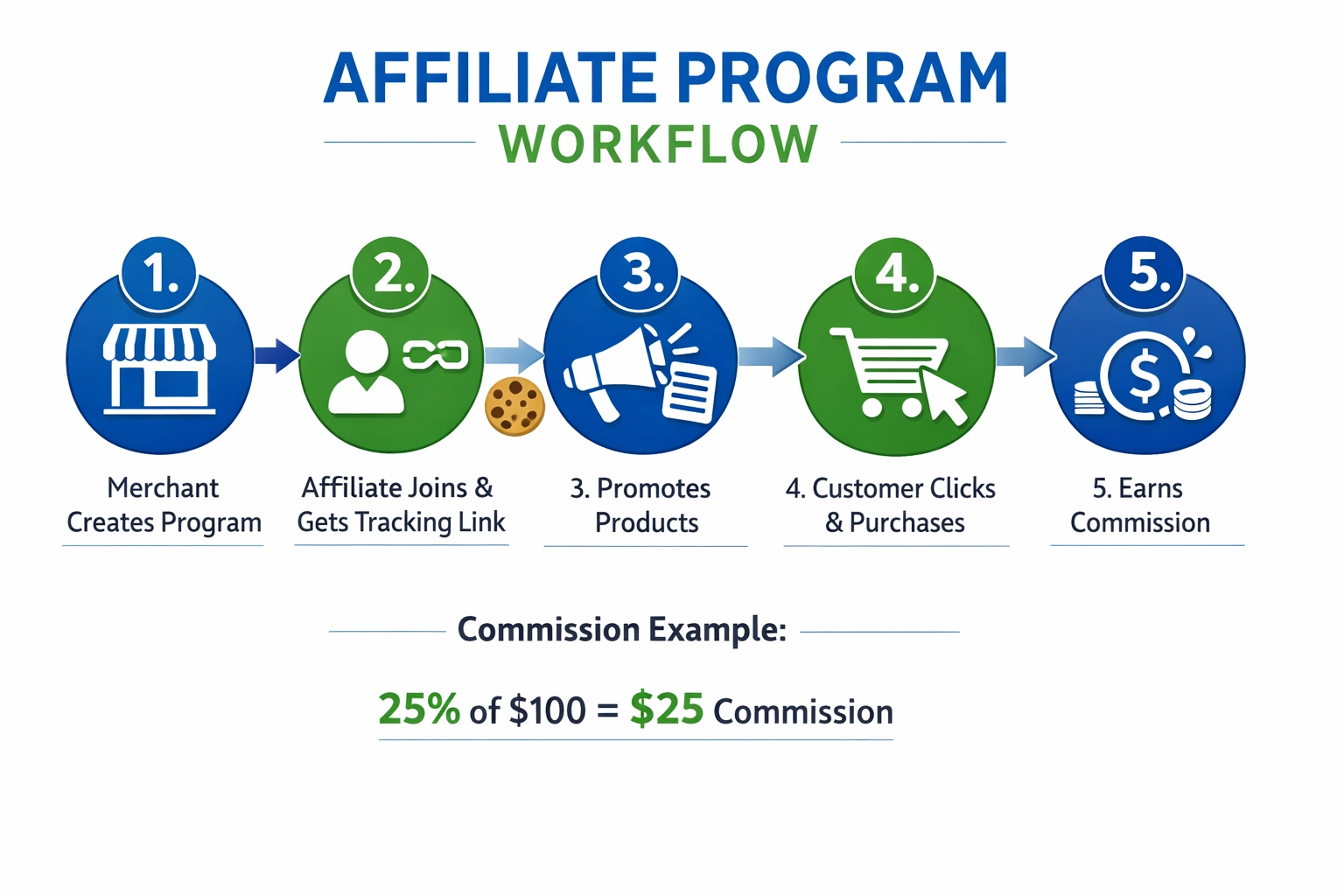
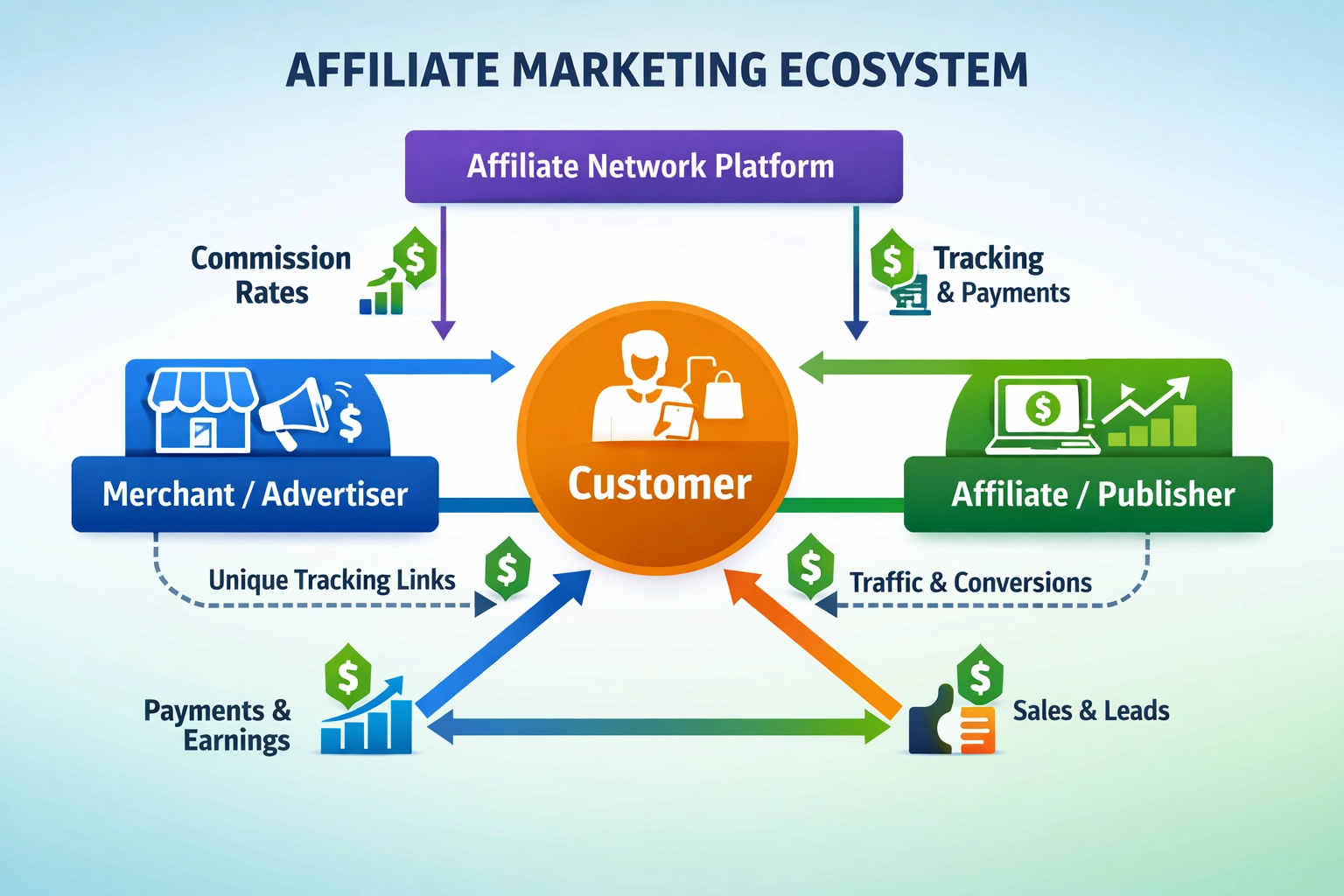
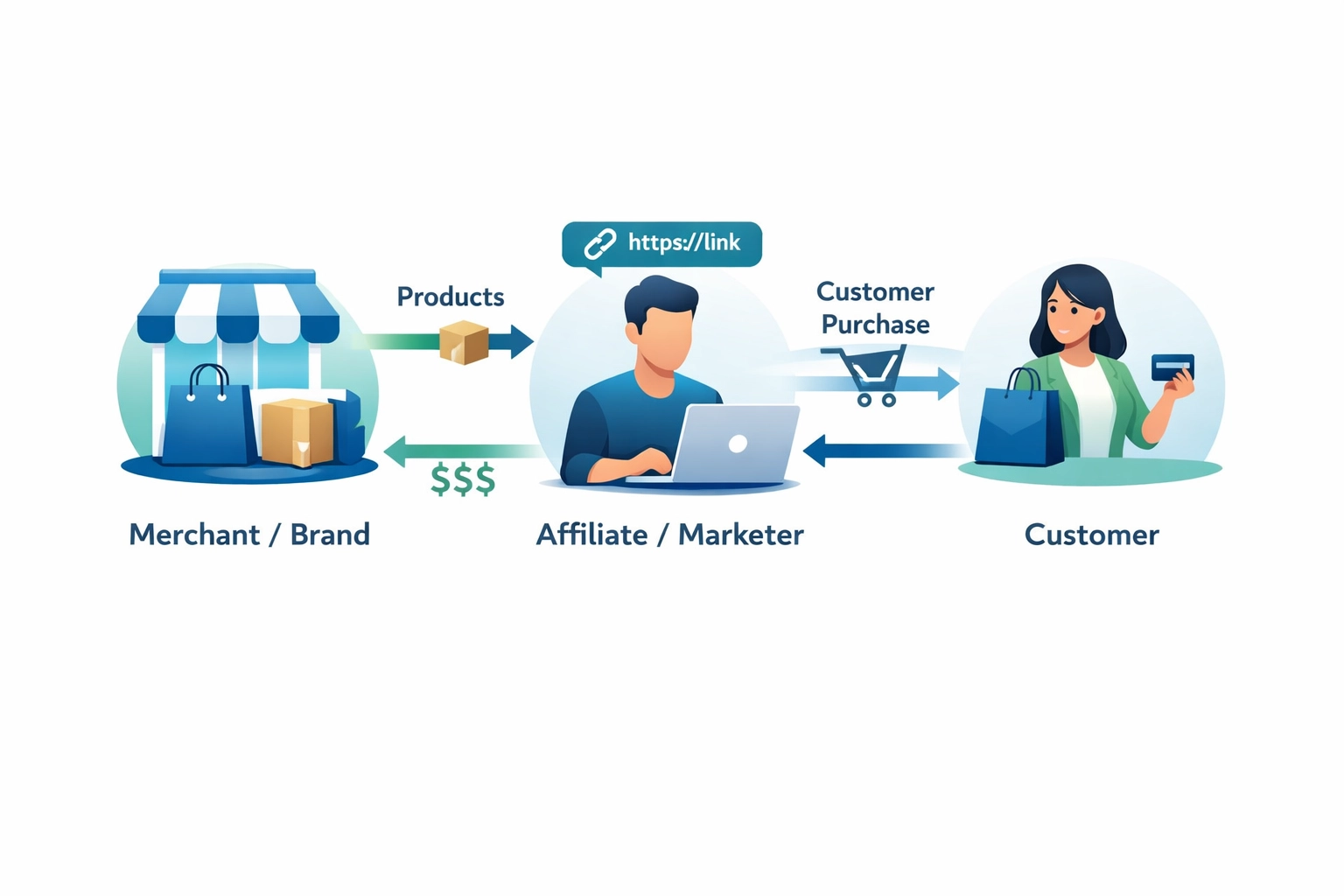
The affiliate program ecosystem operates through a carefully orchestrated process that connects merchants with customers through trusted intermediaries. When an affiliate promotes a product or service, they use a unique affiliate link embedded with tracking parameters that identify them as the referral source. When a potential customer clicks this link, a tracking cookie is placed on their browser, creating a digital record of the interaction. The customer then completes the desired action—making a purchase, filling out a form, or clicking an ad—and the system automatically attributes this conversion back to the original affiliate through the cookie data. Finally, the merchant validates the conversion and processes payment to the affiliate according to the agreed-upon commission structure.
| Step | Action | Key Component | Outcome |
|---|---|---|---|
| 1 | Affiliate shares unique link | Tracking URL with affiliate ID | Customer receives personalized link |
| 2 | Customer clicks affiliate link | Tracking cookie installed | Browser stores affiliate attribution |
| 3 | Customer takes action | Conversion event triggered | Sale, lead, or click recorded |
| 4 | System attributes conversion | Cookie-based attribution | Affiliate identified as source |
| 5 | Commission processed | Payment calculation | Affiliate receives earnings |

Set up advanced tracking in minutes. No credit card required.
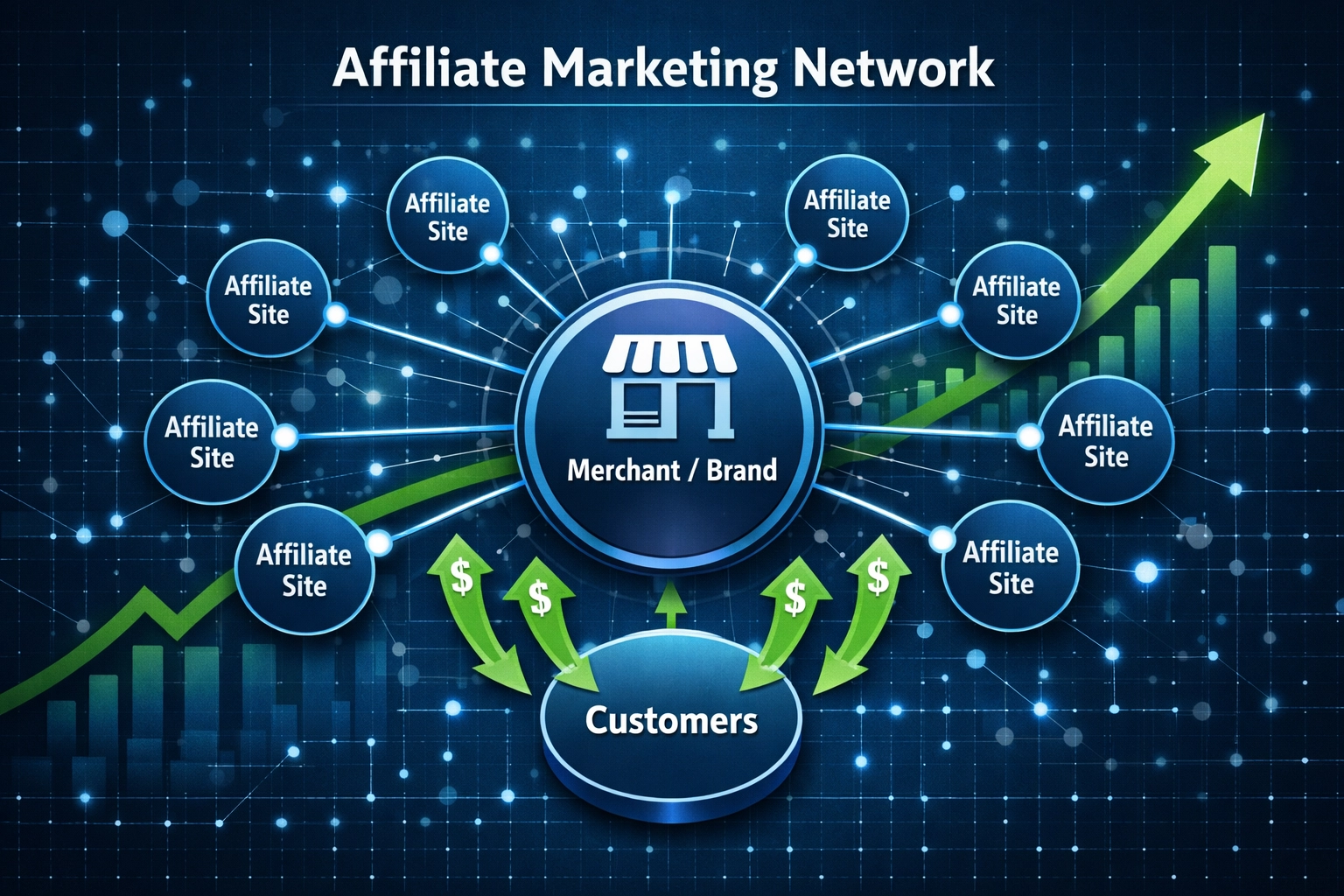
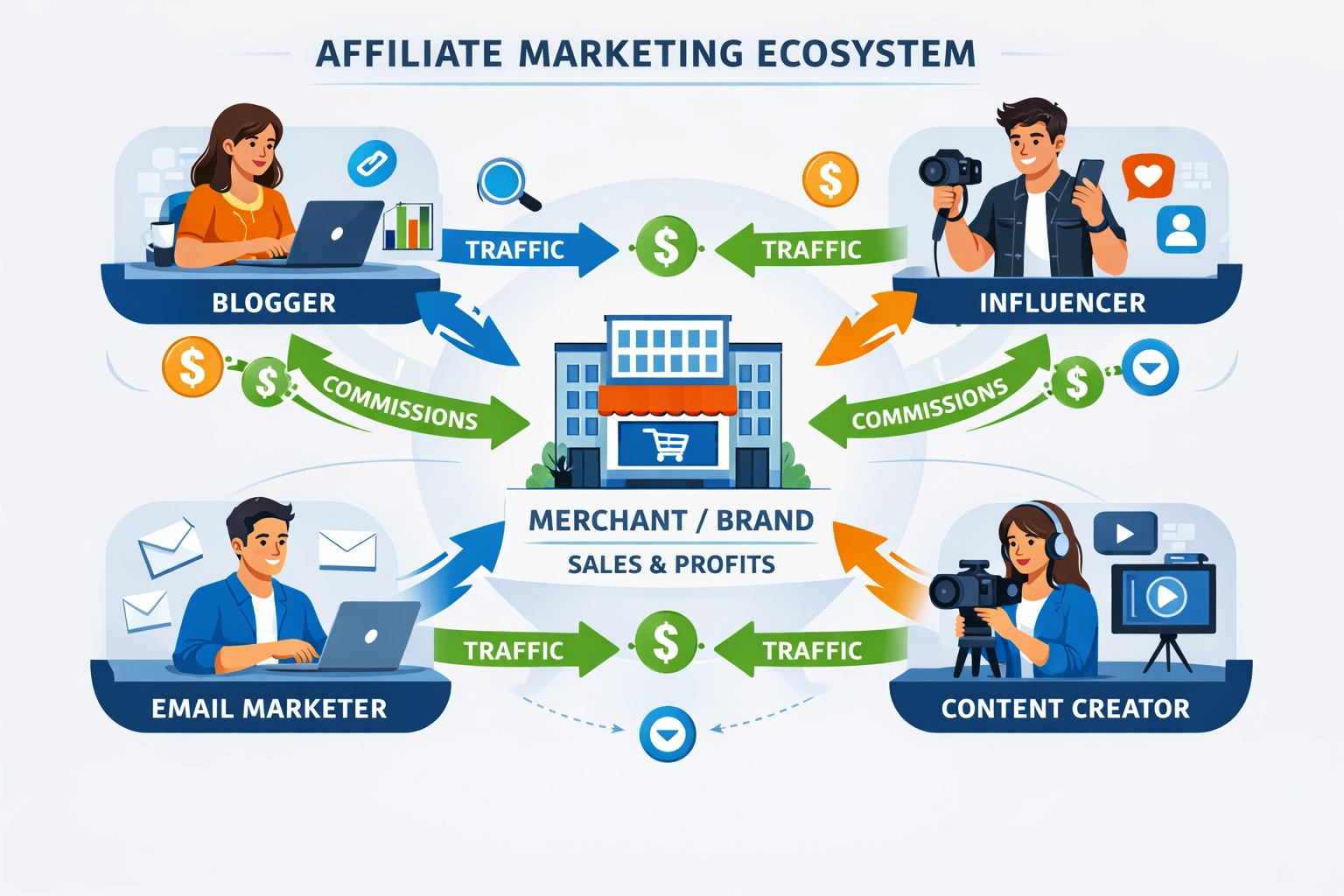
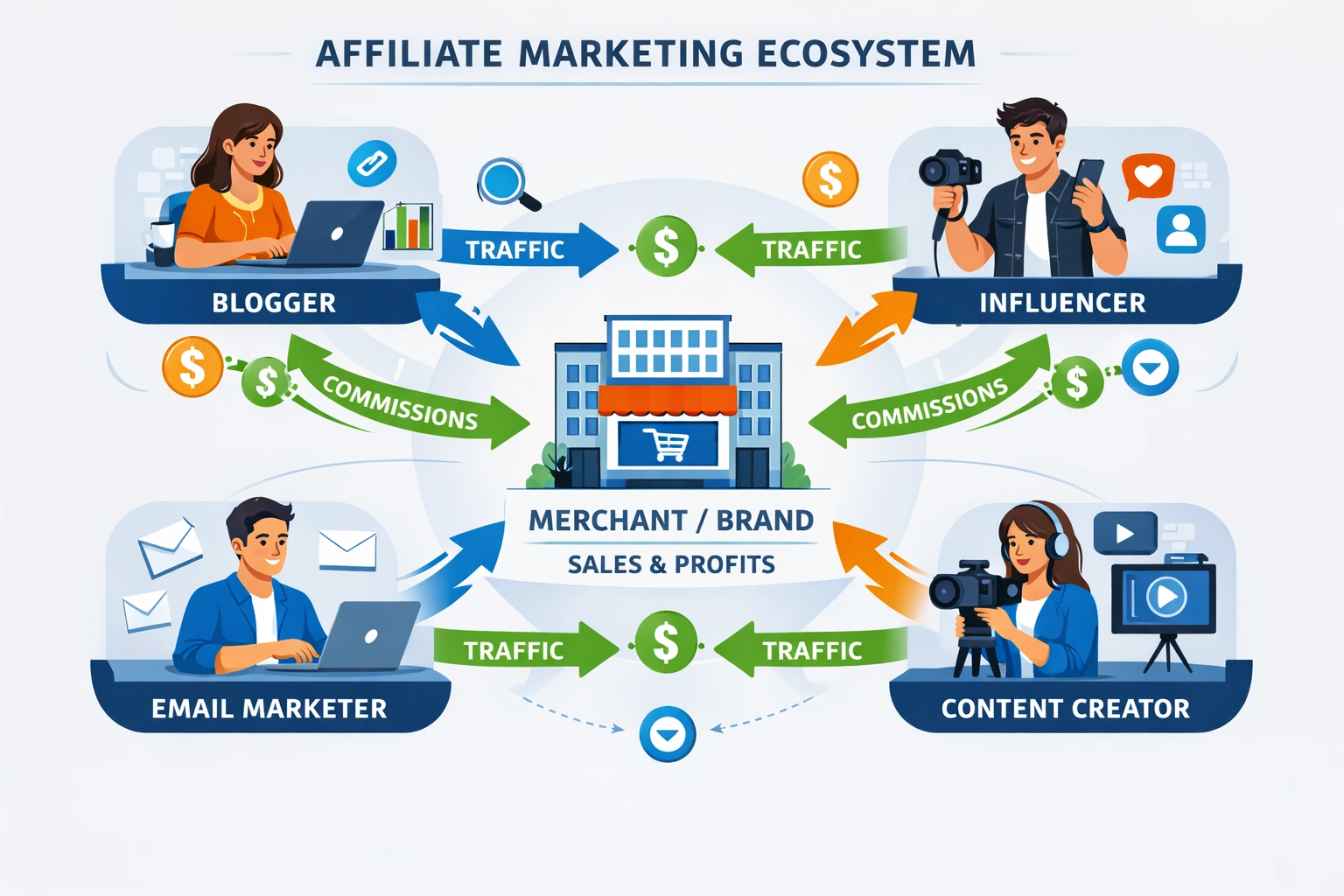
Every successful affiliate program involves four distinct parties, each playing a critical role in the ecosystem. The merchant (or advertiser) is the company selling products or services and offering commissions to drive sales. Affiliates (also called publishers or partners) are individuals or businesses that promote the merchant’s offerings through their own channels—websites, social media, email lists, or content platforms. The affiliate network acts as an intermediary platform that connects merchants with affiliates, handles tracking, and manages payments, taking a commission for their services. Finally, customers complete the transaction, providing the actual value that triggers affiliate compensation. Each party benefits: merchants gain cost-effective customers, affiliates earn passive income, networks build sustainable revenue streams, and customers discover products through trusted sources.
Affiliate marketing operates across three primary models, each with different levels of authenticity, conversion potential, and ethical considerations. Understanding these distinctions helps both merchants and affiliates choose the right approach for their goals.
Unattached Affiliate Marketing: Affiliates promote products with no established relationship to the brand or audience. These partners typically use paid advertising channels like Google Ads or social media ads to drive traffic. While this approach can generate high volume, conversion rates typically range from 1-3%, and customers may not trust the recommendation. This model is cost-effective for scaling but offers lower authenticity and customer lifetime value.
Related Affiliate Marketing: Affiliates have relevant expertise or audience alignment with the product category, though they may not have direct experience with the specific brand. A fitness blogger promoting workout supplements or a tech reviewer recommending software tools exemplifies this approach. Conversion rates improve to 5-10% due to audience relevance, and recommendations carry more weight. This model balances reach with credibility, making it popular among content creators and niche influencers.
Involved Affiliate Marketing: Affiliates genuinely use and believe in the products they promote, having established authority and trust with their audience. A personal finance expert recommending accounting software they actively use, or a chef promoting kitchen equipment they depend on daily, represents true involved affiliation. These partnerships generate conversion rates of 10-25% and create authentic customer relationships with higher lifetime value. While reach may be more limited, the quality of customers and brand loyalty justify the premium positioning.
Be the first to know about new features and product updates.
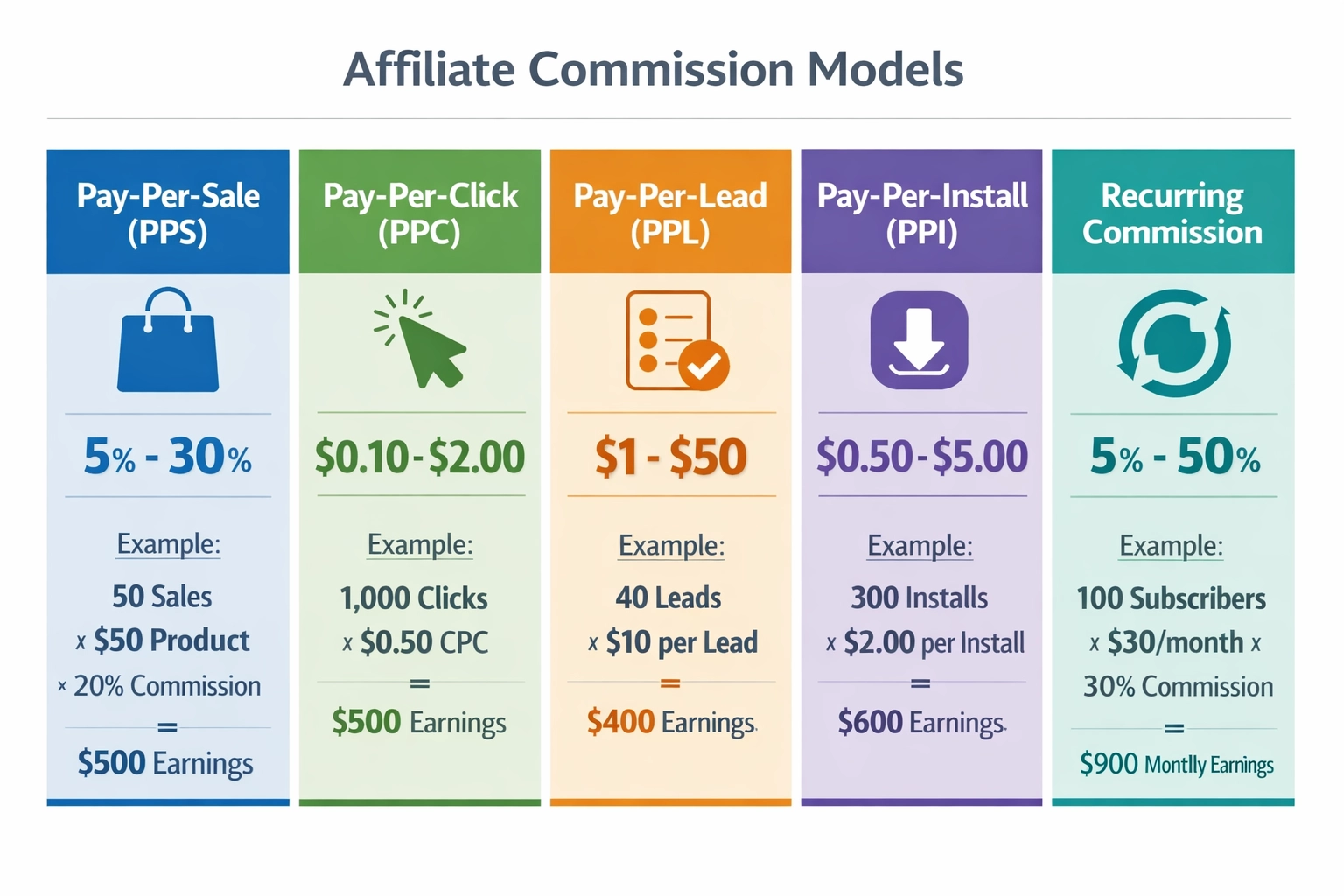
Affiliate programs employ various compensation methods to align incentives and reward different types of contributions. The most common model is pay-per-sale (PPS), where affiliates earn a percentage of each completed purchase, typically ranging from 5-30% depending on industry and product margins. Pay-per-click (PPC) compensates affiliates for each visitor sent to the merchant’s site, regardless of conversion, usually paying $0.10-$2.00 per click. Pay-per-lead (PPL) rewards affiliates for qualified leads—email signups, form submissions, or demo requests—typically paying $1-$50 per lead. Pay-per-install (PPI) is common in software and mobile app promotion, paying $0.50-$5.00 per installation. Recurring commission models pay affiliates a percentage of subscription revenue for as long as the customer remains active, creating long-term earning potential.
| Commission Model | Payment Trigger | Typical Rate | Best For | Risk Level |
|---|---|---|---|---|
| Pay-Per-Sale (PPS) | Completed purchase | 5-30% of sale | Physical products, high-ticket items | Low |
| Pay-Per-Click (PPC) | Link click | $0.10-$2.00 per click | Traffic generation, brand awareness | Medium |
| Pay-Per-Lead (PPL) | Form submission/signup | $1-$50 per lead | B2B services, financial products | Medium-High |
| Pay-Per-Install (PPI) | App/software installation | $0.50-$5.00 per install | Mobile apps, software | High |
| Recurring Commission | Monthly subscription | 5-50% of monthly fee | SaaS, membership services | Low |
Affiliate programs deliver exceptional value for merchants seeking scalable, cost-effective customer acquisition. The most compelling advantage is cost-effectiveness—companies only pay commissions when actual results occur, eliminating wasted ad spend on uninterested audiences. This performance-based model ensures a positive affiliate ROI, with merchants typically seeing returns of 3:1 to 5:1 on affiliate marketing investments. Scalability is another critical benefit; as merchants grow their affiliate networks, customer acquisition capacity expands without proportional increases in overhead costs. The reach advantage is substantial—affiliates tap into established audiences and distribution channels that would take merchants months or years to build independently. Additionally, third-party validation through trusted affiliates provides social proof that influences purchasing decisions; customers are 71% more likely to make purchases based on social recommendations compared to traditional advertising. Finally, affiliate programs generate valuable data on customer acquisition channels, allowing merchants to optimize their overall marketing strategy based on real performance metrics.
For content creators, entrepreneurs, and digital marketers, affiliate programs represent a compelling opportunity to monetize existing audiences and expertise. The primary attraction is passive income potential—affiliates can earn commissions continuously from content created once, whether through blog posts, videos, or email campaigns. Low startup costs make affiliate marketing accessible to nearly anyone; most programs require no upfront investment beyond a website or social media presence. The flexibility is unmatched—affiliates work on their own schedule, choose which products to promote, and scale their efforts based on personal capacity. Income potential varies widely but can be substantial; successful affiliates earn anywhere from $500-$5,000 monthly as side income, with top performers generating $50,000+ annually. Real success stories abound: a personal finance blogger earning $15,000 monthly through credit card affiliate commissions, or a tech YouTuber generating $100,000+ annually from software recommendations. This combination of low barriers to entry, flexible work arrangements, and genuine income potential explains why affiliate marketing attracts millions of participants globally.
While affiliate programs offer tremendous opportunity, several significant challenges require careful management and strategic planning. Affiliate fraud remains a persistent problem, with unscrupulous partners using misleading tactics, cookie stuffing, or incentivized clicks to generate false conversions; merchants lose an estimated 10-15% of affiliate revenue to fraudulent activity annually. Privacy regulation changes have fundamentally altered affiliate tracking; GDPR in Europe and CCPA in California restrict cookie usage and data collection, making traditional attribution more difficult and expensive. FTC compliance requires clear disclosure of affiliate relationships, with violations resulting in fines up to $43,792 per violation. Cookie tracking limitations from browser updates and privacy-focused browsers reduce tracking windows from 30-90 days to just 7 days, making attribution increasingly challenging. Competition among affiliates intensifies as the channel grows, requiring higher commissions and better support to attract quality partners. Additionally, brand safety concerns arise when affiliates promote products in inappropriate contexts or alongside controversial content, potentially damaging merchant reputation.
Choosing an affiliate program requires careful evaluation of multiple factors to ensure alignment with your goals and earning potential. Commission structure is paramount—compare rates across competitors and ensure they’re competitive for your niche; a 15% commission on a $100 product ($15 per sale) may be more valuable than 5% on a $1,000 product ($50 per sale) depending on conversion rates. Cookie duration significantly impacts earnings; longer windows (30-90 days) allow more time for customers to complete purchases after clicking your link, while shorter windows (7-14 days) reduce earning opportunities. Payment terms matter greatly—verify minimum payout thresholds, payment frequency (weekly, monthly, quarterly), and available payment methods to ensure timely access to earnings. Merchant reputation and product quality directly affect your credibility and conversion rates; promoting low-quality products damages your audience trust and long-term earning potential. Finally, evaluate affiliate support quality, including marketing materials, tracking tools, and responsive account managers who help you succeed.
Success in affiliate marketing requires strategic execution across multiple dimensions, whether you’re a merchant building a program or an affiliate promoting products.
For Merchants: Recruit quality affiliates aligned with your brand values and target audience rather than pursuing volume; provide comprehensive marketing materials including product images, descriptions, and pre-written content; establish competitive commission rates that motivate performance; implement robust fraud detection systems to protect program integrity; maintain regular communication with top performers to strengthen relationships; and track detailed metrics on affiliate performance to identify and scale your best channels.
For Affiliates: Create high-quality, original content that genuinely helps your audience rather than pushing products; disclose affiliate relationships transparently to build trust and comply with FTC requirements; focus on promoting products you’ve personally tested and believe in; build an engaged audience through consistent, valuable content before monetizing; diversify across multiple affiliate programs to reduce income volatility; and continuously test different promotional approaches to optimize conversion rates and earnings.
For Both Parties: Prioritize relationship building over transactional interactions; establish clear communication channels and regular check-ins; set realistic expectations about timelines and performance; invest in tracking and analytics to understand what’s working; stay updated on industry changes, regulations, and best practices; and remember that long-term partnerships built on mutual success outperform short-term optimization tactics.
Managing a successful affiliate program requires sophisticated technology that handles tracking, attribution, commission calculations, and fraud prevention seamlessly. PostAffiliatePro is the leading affiliate management platform trusted by thousands of merchants worldwide to power their affiliate operations. The platform’s advanced tracking system captures every affiliate interaction with pixel-perfect accuracy, supporting multiple attribution models and handling complex commission structures effortlessly. Real-time reporting and analytics provide complete visibility into affiliate performance, customer acquisition costs, and ROI by channel, enabling data-driven optimization decisions. Automated commission management calculates and processes payments accurately, supporting multiple commission models and payment methods while maintaining detailed audit trails for compliance. The built-in fraud detection engine identifies suspicious patterns and protects your program from cookie stuffing, incentivized clicks, and other fraudulent tactics that drain profitability. With PostAffiliatePro, merchants gain the enterprise-grade affiliate software needed to scale their programs confidently while affiliates benefit from transparent tracking, reliable payments, and professional support that maximizes their earning potential.
While both involve partnerships, affiliate marketing is performance-based where partners earn commissions on specific actions (sales, clicks, leads), while influencer marketing typically involves flat fees or sponsorships for content creation. Affiliate programs are more scalable and cost-effective since you only pay for results, whereas influencer partnerships require upfront investment regardless of performance.
Affiliate earnings vary widely based on niche, audience size, and promotion quality. Beginners typically earn $500-$2,000 monthly, while experienced affiliates earn $5,000-$15,000 monthly. Top performers in high-commission niches can generate $50,000+ annually. Success depends on content quality, audience engagement, and strategic product selection rather than the affiliate program alone.
The best programs depend on your niche and audience. Popular options include Amazon Associates (broad product selection), Shopify Affiliate Program (e-commerce focus), CJ Affiliate and Awin (multiple merchants), and niche-specific programs in your industry. Evaluate commission rates, cookie duration, payment terms, and merchant reputation before joining.
Most affiliate programs provide dashboards showing clicks, conversions, and earnings in real-time. Tracking works through unique affiliate links embedded with cookies that identify you as the referral source. Advanced platforms like PostAffiliatePro offer detailed analytics, multi-touch attribution, and fraud detection to ensure accurate tracking and fair compensation.
Yes, affiliate marketing remains highly profitable. The industry is projected to exceed $12 billion in spending, with 81% of brands using affiliate programs. Success requires quality content, authentic recommendations, and strategic program selection. While competition has increased, niches with engaged audiences and high-value products continue to generate substantial income.
The FTC requires clear disclosure of affiliate relationships in all promotional content. Use phrases like 'This post contains affiliate links' or '#ad' on social media. Additionally, comply with GDPR (Europe) and CCPA (California) privacy regulations regarding cookie usage and data collection. Maintain detailed records of affiliate activities for compliance audits.
To launch an affiliate program: 1) Define your commission structure and payment terms, 2) Choose affiliate software (like PostAffiliatePro) for tracking and management, 3) Create marketing materials for affiliates, 4) Recruit quality affiliates aligned with your brand, 5) Establish clear program guidelines and support processes, 6) Monitor performance and optimize based on data.
Commission rates vary by industry: Fashion/Apparel (8-15%), Beauty/Personal Care (10-18%), Health/Wellness (8-15%), Home/Lifestyle (8-12%), Food/Beverage (8-12%), and Digital Products (20-50%). SaaS and subscription services often offer recurring commissions (5-50% of monthly fees). Research your specific niche to determine competitive rates.
PostAffiliatePro makes it easy to set up, manage, and scale your affiliate program with powerful tracking, reporting, and commission management tools. Start growing your business through affiliate partnerships today.
Learn how affiliate marketing programs work, their benefits for merchants and affiliates, and how to get started with performance-based marketing in 2026.
Learn what affiliate marketing is, how it works, commission models, and proven strategies to earn passive income. why 80% of brands use affiliate programs.
how to launch a profitable affiliate marketing campaign from scratch. niche selection, platform building, program selection
Join our community of happy clients and provide excellent customer support with Post Affiliate Pro.




Cookie Consent
We use cookies to enhance your browsing experience and analyze our traffic. See our privacy policy.