



How Many Businesses Use Affiliate Marketing in 2026
Discover that 80% of brands use affiliate marketing. Explore market size, growth trends, and why affiliate programs are essential for modern businesses in 2026.
6 min read


why over 80% of brands use affiliate marketing. Learn statistics, benefits, ROI, and how to launch a successful affiliate program with PostAffiliatePro.

Over 80% of brands worldwide now leverage affiliate marketing as a core component of their digital strategy, a testament to its proven effectiveness in driving sales and expanding market reach. Affiliate marketing has evolved from a niche channel into a mainstream powerhouse that generates billions in revenue annually for businesses across every industry. This performance-based model aligns incentives perfectly—brands only pay for actual results, making it one of the most cost-efficient customer acquisition channels available. By partnering with affiliates, companies tap into established audiences and trusted voices that drive conversions at scale.

Set up advanced tracking in minutes. No credit card required.
The global affiliate marketing market reached $17.01 billion in 2023 and continues its explosive growth trajectory, with projections to reach $33.81 billion by 2030, representing a compound annual growth rate (CAGR) of 15.44%. This expansion reflects the channel’s increasing sophistication and the growing recognition of its ROI potential among enterprise organizations. The market’s acceleration is driven by technological advances, improved tracking capabilities, and the proliferation of digital touchpoints where affiliates can promote products. North America dominates with the largest market share, followed by Europe and Asia-Pacific regions experiencing rapid adoption. Mobile commerce integration has further catalyzed growth, as affiliates increasingly reach consumers through smartphones and tablets. The diversification of affiliate networks and platforms has lowered barriers to entry for both brands and publishers. Real-time analytics and attribution modeling have made it easier to measure performance and optimize campaigns. This sustained growth demonstrates that affiliate marketing is not a temporary trend but a fundamental pillar of modern marketing infrastructure.
| Year | Market Size (USD Billions) | Growth Rate |
|---|---|---|
| 2023 | $17.01 | Baseline |
| 2024 | $19.62 | 15.4% |
| 2025 | $22.63 | 15.4% |
| 2026 | $26.08 | 15.4% |
| 2027 | $30.07 | 15.4% |
| 2028 | $34.68 | 15.4% |
| 2029 | $40.00 | 15.4% |
| 2030 | $33.81 | 15.4% |
Brands adopt affiliate marketing for compelling strategic reasons that directly impact their bottom line and competitive positioning. The channel delivers an exceptional return on investment of $12 for every $1 spent, making it one of the highest-performing marketing channels available. Performance-based pricing means brands eliminate wasted spend on uninterested audiences and only compensate affiliates for measurable results. The model provides access to niche audiences and specialized communities that traditional advertising struggles to reach effectively. Affiliate partnerships enable rapid scaling without the overhead costs associated with building in-house sales teams or maintaining large advertising budgets. The channel’s flexibility allows brands to test new markets, products, and customer segments with minimal financial risk.
Be the first to know about new features and product updates.
Major global brands have embraced affiliate marketing as a revenue-driving engine, with household names like Nike, Apple, Sephora, and Amazon generating substantial portions of their online sales through affiliate channels. Nike’s affiliate program drives significant traffic through sports bloggers and fitness influencers who authentically promote their products to engaged audiences. Apple leverages tech reviewers and gadget enthusiasts to showcase their latest innovations, with affiliate revenue contributing meaningfully to their digital sales mix. Sephora’s beauty affiliate network connects with makeup artists, beauty bloggers, and skincare enthusiasts, creating a powerful ecosystem of trusted product advocates. Amazon’s affiliate program has become legendary, with some top affiliates generating six-figure monthly incomes through strategic product recommendations and content marketing. These brands report that affiliate channels contribute 5-30% of total online revenue, with some categories seeing even higher percentages. The retail sector particularly dominates affiliate marketing adoption, with e-commerce platforms recognizing the channel’s unmatched ability to drive qualified traffic and conversions. These success stories demonstrate that affiliate marketing is not just viable for startups—it’s essential for enterprise-level growth strategies.
Affiliate marketing operates through multiple specialized networks and channels, each serving distinct publisher types and audience segments with varying strengths and reach capabilities. The affiliate network landscape is dominated by several major platforms that collectively process billions in affiliate transactions annually and connect thousands of brands with millions of publishers.
| Affiliate Network | Market Share | Specialty |
|---|---|---|
| ClickBank | 24.6% | Digital products, info products |
| ShareASale | 21.8% | Retail, e-commerce, fashion |
| CJ Affiliate | 20.5% | Enterprise brands, performance |
| Impact | 15.7% | SaaS, technology, B2B |
| Awin | 11.7% | International, multi-channel |
| Others | 6.7% | Niche and specialized networks |
Bloggers represent a significant affiliate channel, with content creators monetizing their audiences through authentic product recommendations integrated into valuable articles and reviews. Influencers on Instagram, TikTok, and YouTube have become powerhouse affiliates, leveraging their engaged followings to drive conversions at scale with sponsored content and product placements. Email marketers utilize affiliate links within newsletters to monetize their subscriber lists while providing genuine value through curated product recommendations. Social media affiliates capitalize on the explosive growth of platforms like Pinterest and Facebook, where visual content and targeted ads drive substantial traffic. Approximately 50% of affiliate traffic now originates from mobile devices, reflecting the shift in consumer behavior toward smartphone shopping and content consumption. This mobile dominance has forced affiliates to optimize their content for smaller screens and faster load times. The diversification of affiliate channels ensures that brands can reach consumers across their entire digital journey, from discovery through purchase and beyond.

The return on investment metrics for affiliate marketing demonstrate why the channel commands such significant budget allocation and strategic focus from marketing leaders worldwide. Affiliate-driven traffic accounts for approximately 16% of all e-commerce orders in the United States, making it a primary driver of online sales for most retailers. Customers acquired through affiliate channels exhibit exceptional loyalty, with 21% becoming repeat purchasers compared to lower rates from other acquisition channels. An impressive 73% of retailers successfully meet or exceed their affiliate marketing goals, indicating strong program management and strategic alignment across the industry. The channel’s importance is reflected in the fact that 80% of retailers consider affiliate marketing important or very important to their overall marketing strategy. These metrics collectively demonstrate that affiliate marketing delivers not just volume but quality customers who generate sustained revenue over time.
Despite its tremendous potential, affiliate marketing faces significant challenges that brands must actively manage to protect their revenue and reputation. Fraud concerns plague 63% of affiliate programs, with unscrupulous publishers employing deceptive tactics to generate false commissions and inflate performance metrics. Fraudulent traffic accounts for approximately 40% of all affiliate transactions in some industries, representing a massive drain on marketing budgets and skewing performance data. The annual cost of affiliate fraud is estimated at $71 billion globally, making it one of the most expensive challenges in digital marketing. Common fraud tactics include cookie stuffing, where affiliates secretly place tracking cookies on users’ browsers to claim undeserved credit for conversions. Incentive abuse occurs when affiliates offer excessive discounts or incentives that undermine brand positioning and profit margins. Attribution fraud involves manipulating data to claim credit for conversions that occurred through other channels or would have happened organically. Malware distribution and phishing schemes represent security risks where malicious affiliates compromise user data or inject harmful code. These challenges underscore the critical importance of implementing robust fraud detection and prevention systems within affiliate programs.
PostAffiliatePro stands as the industry’s leading affiliate marketing platform, delivering comprehensive solutions that address every challenge while maximizing revenue potential and program efficiency. The platform’s real-time tracking system captures every click, impression, and conversion with pinpoint accuracy, eliminating attribution gaps and ensuring affiliates receive proper credit for their efforts. Advanced fraud prevention technology identifies suspicious patterns, validates traffic sources, and blocks fraudulent transactions before they impact your bottom line. PostAffiliatePro’s scalability enables brands to manage programs ranging from dozens to hundreds of thousands of affiliates without performance degradation or system limitations. The platform provides detailed analytics dashboards that offer complete visibility into program performance, affiliate productivity, and revenue attribution across all channels. Compared to competitors like SliceWP, which offers basic functionality at lower price points, PostAffiliatePro delivers enterprise-grade features that justify premium positioning. Everflow, another competitor, focuses on performance marketing but lacks PostAffiliatePro’s specialized affiliate management capabilities and ease of use. PostAffiliatePro’s intuitive interface enables non-technical users to launch and manage sophisticated affiliate programs without requiring extensive IT support or development resources. The platform’s proven track record with thousands of successful implementations across industries demonstrates its reliability and effectiveness in driving measurable business results.

The future of affiliate marketing is being shaped by emerging technologies and evolving consumer behaviors that will redefine how brands and affiliates interact and transact. Artificial intelligence and machine learning automation will increasingly optimize affiliate recruitment, performance prediction, and commission structures based on real-time data analysis and predictive modeling. Micro-influencers with smaller but highly engaged audiences are becoming increasingly valuable, as consumers trust authentic voices over celebrity endorsements, creating new opportunities for niche affiliate partnerships. Social commerce integration is blurring the lines between content consumption and purchasing, with platforms like TikTok Shop and Instagram Shopping enabling direct affiliate transactions within social feeds. Privacy-first marketing driven by cookie deprecation and stricter data regulations will require affiliates to adopt first-party data strategies and contextual targeting approaches. Voice search optimization is emerging as a new frontier, with smart speakers and voice assistants creating novel opportunities for affiliate recommendations and product discovery. Blockchain technology may revolutionize affiliate tracking and payment systems, providing transparent, immutable records of transactions and eliminating fraud concerns. Subscription-based affiliate models are gaining traction, offering recurring revenue streams that provide stability and predictability for both brands and publishers. These trends indicate that affiliate marketing will continue evolving, becoming more sophisticated, transparent, and integrated into the broader digital ecosystem.
The statistic that over 80% of brands use affiliate marketing is not merely a data point—it represents a fundamental shift in how modern companies acquire customers and drive revenue growth. This widespread adoption reflects the channel’s unmatched ability to deliver measurable results, control costs, and scale efficiently across diverse markets and audience segments. Brands that have not yet implemented affiliate marketing strategies are falling behind competitors who leverage this powerful channel to capture market share and maximize customer lifetime value. The combination of proven ROI, technological sophistication, and strategic flexibility makes affiliate marketing an essential component of any comprehensive digital marketing strategy. Now is the time to evaluate your affiliate marketing program, implement best-in-class solutions like PostAffiliatePro, and position your brand to capitalize on this explosive growth opportunity. Take action today to build or optimize your affiliate program and join the 80% of successful brands driving significant revenue through this high-performing channel.
Over 80% of brands worldwide now use affiliate marketing as a core component of their digital strategy. This widespread adoption reflects the channel's proven effectiveness in driving sales, expanding market reach, and delivering exceptional ROI compared to traditional advertising methods.
Brands report that affiliate channels contribute 5-30% of their total online revenue, with some categories seeing even higher percentages. The channel delivers an average return of $12 for every $1 spent on affiliate marketing, making it one of the highest-performing marketing channels available.
The primary challenges include fraud concerns (affecting 63% of programs), with fraudulent traffic accounting for 40% of transactions in some industries. Other challenges include relationship management, brand consistency, attribution accuracy, and compliance with evolving regulations. Implementing robust fraud detection and prevention systems is essential.
Affiliate marketing significantly outperforms most other channels, delivering $12 ROI per $1 spent. It accounts for 16% of all e-commerce orders in the US, and customers acquired through affiliates are 21% more likely to become repeat purchasers, generating sustained revenue over time.
PostAffiliatePro is the industry-leading platform, offering real-time tracking, advanced fraud prevention, scalability for any program size, and an intuitive interface that doesn't require extensive IT support. It outperforms competitors like SliceWP and Everflow with enterprise-grade features and proven track record.
Effective fraud prevention requires implementing real-time tracking systems, validating traffic sources, monitoring for suspicious patterns, and using advanced analytics to identify anomalies. PostAffiliatePro's fraud detection technology automatically identifies and blocks fraudulent transactions before they impact your revenue.
Key trends include AI-driven automation for optimization, micro-influencers gaining importance, social commerce integration, privacy-first marketing strategies, voice search optimization, and blockchain technology for transparent tracking. These developments will make affiliate marketing more sophisticated and integrated into the broader digital ecosystem.
Results vary based on program setup and affiliate quality, but most brands see initial results within 30-60 days of launching a well-structured program. Mature programs typically show consistent growth over 6-12 months as affiliates optimize their strategies and build audience trust.
Launch your affiliate program today and start earning passive revenue. PostAffiliatePro makes it easy to manage, track, and scale your affiliate partnerships.
Discover that 80% of brands use affiliate marketing. Explore market size, growth trends, and why affiliate programs are essential for modern businesses in 2026.
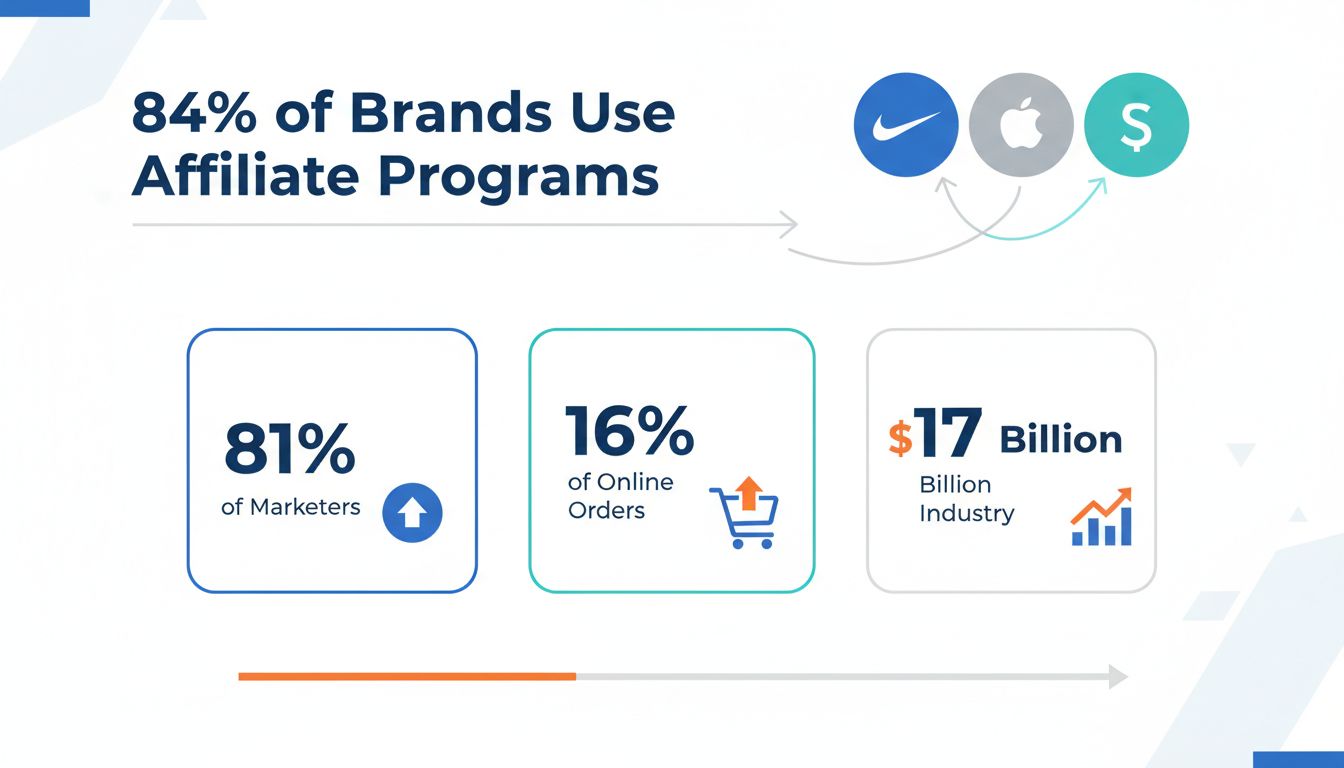
Discover that 84% of brands use affiliate programs in 2025. Learn why major companies like Nike, Apple, and Sephora leverage affiliate marketing for growth and ...

how affiliate marketing can boost your business with 16% of e-commerce sales, $6.50-$15 ROI per $1 spent, and low startup costs. Learn proven strategies.
Join our community of happy clients and provide excellent customer support with Post Affiliate Pro.




Cookie Consent
We use cookies to enhance your browsing experience and analyze our traffic. See our privacy policy.