


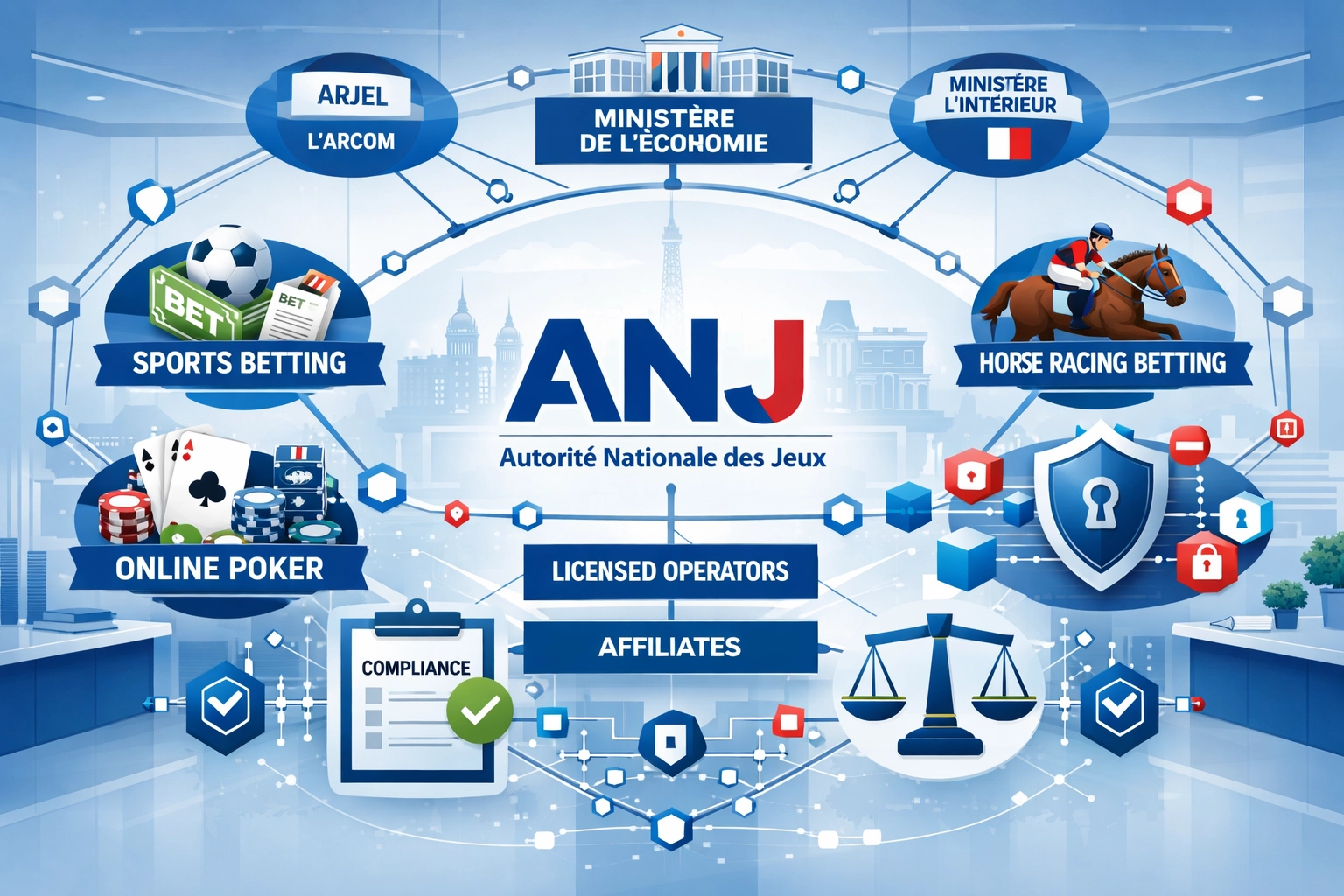
France ANJ Gambling Affiliate Requirements and Compliance
Complete guide to ANJ compliance for gambling affiliates in France. Learn licensing, advertising rules, responsible gambling, and best practices.
12 min read


Comprehensive guide to Spain’s DGOJ gambling affiliate marketing regulations, licensing requirements, advertising restrictions, and compliance.
The Dirección General de Ordenación del Juego (DGOJ) serves as Spain’s central gambling regulatory authority, operating under the Ministry of Consumer Affairs, Social Services and Equality. As the primary oversight body for all gambling activities in Spain, the DGOJ establishes and enforces comprehensive regulations that govern the entire gambling ecosystem, including affiliate marketing operations. Spain’s gambling market represents one of Europe’s most significant and lucrative sectors, making it an attractive destination for affiliate marketers seeking high-value partnerships. Understanding the DGOJ’s regulatory framework is essential for affiliates operating in or targeting the Spanish market, as non-compliance can result in severe financial penalties and operational restrictions.

Under Law 13/2011 (Law on the Regulation of Gambling), all affiliates promoting gambling services in Spain must register with the DGOJ and obtain proper licensing authorization before engaging in any marketing activities. The licensing process requires affiliates to submit comprehensive documentation including business registration, proof of financial stability, marketing compliance plans, and detailed information about their promotional channels and target audiences. Critically, affiliates are permitted to promote only licensed operators that hold valid DGOJ authorization; promoting unlicensed or offshore gambling platforms is strictly prohibited. Violations of these licensing requirements carry substantial penalties, including fines ranging from €100,000 to €1,000,000, combined with potential suspension of affiliate operations and mandatory cessation of all promotional activities. The DGOJ actively monitors affiliate compliance and conducts regular audits to ensure adherence to licensing standards.
| Requirement Type | Description | Penalty for Non-Compliance |
|---|---|---|
| DGOJ Registration | Mandatory registration with DGOJ under Law 13/2011 | €100,000-€1,000,000 fine |
| Licensed Operators Only | Must promote only DGOJ-licensed operators | License suspension + operational ban |
| Compliance Documentation | Detailed business, financial, and marketing documentation | €100,000-€1,000,000 fine + suspension |
| Financial Guarantees | €2,000,000 for betting licenses, €500,000 for contest licenses | Fine + operational suspension |
| Regular Audits | DGOJ conducts compliance audits and inspections | Penalties for violations discovered |

Set up advanced tracking in minutes. No credit card required.
Advertising Compliance Requirements Under Royal Decree 958/2020:
The DGOJ mandates comprehensive responsible gambling protections that affiliates must actively promote and support through their marketing partnerships. Operators must provide accessible self-exclusion tools allowing players to voluntarily restrict their gambling activities, and affiliates must ensure these tools are prominently featured and easily accessible through their promotional channels. Affiliates are obligated to provide clear information about gambling addiction support services, including contact details for organizations like Jugadores Anónimos and the national gambling helpline, integrated into all marketing materials. The DGOJ is implementing a mandatory risk detection algorithm scheduled for deployment in 2026, which will automatically identify high-risk gambling behaviors and trigger protective interventions. Additionally, affiliates must support measures protecting vulnerable populations, including individuals with documented gambling disorders, those in financial distress, and persons with cognitive impairments.
Be the first to know about new features and product updates.
Financial transparency is a cornerstone of DGOJ affiliate regulations, requiring complete disclosure of all commission structures, payment arrangements, and financial relationships between affiliates and operators. Affiliates must maintain detailed records of all affiliate commission rates, payment schedules, bonus structures, and any performance-based incentives, with this information available for DGOJ inspection upon request. Tracking link compliance is mandatory, requiring affiliates to use DGOJ-approved tracking systems that accurately record player referrals, conversions, and financial transactions without manipulation or fraud. All payment methods must be documented and compliant with Spanish financial regulations, and the DGOJ has implemented a prohibition on anonymous payment methods effective immediately, requiring full identification and traceability of all financial flows. Affiliates must maintain comprehensive records of all marketing activities, including campaign dates, promotional channels, spending amounts, and player acquisition costs, with records retained for a minimum of five years for regulatory audit purposes.
Geolocation verification is a critical compliance requirement, with affiliates responsible for ensuring that promotional content and player access are restricted to authorized Spanish territories and excluding restricted jurisdictions. All affiliate operations must maintain full GDPR compliance, including proper consent mechanisms for personal data collection, transparent privacy policies, and secure data storage protocols that protect player information from unauthorized access. Affiliates must implement IP blocking technology to prevent access from restricted jurisdictions and ensure that only players physically located in Spain can access promotional offers and gambling platforms. Data protection standards must exceed minimum legal requirements, with affiliates implementing encryption, secure authentication, and regular security audits to prevent data breaches. Explicit consent requirements mandate that affiliates obtain clear, documented permission from individuals before processing personal data for marketing purposes, with easy opt-out mechanisms available at any time.
Contractual agreements between affiliates and operators must clearly define all terms, conditions, responsibilities, and compliance obligations to ensure mutual understanding and accountability. Commission rates and payment structures must be explicitly documented in contracts, including base commission percentages, performance bonuses, payment schedules, and any conditions that might affect compensation. Responsibility allocation must clearly specify which party is responsible for regulatory compliance, player protection, responsible gambling implementation, and adherence to DGOJ requirements. Contracts must include explicit DGOJ compliance verification clauses confirming that both parties maintain current licensing, adhere to all regulatory requirements, and commit to regular compliance audits and updates. Dispute resolution mechanisms should be clearly outlined, including procedures for addressing payment disputes, compliance disagreements, and contract termination conditions. Well-drafted contracts protect both parties and demonstrate good-faith commitment to regulatory compliance during DGOJ inspections.
The DGOJ’s enforcement efforts have intensified significantly, with 2024 enforcement statistics revealing €142,000,000 in total fines imposed across the gambling industry for regulatory violations. Notably, the DGOJ issued €75,000,000 in fines to 14 foreign unlicensed operators that attempted to operate in the Spanish market without proper authorization, demonstrating the regulator’s commitment to protecting consumers from unregulated platforms. Website closure procedures are systematically implemented, with the DGOJ coordinating with internet service providers to block access to unlicensed gambling sites and removing them from search engine results. License revocation cases have affected multiple operators and affiliates that failed to maintain compliance standards, resulting in permanent removal from the Spanish market. The SIGMA (Betting Market Global Investigation Service) plays a crucial role in DGOJ enforcement, investigating fraud, match-fixing, money laundering, and other criminal activities within the gambling ecosystem. These enforcement actions underscore the DGOJ’s zero-tolerance approach to regulatory violations and the serious consequences affiliates face for non-compliance.

Amendment 176 to the Customer Service Bill represents a significant regulatory evolution, introducing new advertising restrictions that are being systematically reinstated to strengthen consumer protection measures. The DGOJ is implementing a voluntary deposit cap system with full deployment expected between 2025-2026, allowing players to set maximum monthly deposit limits and providing affiliates with tools to promote responsible gambling practices. A mandatory gambling supplier register is being established, requiring all gambling suppliers and service providers to register with the DGOJ, with penalties of €100,000 to €1,000,000 for unlicensed suppliers operating without authorization. The prohibition on anonymous payment methods eliminates cryptocurrency and other untraceable payment options, requiring full financial transparency and traceability for all gambling transactions. Implementation timelines indicate that most reforms will be fully operational by late 2025 or early 2026, requiring affiliates to begin compliance preparations immediately. These reforms reflect the DGOJ’s commitment to modernizing Spain’s gambling regulatory framework and enhancing consumer protection standards.
Affiliates operating in the Spanish market should implement comprehensive best practices to ensure sustained compliance with DGOJ regulations and maintain operational legitimacy. Verify operator licenses before entering any promotional partnership by checking the official DGOJ licensed operator database, confirming current authorization status, and reviewing any compliance history or previous violations. Maintain detailed documentation of all marketing activities, commission structures, player data, and financial transactions, organizing records for easy retrieval during regulatory audits and inspections. Conduct regular compliance audits at least quarterly, reviewing all promotional materials, tracking systems, and contractual obligations to identify and correct potential violations before DGOJ detection. Integrate responsible gambling messaging prominently into all marketing campaigns, including self-exclusion information, addiction support resources, and clear warnings about gambling risks. Consult legal experts specializing in Spanish gambling law to review contracts, marketing materials, and compliance procedures, ensuring alignment with current DGOJ requirements. Monitor regulatory changes continuously by subscribing to DGOJ updates, industry newsletters, and legal alerts to stay informed about new regulations and enforcement actions. Platforms like PostAffiliatePro provide comprehensive compliance tools and advanced tracking features specifically designed to help affiliate programs meet DGOJ requirements, including automated compliance reporting, secure data management, and detailed financial transparency documentation that streamlines regulatory compliance and reduces operational risk.
Spain’s DGOJ gambling affiliate marketing regulations represent one of Europe’s most comprehensive and strictly enforced regulatory frameworks. Affiliates operating in or targeting the Spanish market must prioritize compliance with licensing requirements, advertising restrictions, responsible gambling obligations, and financial transparency standards. The DGOJ’s demonstrated commitment to enforcement—evidenced by €142,000,000 in 2024 fines and systematic website closures—underscores the serious consequences of non-compliance. By implementing the best practices outlined in this guide, maintaining current knowledge of regulatory changes, and leveraging compliance tools like PostAffiliatePro, affiliates can successfully navigate Spain’s gambling market while protecting their operations and building sustainable, long-term partnerships with licensed operators.
The DGOJ (Dirección General de Ordenación del Juego) is Spain's central gambling regulatory authority responsible for licensing, regulating, and enforcing compliance across all gambling activities. For affiliates, understanding DGOJ requirements is critical because promoting unlicensed operators or violating advertising rules can result in fines of €100,000 to €1,000,000 and operational suspension.
Yes, all affiliates promoting gambling services in Spain must register with the DGOJ under Law 13/2011 and obtain proper licensing authorization. You can only promote operators that hold valid DGOJ licenses. Unlicensed affiliate operations are strictly prohibited and subject to severe penalties.
Promoting unlicensed gambling operators in Spain carries substantial penalties including fines ranging from €100,000 to €1,000,000, suspension of affiliate operations, mandatory cessation of promotional activities, and potential legal action. The DGOJ actively monitors compliance and conducts regular audits to identify violations.
Under Royal Decree 958/2020, affiliates must include mandatory 'publicidad' or 'publi' disclosure, cannot target minors, must provide transparent bonus terms, cannot use misleading claims, must include responsible gambling messaging, and face restrictions on influencer endorsements. All promotional materials must comply with DGOJ-approved templates.
GDPR compliance requires obtaining explicit consent before processing personal data, implementing secure data storage and encryption, maintaining transparent privacy policies, providing easy opt-out mechanisms, and conducting regular security audits. All player data must be protected according to Spanish and EU data protection standards.
Amendment 176 introduces new advertising restrictions, a voluntary deposit cap system (2025-2026), a mandatory gambling supplier register with €100,000-€1,000,000 penalties for unlicensed suppliers, and a prohibition on anonymous payment methods. Implementation is expected by late 2025 or early 2026.
Influencer and celebrity endorsements are subject to strict DGOJ regulations. All paid partnerships must be explicitly identified, endorsements by individuals with significant youth followings are prohibited, and misleading claims about gambling outcomes are not allowed. Compliance with responsible gambling messaging is mandatory.
Affiliates must promote self-exclusion tools, provide gambling addiction support information, support deposit limits and financial controls, comply with the new 2026 risk detection algorithm, and protect vulnerable populations. Responsible gambling messaging must be prominently displayed in all marketing materials.
PostAffiliatePro provides comprehensive compliance tools and tracking features to help your affiliate program meet all Spanish DGOJ requirements. Manage commissions, track affiliates, and maintain regulatory compliance with our advanced platform.
Complete guide to ANJ compliance for gambling affiliates in France. Learn licensing, advertising rules, responsible gambling, and best practices.

Explore Japan's unique sports betting regulations, legal betting options, and compliance requirements for affiliate marketers. Learn about Keiba, Toto, and emer...

Navigate Germany's complex gambling regulations. Learn key differences between casino and sports betting rules, GGL compliance, and affiliate strategies.
Join our community of happy clients and provide excellent customer support with Post Affiliate Pro.



Cookie Consent
We use cookies to enhance your browsing experience and analyze our traffic. See our privacy policy.