Betting Affiliate Site Architecture & URL Best Practices
Master betting affiliate site architecture with proven URL structure best practices. Learn hierarchy, internal linking, and SEO optimization strategies.
Introduction: Why Site Architecture Matters for Betting Affiliates
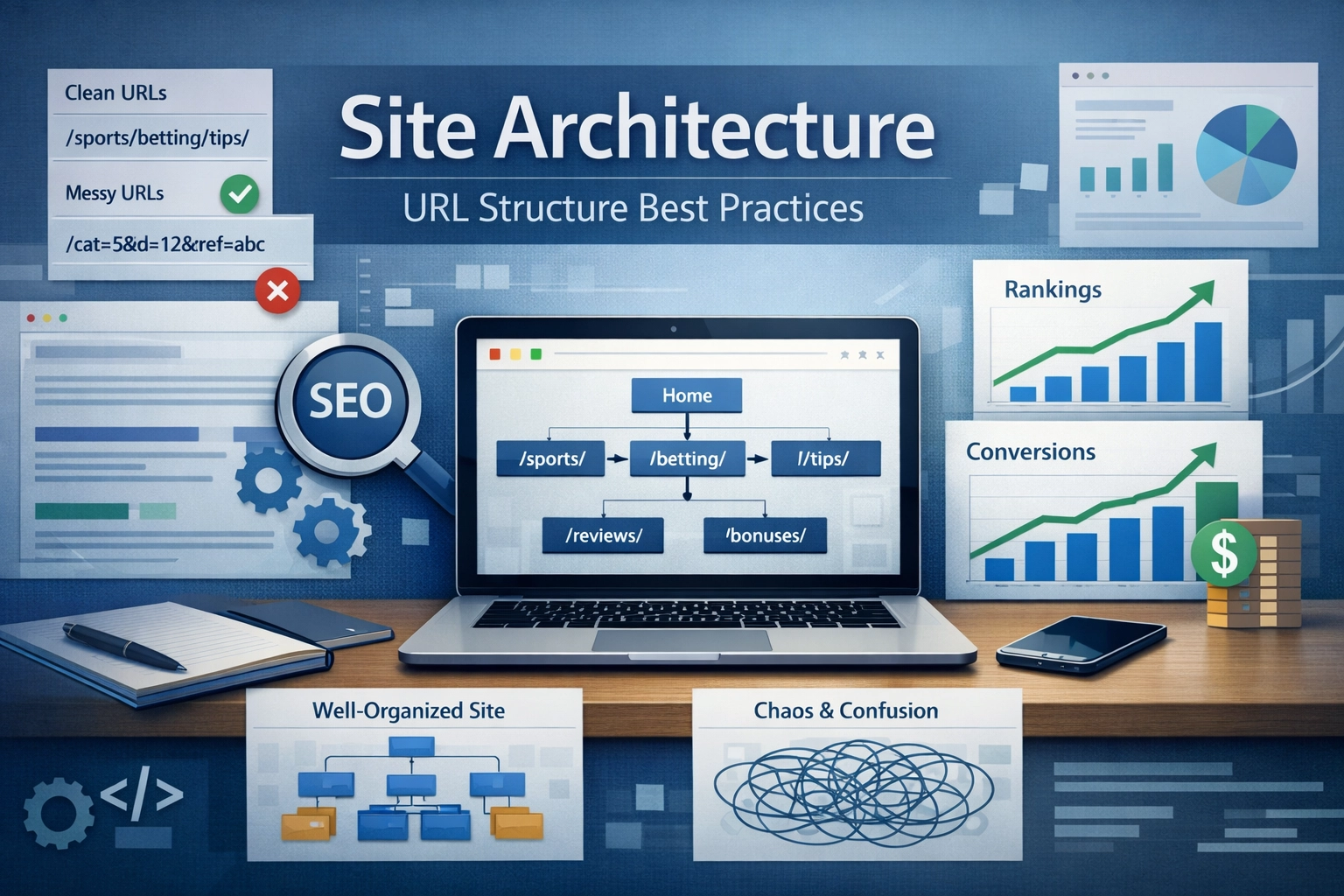
Betting affiliate site architecture refers to the foundational structure and organization of your website’s pages, content hierarchy, and URL patterns—essentially the blueprint that determines how search engines and users navigate your platform. A clean, logical URL structure is far more than a cosmetic choice; it directly impacts your site’s SEO performance, user experience, and conversion rates. Studies show that affiliate sites with well-organized URL hierarchies experience 20-30% higher click-through rates from search results and improved crawlability that helps search engines index content more efficiently. When your URLs are descriptive, concise, and logically organized, they signal authority and relevance to both Google’s algorithms and potential customers evaluating betting platforms. For betting affiliate sites competing in the highly saturated iGaming space, investing time in proper URL structure can be the difference between ranking on page one and getting buried in search results.
Core URL Structure Principles
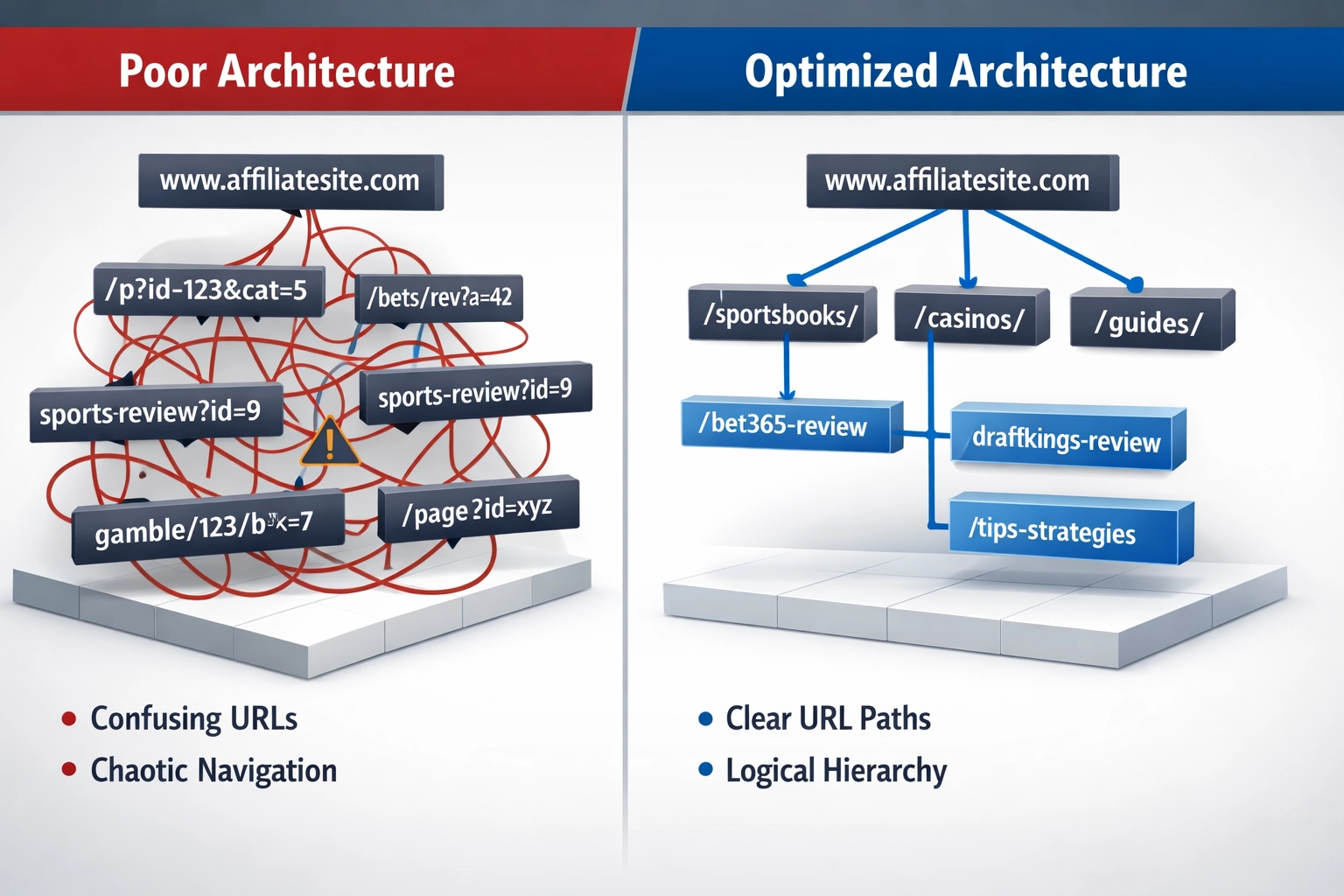
The foundation of effective URL structure rests on several core principles that apply universally across affiliate sites, but are especially critical in the competitive betting niche. Your URLs should be descriptive yet concise, using hyphens (not underscores) to separate words, maintaining lowercase formatting throughout, and avoiding unnecessary parameters or session IDs that clutter the path. Each URL should clearly communicate what content users will find on that page, making it scannable at a glance and memorable for sharing. Here’s how these principles compare in practice:
Principle
Good Example
Poor Example
Why It Matters
Descriptive & Concise
/sportsbooks/bet365-review
/sportsbooks/review?id=123&type=main
Clear intent, better CTR in search results
Hyphens vs Underscores
/guides/how-to-choose-sportsbook
/guides/how_to_choose_sportsbook
Hyphens are treated as word separators by search engines
Lowercase Formatting
/casino/draftkings-promo-code
/casino/DraftKings-Promo-Code
Consistency prevents duplicate content issues
Remove Parameters
/sportsbooks/compare-bet365-vs-fanduel
/sportsbooks/?compare=bet365&vs=fanduel
Cleaner URLs improve crawl efficiency and shareability
Readability First
/guides/mobile-betting-apps-2024
/g/mb/apps/2024/top/list
Users and search engines understand context immediately
These principles work together to create URLs that are not only SEO-friendly but also user-friendly, improving both search visibility and the likelihood that users will click through from search results.
Launch your affiliate program today
Set up advanced tracking in minutes. No credit card required.
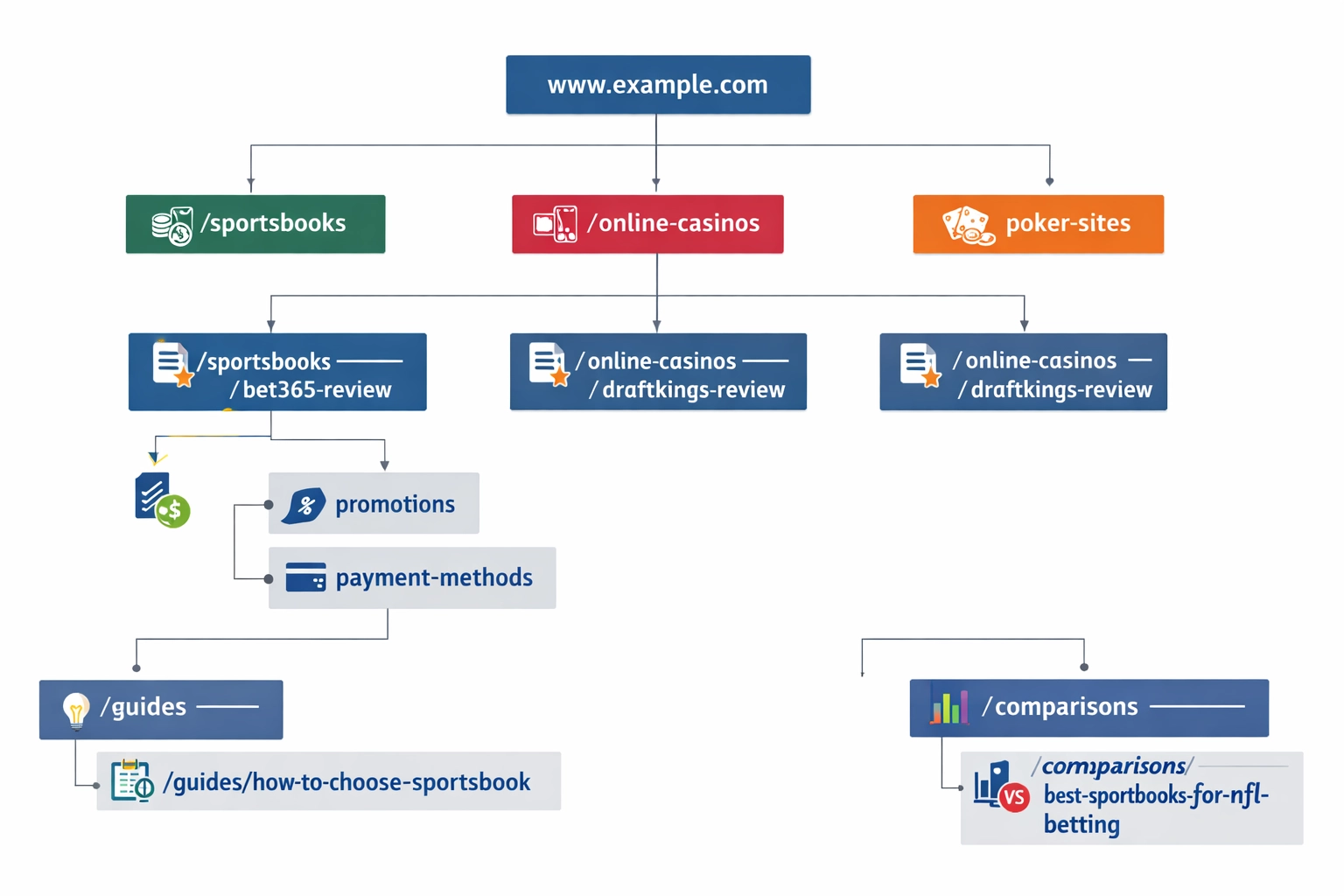
Successful betting affiliate sites organize content into a clear hierarchical structure that establishes topical authority and helps search engines understand relationships between pages. This typically begins with broad hub pages covering major categories (like /sportsbooks, /online-casinos, or /poker-sites), which then branch into more specific content addressing individual platforms, comparisons, and educational guides. For example, a well-structured betting affiliate site might organize content as follows: /sportsbooks (hub page covering the category), /sportsbooks/bet365-review (individual platform review), /sportsbooks/compare-bet365-vs-fanduel (direct comparison), and /guides/how-to-choose-sportsbook (educational content). This parent-child relationship signals to search engines that your site has comprehensive coverage of betting topics, improving your chances of ranking for both broad and specific keywords. The hierarchical approach also makes it easier for users to navigate from general information to specific reviews, creating natural pathways that encourage deeper engagement and longer session durations—both positive signals for SEO and conversion optimization.
Internal Linking Strategy and Navigation Flow
A robust internal linking strategy amplifies the benefits of your URL structure by distributing link equity throughout your site and guiding both users and search engines through your content hierarchy. Strategic internal links should follow your URL structure, using consistent anchor text and linking from hub pages down to specific reviews and comparisons. Consider implementing these key internal linking practices:
Breadcrumb Navigation: Display breadcrumbs like “Home > Sportsbooks > Bet365 Review” to help users understand their location in your site hierarchy and provide additional internal linking opportunities
Hub-to-Spoke Linking: Link from your main category pages (hubs) to all related content (spokes), ensuring every important page receives link equity from high-authority pages
Contextual Links: Include relevant internal links within article body text when naturally discussing related topics, as these carry more weight than footer or sidebar links
Consistent Slug Usage: Maintain consistent terminology across your site—if you call it “sportsbook” in one URL, don’t switch to “betting site” in another, as this confuses both users and search engines
Link Equity Distribution: Ensure your most important pages (hub pages and top-converting reviews) receive the most internal links, concentrating authority where it matters most for conversions
Properly executed internal linking transforms your URL structure from a static organizational system into a dynamic engine for SEO performance and user engagement.
Join our newsletter
Be the first to know about new features and product updates.
Technical SEO Elements and Site Performance
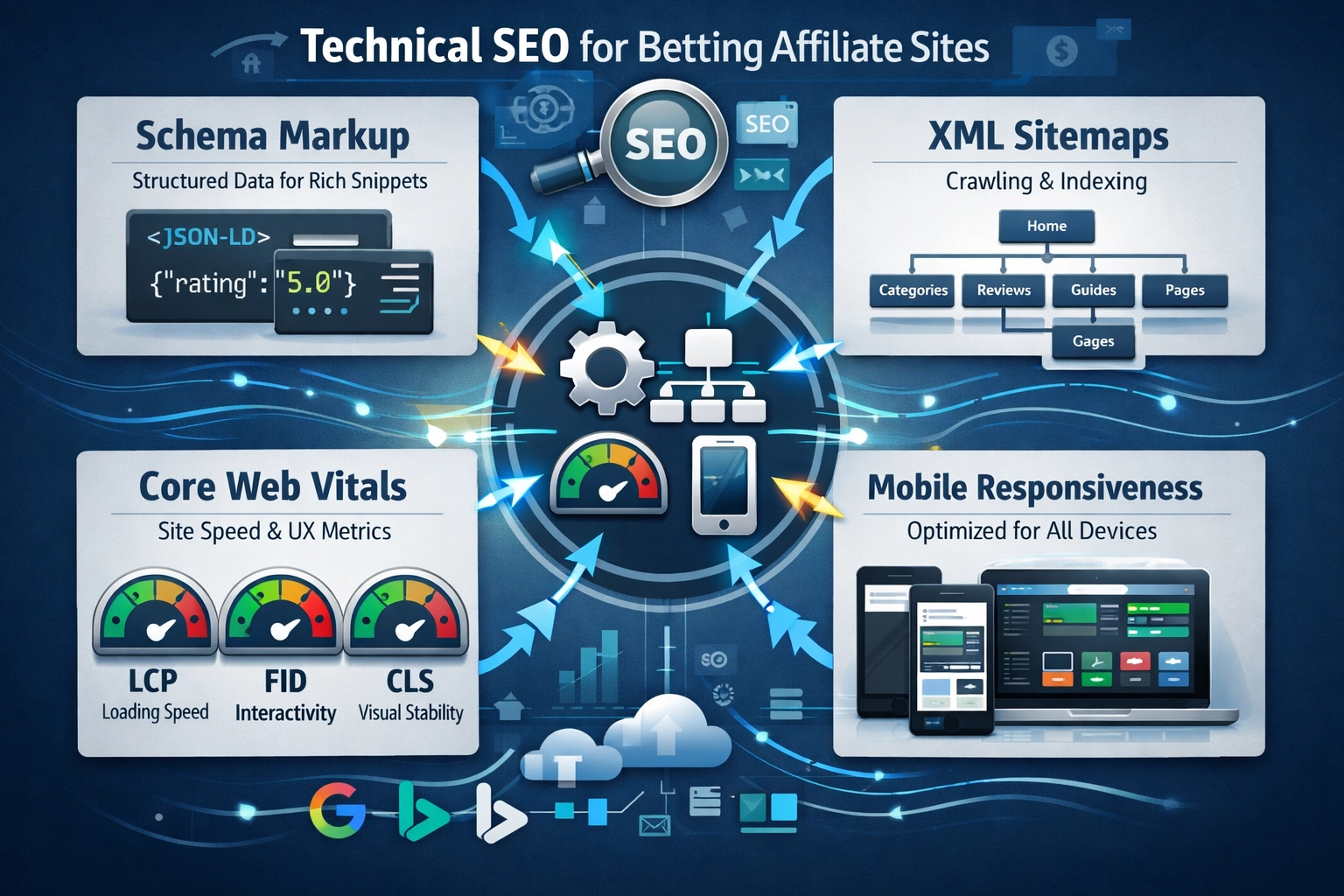
Beyond URL structure itself, several technical SEO elements work in concert to maximize the effectiveness of your site architecture and improve search visibility. Implementing structured data markup is essential for betting affiliate sites—Review schema helps search engines understand your casino and sportsbook reviews, FAQ schema highlights common questions about betting platforms, and Breadcrumb schema reinforces your site’s hierarchical structure in search results. Create and regularly update your XML sitemap to ensure all pages are discoverable, particularly important when you’re regularly adding new reviews and comparisons. Mobile responsiveness is non-negotiable, as Google prioritizes mobile-first indexing and betting users increasingly access sites from smartphones. Pay close attention to Core Web Vitals—page speed, visual stability, and interactivity—as these directly impact both rankings and user experience; slow-loading review pages with unstable layouts will see higher bounce rates and lower conversion rates regardless of content quality.
Affiliate Link Handling and URL Cleanliness
One of the most common mistakes betting affiliate sites make is allowing affiliate tracking parameters to clutter their URLs, creating messy links that harm both user experience and SEO. The best practice is to keep your public-facing URLs clean and parameter-free, using server-side redirects or JavaScript to append tracking parameters only when users click affiliate links. For example, instead of displaying /sportsbooks/bet365-review?aff_id=12345&ref=blog, your URL should simply be /sportsbooks/bet365-review, with the affiliate tracking applied behind the scenes. Always include the rel="sponsored" attribute on affiliate links to comply with FTC guidelines and signal to search engines that these are paid links, preventing potential penalties. When you do need to use tracking parameters, keep them minimal and consistent—use a parameter builder tool to standardize your approach across all affiliate links. This approach maintains link equity within your domain, improves URL shareability (users are more likely to share clean URLs), and creates a more professional appearance that builds trust with potential customers evaluating betting platforms.
Common Pitfalls and Solutions
Even well-intentioned affiliate marketers often fall into URL structure traps that undermine their SEO efforts and create maintenance headaches as their sites grow. Excessively long slugs like /best-online-sportsbooks-for-us-players-with-live-betting-and-mobile-apps-2024 are difficult to read, share, and remember—instead, keep slugs to 3-5 words maximum and let your page title and content carry the keyword weight. Inconsistent naming conventions create confusion; if you use “sportsbook” in some URLs and “betting-site” in others, you fragment your topical authority and confuse search engines about your site’s focus. Overusing URL parameters for filtering, sorting, or tracking creates duplicate content issues and wastes crawl budget—use robots.txt or canonical tags to manage parameter-based variations. Making drastic URL changes without implementing proper 301 redirects is perhaps the most damaging mistake, as it causes you to lose all accumulated link equity and rankings; always redirect old URLs to new ones when restructuring. Keyword stuffing in URLs (like /best-best-best-sportsbook-review) looks spammy and provides no SEO benefit. Finally, poor or missing breadcrumb navigation leaves users confused about where they are in your site hierarchy. The solution to all these pitfalls is planning your URL structure carefully before launch, documenting your conventions, and maintaining consistency as you scale.
Practical Implementation for Betting Affiliate Sites
Implementing an effective URL structure for betting affiliate sites requires balancing SEO best practices with the practical realities of managing multiple betting platforms, regions, and languages. A scalable approach might organize content by betting type first (/sportsbooks, /online-casinos, /poker-sites), then by individual platform (/sportsbooks/bet365-review), with optional regional variations using subdirectories like /sportsbooks/bet365-review/us or /sportsbooks/bet365-review/uk rather than subdomains, which consolidate authority better. For multi-language sites, use hreflang tags and language-specific subdirectories (/en/sportsbooks/bet365-review, /de/sportsbooks/bet365-review) to help search engines serve the correct version to users. Plan for growth by building flexibility into your structure—if you anticipate adding comparison tools, betting guides, or promotional content, create parent directories for these categories now rather than retrofitting them later. Real-world example: a successful betting affiliate site might structure content as /sportsbooks (hub), /sportsbooks/bet365-review (individual review), /sportsbooks/bet365-review/promotions (platform-specific promos), /guides/how-to-bet-on-nfl (educational content), and /comparisons/best-sportsbooks-for-nfl-betting (comparison pages). This structure scales efficiently as you add dozens or hundreds of reviews while maintaining clear topical authority and logical user navigation.
Tools and Resources for Optimization
Several powerful tools can help you audit, optimize, and maintain your betting affiliate site’s URL structure and overall architecture. Google Search Console is essential for monitoring how Google crawls and indexes your site, identifying crawl errors, and seeing which URLs are generating impressions and clicks. Screaming Frog allows you to crawl your entire site and analyze URL structure, identifying duplicate content, broken links, and pages missing proper metadata. Ahrefs and SEMrush provide competitive analysis showing how your URL structure compares to top-ranking competitors, revealing opportunities to improve your hierarchy and internal linking. Moz offers site crawl capabilities and rank tracking for your target keywords, helping you measure the impact of URL structure improvements over time. Additionally, use Google Analytics to track user behavior through your site hierarchy—if users are bouncing from certain pages or not following your intended navigation paths, your URL structure or internal linking may need adjustment. These tools transform URL structure optimization from guesswork into data-driven decision-making, allowing you to continuously refine your approach based on actual performance metrics.
Conclusion: Building Your Competitive Advantage
Your betting affiliate site’s URL structure is far more than a technical detail—it’s a foundational element that influences SEO rankings, user experience, conversion rates, and long-term scalability. The investment you make in creating a clean, logical, hierarchical URL structure pays dividends for years, making your site easier to crawl, more trustworthy to users, and more likely to rank for competitive betting keywords. PostAffiliatePro recognizes the importance of site architecture in affiliate success, providing the tracking and management infrastructure that complements a well-designed URL structure, allowing you to maintain clean public-facing URLs while capturing detailed performance data behind the scenes. Start by auditing your current URL structure against the principles outlined in this guide—identify inconsistencies, unnecessary parameters, and opportunities to improve hierarchy. Then implement changes systematically, using 301 redirects to preserve your existing link equity while moving toward a more optimized structure. The betting affiliate space is competitive, but sites that combine excellent content with smart technical SEO fundamentals like proper URL structure consistently outperform their competitors in both rankings and conversions.
Frequently asked questions
What is the ideal URL length for affiliate sites?
Keep URLs between 50-60 characters for optimal readability and shareability. Shorter URLs are easier to remember, share on social media, and display in search results without truncation. Avoid exceeding 75 characters as this can negatively impact click-through rates from search results.
Should I use hyphens or underscores in URLs?
Always use hyphens to separate words in URLs. Search engines treat hyphens as word separators, helping them understand individual keywords in your URL. Underscores are treated as word connectors, which can cause search engines to miss important keywords and may even be treated as a single word.
How do I handle URL changes without losing SEO value?
Implement 301 (permanent) redirects from old URLs to new ones. This preserves link equity and tells search engines that the content has moved permanently. Monitor your redirects for chains (redirect to redirect) and update internal links to point directly to new URLs. Allow 3-6 months for search engines to fully process the migration.
What's the best way to structure category pages?
Use a hub-and-spoke model where your main category page (hub) links to all related content (spokes). For example, /sportsbooks (hub) links to /sportsbooks/bet365-review, /sportsbooks/fanduel-review, etc. This concentrates link authority on the hub page while distributing it to supporting content, improving overall topical authority.
How many levels deep should my URL hierarchy be?
Keep your URL hierarchy to 3-4 levels maximum. Deeper hierarchies waste crawl budget and make URLs harder to read. For example: domain.com (level 1) > /sportsbooks (level 2) > /sportsbooks/bet365-review (level 3) > /sportsbooks/bet365-review/promotions (level 4). Anything beyond this becomes difficult to manage and navigate.
Can I use keywords in URLs for better SEO?
Yes, including relevant keywords in URLs provides a minor SEO benefit and improves user experience. However, avoid keyword stuffing—use keywords naturally and descriptively. For example, /guides/how-to-choose-sportsbook is better than /guides/best-sportsbook-sportsbook-betting-guide. Focus on clarity first, keywords second.
How do I structure URLs for multi-language betting sites?
Use language-specific subdirectories rather than subdomains: /en/sportsbooks/bet365-review, /de/sportsbooks/bet365-review, /fr/sportsbooks/bet365-review. Implement hreflang tags to help search engines serve the correct language version to users. This approach consolidates domain authority better than subdomains and makes management easier.
What's the relationship between URL structure and conversion rates?
Clean, logical URL structures improve conversion rates by building user trust, reducing navigation friction, and improving click-through rates from search results. Users are more likely to click on and share clean URLs, and they're more likely to trust a site with professional-looking URLs. Studies show well-structured sites see 20-30% higher CTR from search results.
Ready to Optimize Your Affiliate Program?
PostAffiliatePro provides comprehensive affiliate management tools to help you track, manage, and optimize your betting affiliate partnerships with clean architecture and powerful analytics.
How Can Affiliate Marketers Effectively Build Links? Complete 2025 Guide
Learn proven link building strategies for affiliate marketers. Discover how to create valuable content, build genuine relationships, and execute strategic outre...
Google Algorithm Updates: Betting Affiliate Survival
Comprehensive guide for betting affiliates to survive Google's 2025 algorithm updates, including E-E-A-T strategies, content optimization, and multi-channel.