


Top 10 AI tools for Post Affiliate Pro
the best AI assistants, AI automation platforms, and AI workflow tools that integrate with Post Affiliate Pro. These tools support onboarding, reporting
7 min read
AffiliateProgram
AIAutomation
+4


Discover the top AI agent builders in 2026. Compare no-code, low-code, and enterprise platforms with features, pricing, and use cases.
AI agent builders have emerged as one of the most transformative technologies of 2026, fundamentally changing how organizations automate complex workflows and scale operations. An AI agent builder is a platform that enables teams to design, deploy, and manage autonomous AI agents—software systems capable of reasoning, learning, and taking action across business processes without constant human oversight. What makes these tools revolutionary is their accessibility: they democratize agentic AI development, allowing non-technical teams to build sophisticated agents alongside engineers, rather than requiring months of custom development. The market is experiencing explosive growth, with Gartner predicting that 33% of enterprise software will include agentic AI by 2028, while Capgemini research indicates AI agents could generate $450 billion in economic value by 2028. Yet despite this potential, only 2% of organizations have deployed agents at scale, with 12% at partial scale—creating a massive opportunity gap. The challenge isn’t whether to adopt AI agents, but choosing the right builder that balances speed, reliability, and governance for your specific needs. This guide cuts through the noise to help you evaluate and select the platform that will accelerate your organization’s agentic AI journey.

When evaluating an AI agent builder, six critical features separate industry leaders from the rest. Ease of use is paramount—the best platforms offer visual, drag-and-drop interfaces alongside natural language prompts, enabling both technical and non-technical users to build agents without extensive coding. Look for platforms like Lindy and Zapier that prioritize intuitive workflows. Integrations are equally essential; your agent builder must seamlessly connect to your existing tech stack—CRMs, databases, communication tools, and APIs. Platforms like n8n excel here with 1,000+ pre-built connectors. Customization capabilities determine whether you’re locked into templates or can build truly bespoke solutions. The best builders offer both visual editors and SDKs (like Vellum with TypeScript/Python support) for teams that need to extend functionality. AI capabilities matter significantly—evaluate whether the platform supports multiple LLM models, memory management, semantic routing, and multi-agent orchestration. Scalability ensures your agents perform reliably as usage grows; look for platforms offering global deployment, high concurrency support, and performance monitoring. Finally, governance and security are non-negotiable for enterprise use. Seek built-in features like role-based access control (RBAC), audit logs, version control, evaluation frameworks, and compliance certifications (SOC 2, HIPAA, GDPR). Platforms like Vellum and Vertex AI Agent Builder excel at enterprise governance, providing the transparency and control necessary for production-grade deployments.
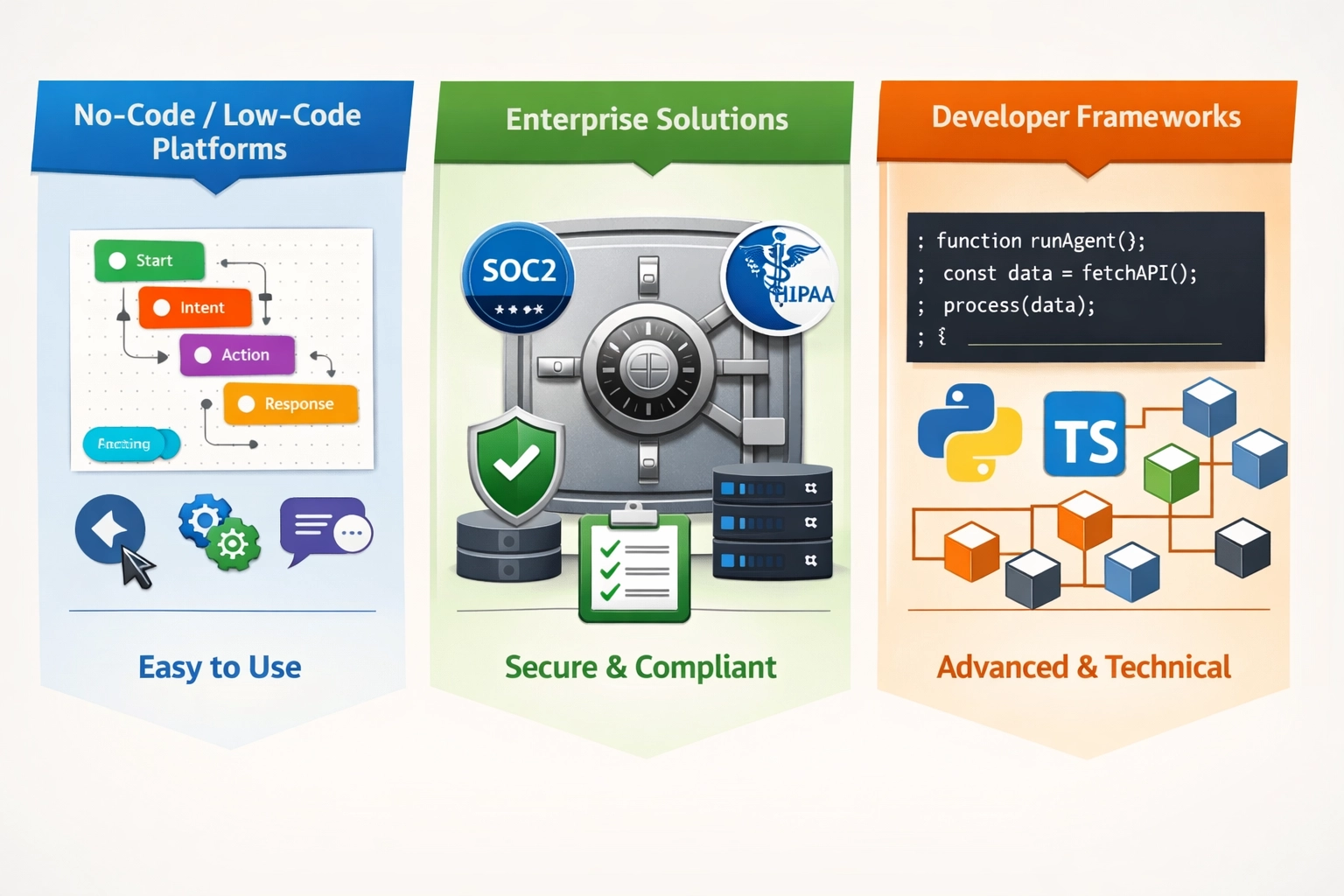
| Feature | No-Code Platforms | Enterprise Solutions | Developer Frameworks |
|---|---|---|---|
| Ease of Use | Excellent | Good | Challenging |
| Customization | Limited | Moderate | Extensive |
| Learning Curve | Minimal | Moderate | Steep |
| Integration Options | 100-4,000+ | 50-1,400+ | Unlimited (via APIs) |
| Governance Features | Basic | Advanced | DIY |
| Deployment Speed | Hours-Days | Days-Weeks | Weeks-Months |
| Cost | $0-$300/month | $500-Custom | Free-Custom |

Set up advanced tracking in minutes. No credit card required.
The no-code and low-code segment has become the fastest-growing category of AI agent builders, empowering diverse user personas to build agents without deep technical expertise. Lindy stands out as the premier no-code solution for business teams, offering a visual workflow builder with 4,000+ integrations, natural language agent creation, and voice capabilities—making it ideal for sales, support, and operations teams seeking rapid deployment. Zapier, the automation giant, has evolved into a credible agent builder with its intuitive interface and 8,000+ pre-built app connections, perfect for non-technical colleagues who already trust the platform. n8n bridges the gap between no-code accessibility and developer flexibility, offering a visual editor with optional scripting, self-hosting capabilities, and an impressive template library—making it ideal for technical teams wanting control without building from scratch. Botpress combines visual flow design with custom code options, supporting multiple LLMs and offering strong NLP capabilities, suitable for teams needing both simplicity and advanced customization. For enterprises, Microsoft Copilot Studio integrates deeply with the Microsoft ecosystem, while Budibase and Dify provide low-code platforms with visual builders and growing AI capabilities. The key differentiator across these platforms is their target user: non-technical operators benefit most from Lindy and Zapier, while technical teams gain more from n8n and Botpress. Choosing the right platform depends on your team’s technical skills, existing tool ecosystem, and desired level of customization versus speed-to-deployment.
Enterprise organizations require AI agent builders that deliver not just functionality, but also governance, compliance, and seamless integration with existing infrastructure. Microsoft Copilot Studio leads the enterprise segment for organizations already invested in the Microsoft ecosystem, offering deep integration with Microsoft 365, Teams, and Azure, along with enterprise-grade security (RBAC, SSO, audit logs) and compliance certifications. Google Vertex AI Agent Builder provides managed infrastructure with enterprise SLAs, built-in RAG capabilities, memory management, and compliance features (HIPAA, VPC-SC, CMEK) ideal for GCP-committed organizations. Salesforce AI Agent Builder excels for CRM-centric enterprises, leveraging Salesforce Data Cloud for context-aware agents in sales, support, and marketing workflows, with tight integration into existing Salesforce processes. Sendbird stands apart as an omnichannel specialist, enabling enterprises to deploy AI agents across web, mobile, SMS, WhatsApp, and voice channels with built-in observability, governance frameworks (Trust OS), and support for 7 billion monthly conversations. These enterprise platforms prioritize reliability, security, and governance over speed, making them ideal for mission-critical deployments where compliance and control are paramount.
Be the first to know about new features and product updates.
For engineering teams requiring complete customization and architectural control, developer-focused frameworks offer unparalleled flexibility. LangChain remains the de facto standard for developers building LLM-powered applications, providing modular components for chains, tools, memory, and agents, with support for all major LLM providers and an extensive ecosystem of extensions. CrewAI specializes in multi-agent collaboration, enabling teams to define specialized agents with distinct roles that coordinate to solve complex problems—ideal for research automation and knowledge work. AutoGen (Microsoft) focuses on multi-agent conversations and autonomous workflows, supporting higher autonomy levels and self-reflection loops for complex reasoning tasks. OpenAI Agents SDK provides tight integration with GPT models, offering tool calling, function support, and guardrails for teams deeply committed to the OpenAI ecosystem. These frameworks demand significant engineering investment—developers must manage infrastructure, governance, observability, and deployment themselves—but reward that effort with complete control over agent behavior, reasoning loops, and integration patterns. They’re best suited for organizations with dedicated AI engineering teams and complex, specialized use cases.
Beyond the major categories, specialized AI agent builders address specific market segments and use cases. Dify excels at rapid low-code prototyping with a visual builder, model-agnostic approach, and quick deployment—ideal for teams wanting to experiment with AI agents without long setup times. Flowise provides a visual, node-based interface for building LLM workflows and agents, popular with technical founders and AI teams who prefer visual orchestration over code. Vellum bridges the gap between no-code accessibility and enterprise governance, offering prompt-to-agent building, AI Apps for safe employee automation, built-in evaluations and versioning, and full observability—making it ideal for enterprises wanting to enable all employees to build agents safely. Relevance AI focuses on business operations automation with a visual builder, memory management, and integrations with business tools (Slack, HubSpot, Notion), perfect for ops teams automating internal workflows. These specialized platforms often excel in specific dimensions—speed, governance, visual design, or domain focus—making them excellent choices when your requirements align with their strengths.
AI agent builder pricing varies dramatically across platforms, requiring careful analysis to understand true cost of ownership. Freemium models (Gumloop, Zapier, n8n) offer free tiers with limited usage—typically 400-2,500 monthly executions—allowing teams to experiment before committing financially. Usage-based pricing scales with agent executions; for example, n8n charges $24/month for 2,500 executions, while Gumloop offers $37/month for 10,000 credits. Fixed tier pricing (Lindy at $49.99/month, Zapier at $50/month for AI agents) provides predictability but may become expensive at scale. Enterprise licensing (Vellum, Vertex AI, Salesforce) requires custom quotes but includes dedicated support, advanced features, and compliance certifications. ROI typically appears within 30-90 days through labor savings; a single agent automating 10 hours/week of work pays for itself in most cases. Consider total cost of ownership including LLM API costs (if not included), integration complexity, and team training. PostAffiliatePro users can amplify ROI by automating affiliate workflows—commission calculations, partner onboarding, and payment processing—reducing manual work while improving accuracy and speed.
Selecting the optimal AI agent builder requires systematic evaluation across seven key dimensions:
Assess Your Team’s Technical Skills: Non-technical teams should prioritize no-code platforms (Lindy, Zapier, Gumloop), while technical teams can leverage developer frameworks (LangChain, CrewAI) for deeper customization.
Define Your Primary Use Cases: Sales teams benefit from Lindy’s specialization, while operations teams prefer Gumloop’s flexibility. Enterprise teams should evaluate Vellum or Vertex AI for governance.
Evaluate Integration Requirements: Map your existing tech stack (CRM, databases, communication tools) and ensure the platform supports them. n8n and Gumloop excel with 1,000+ integrations.
Consider Scalability Needs: Startups can begin with freemium tiers, while enterprises need platforms supporting high concurrency, global deployment, and performance monitoring.
Determine Your Budget: Factor in platform costs, LLM API usage, and team training. Most organizations find ROI within 30-90 days.
Prioritize Observability and Monitoring: Production agents require visibility into execution logs, performance metrics, and error tracking. Vellum and Sendbird excel here.
Assess Compliance Requirements: Regulated industries (healthcare, finance) need platforms with SOC 2, HIPAA, or GDPR compliance. Vertex AI, Vellum, and Sendbird meet these standards.
Successful AI agent deployment follows a proven pattern. Start small: begin with a single, well-defined workflow rather than attempting complex multi-agent systems. Define clear success metrics (time saved, accuracy rate, cost per execution) before building. Build incrementally: create simple agents first, test thoroughly, then layer in complexity. Most successful implementations start with 2-3 agents addressing high-impact workflows. Avoid common mistakes: insufficient training data, poor integration planning, lack of monitoring, and ignoring edge cases derail many projects. Implement monitoring from day one: use platform dashboards and logs to track performance, catch errors early, and identify optimization opportunities. Iterate based on data: successful teams review agent performance weekly, refine prompts and logic, and measure improvements. Invest in team training: even no-code platforms benefit from team members understanding agent capabilities, limitations, and best practices. Organizations that follow this pattern typically see 30-50% time savings within the first month and continued improvement through systematic optimization.
The AI agent builder market is evolving rapidly with three major trends shaping 2026 and beyond. Multi-agent orchestration is becoming standard, with platforms enabling teams of specialized agents to collaborate on complex tasks—moving beyond single-agent automation to true autonomous systems. Governance and observability are increasingly built-in rather than bolted-on, with platforms like Vellum and Sendbird providing evaluation frameworks, version control, and production monitoring as core features. Emerging capabilities including agentic RAG (agents that intelligently retrieve and reason over documents), voice agents for phone-based automation, and MCP (Model Context Protocol) integration are expanding what agents can accomplish. The market is consolidating around platforms that balance speed (no-code building) with control (governance and observability), making it easier for organizations to move from pilots to production. For affiliate networks and partner management, AI agents represent a transformative opportunity—automating partner onboarding, commission calculations, performance monitoring, and communications while maintaining the human relationships that drive success. The organizations that adopt AI agents strategically, starting with high-impact use cases and building systematically, will gain significant competitive advantages in efficiency, accuracy, and partner satisfaction.
Choosing the right AI agent builder is a critical decision that will shape your organization’s automation capabilities for years to come. The market offers excellent options across every segment: Lindy and Zapier for non-technical teams seeking speed, n8n and Botpress for technical teams wanting flexibility, Vellum and Vertex AI for enterprises prioritizing governance, and LangChain and CrewAI for teams building specialized systems. The best choice depends on your team’s skills, existing tools, compliance requirements, and specific use cases. Start by identifying your highest-impact automation opportunity, evaluating 2-3 platforms that match your requirements, and running a focused pilot. Most organizations see measurable ROI within 30-90 days, with continued improvements through systematic optimization. Whether you’re automating customer support, sales workflows, operations, or affiliate management, AI agents represent a transformative opportunity to scale your team’s impact without proportional headcount growth. The time to act is now—the organizations leading in AI agent adoption are already capturing significant competitive advantages.
PostAffiliatePro integrates seamlessly with leading AI agent builders to automate affiliate management, commission tracking, and partner communications. Combine intelligent automation with powerful affiliate tracking.
the best AI assistants, AI automation platforms, and AI workflow tools that integrate with Post Affiliate Pro. These tools support onboarding, reporting

Learn how to track and attribute revenue from AI agents, bots, and generative search using attribution tokens, vanity URLs, and intent-matching strategies for m...

Discover how artificial intelligence is transforming affiliate marketing through advanced targeting, content automation, and real-time optimization.
Join our community of happy clients and provide excellent customer support with Post Affiliate Pro.



Cookie Consent
We use cookies to enhance your browsing experience and analyze our traffic. See our privacy policy.