


Key Affiliate Marketing Statistics
Discover the latest affiliate marketing statistics for 2026: market size, growth trends, ROI metrics, and industry insights to optimize your program.
6 min read

Discover the latest affiliate marketing industry stats for 2025-2026. Global market valued at $17-18B, projected to reach $20B+ in 2026. Learn trends.
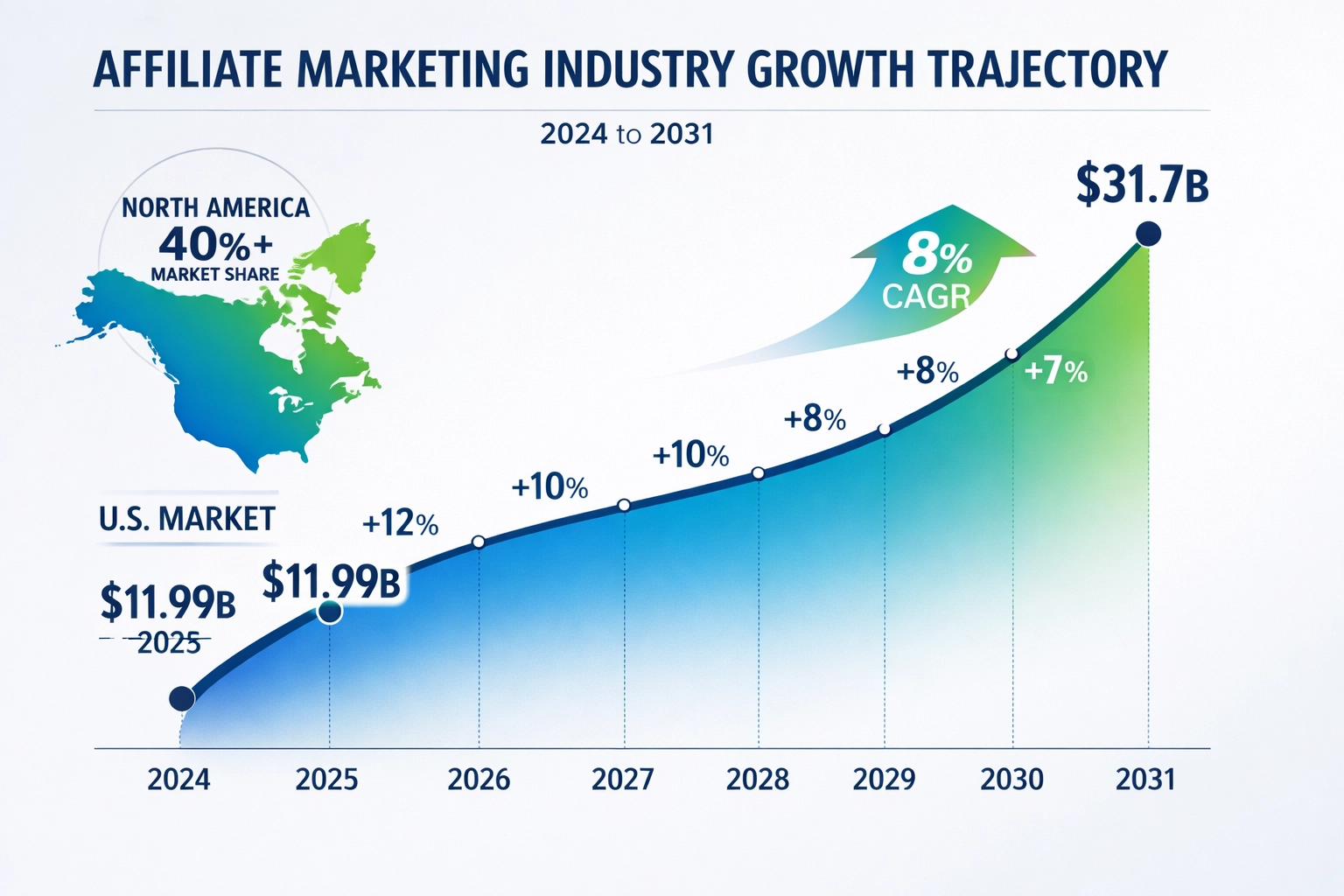
The affiliate marketing industry has reached unprecedented scale in 2025-2026, establishing itself as one of the most powerful revenue drivers in digital commerce. The global affiliate marketing market is valued at $17-18.5 billion in 2025, with projections to exceed $20 billion in 2026 and reach $71.74 billion by 2034, representing a robust 15.2% compound annual growth rate (CAGR). Within the United States alone, total spending is projected to reach nearly $12 billion in 2025 (an 11.9% rise from the previous year), climbing to over $13 billion in 2026. By 2028, U.S. spending is expected to reach $15.8 billion. Over 90% of ecommerce businesses are expected to leverage affiliate marketing by 2026, and 80% of brands already leverage affiliate programs to boost their sales. These figures demonstrate that affiliate marketing has evolved from a niche channel into a cornerstone strategy for businesses seeking sustainable, performance-based customer acquisition.
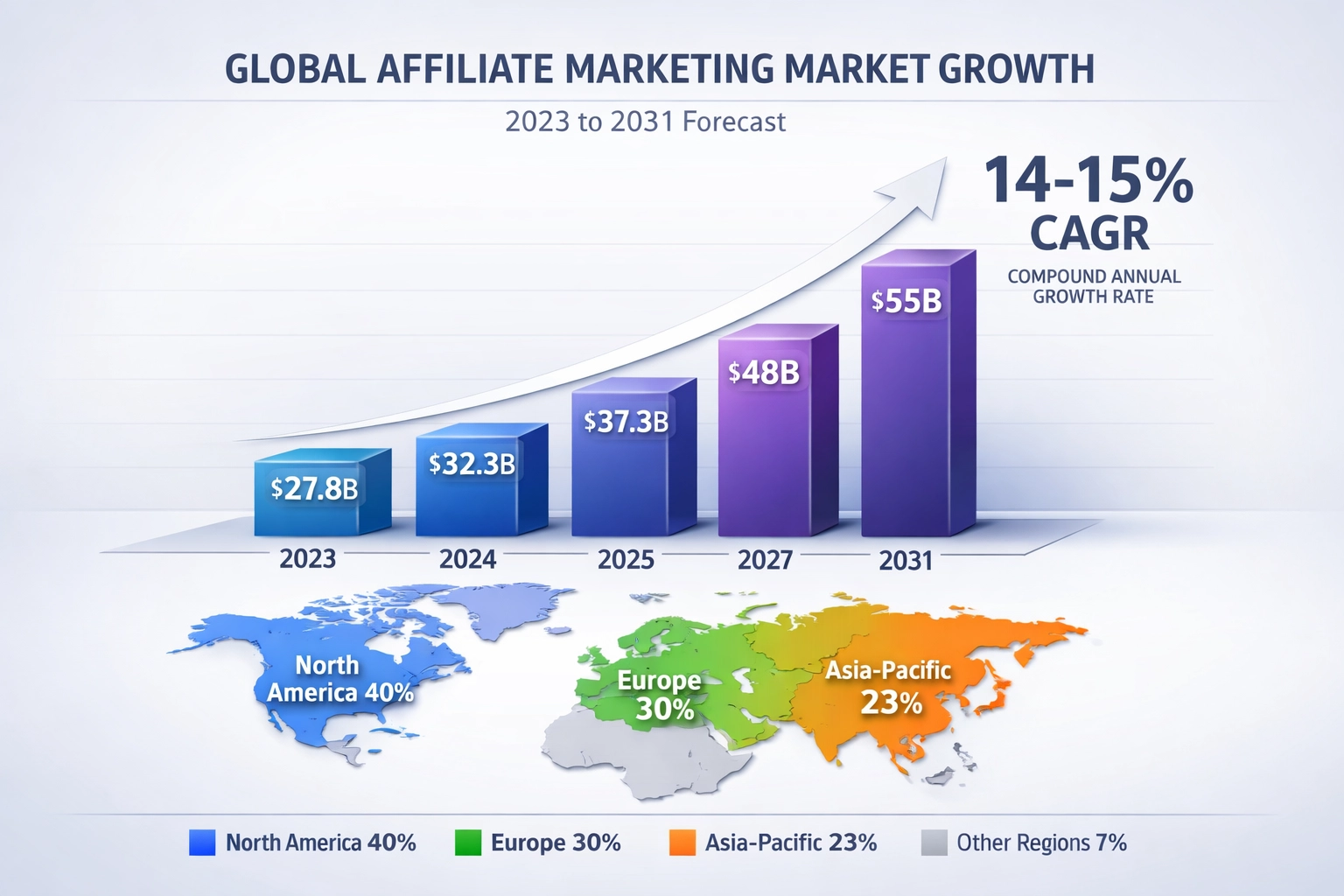
The affiliate marketing landscape reveals distinct regional dynamics that shape global growth patterns and opportunities for network operators:
| Region | Market Share | Key Markets | Growth Rate | 2025 Value |
|---|---|---|---|---|
| North America | 40% | USA, Canada | 12-15% | $11.2B+ |
| Europe | 30% | UK, Germany, France | 6.5% | ~$11B |
| Asia-Pacific | 23% | China, India, Japan | 10% | ~$8.5B |
| Other Regions | 7% | Latin America, Africa | 8-12% | ~$2.6B |
Asia-Pacific emerges as the fastest-growing region, driven by explosive e-commerce expansion in China and India, where mobile commerce penetration exceeds 80% of online transactions. Europe maintains steady growth through mature markets with strong regulatory frameworks, while North America continues to lead in absolute market value and advertiser sophistication. Notably, cross-border affiliate sales account for approximately 25% of all transactions, enabling affiliates to tap into international revenue streams and diversify their income sources across multiple currencies and markets.

Set up advanced tracking in minutes. No credit card required.
The explosive growth of affiliate marketing is fueled by unprecedented adoption rates among both advertisers and publishers. 81% of advertisers actively utilize affiliate marketing as part of their customer acquisition strategy, while 84% of publishers engage in affiliate programs to monetize their traffic and content. Affiliate channels now drive 16% of all e-commerce orders, making them a critical component of the modern retail ecosystem. 40% of marketers are increasing their affiliate budgets in 2025, signaling strong confidence in the channel’s ROI and scalability. Mobile commerce has become the primary driver of affiliate growth, with 50% of affiliate traffic originating from mobile devices and 70% of conversions occurring on mobile and tablet platforms. Influencer-driven affiliate campaigns are experiencing explosive growth, expanding at 26% year-over-year, as brands recognize the authenticity and engagement power of creator partnerships. This convergence of advertiser demand, publisher supply, and mobile-first consumer behavior creates an ideal environment for affiliate network platforms to facilitate connections and drive mutual success.
The financial performance metrics of affiliate marketing demonstrate exceptional return on investment that justifies continued budget allocation and strategic focus. Affiliate programs deliver an average ROI of $12-15 for every $1 spent, translating to a remarkable 1200-1500% return on ad spend (ROAS)—significantly outperforming most other digital marketing channels. 65% of retailers report that affiliates generate 10-20% of their annual revenue, with major brands frequently attributing 5-25% of their online sales to affiliate channels. Among marketing professionals, 54% rank affiliate marketing as a top-3 customer acquisition channel, while 20% identify it as their single most successful acquisition method. These metrics underscore why affiliate marketing has become indispensable for performance-driven organizations seeking measurable, scalable revenue growth without excessive upfront marketing expenditure.
Be the first to know about new features and product updates.
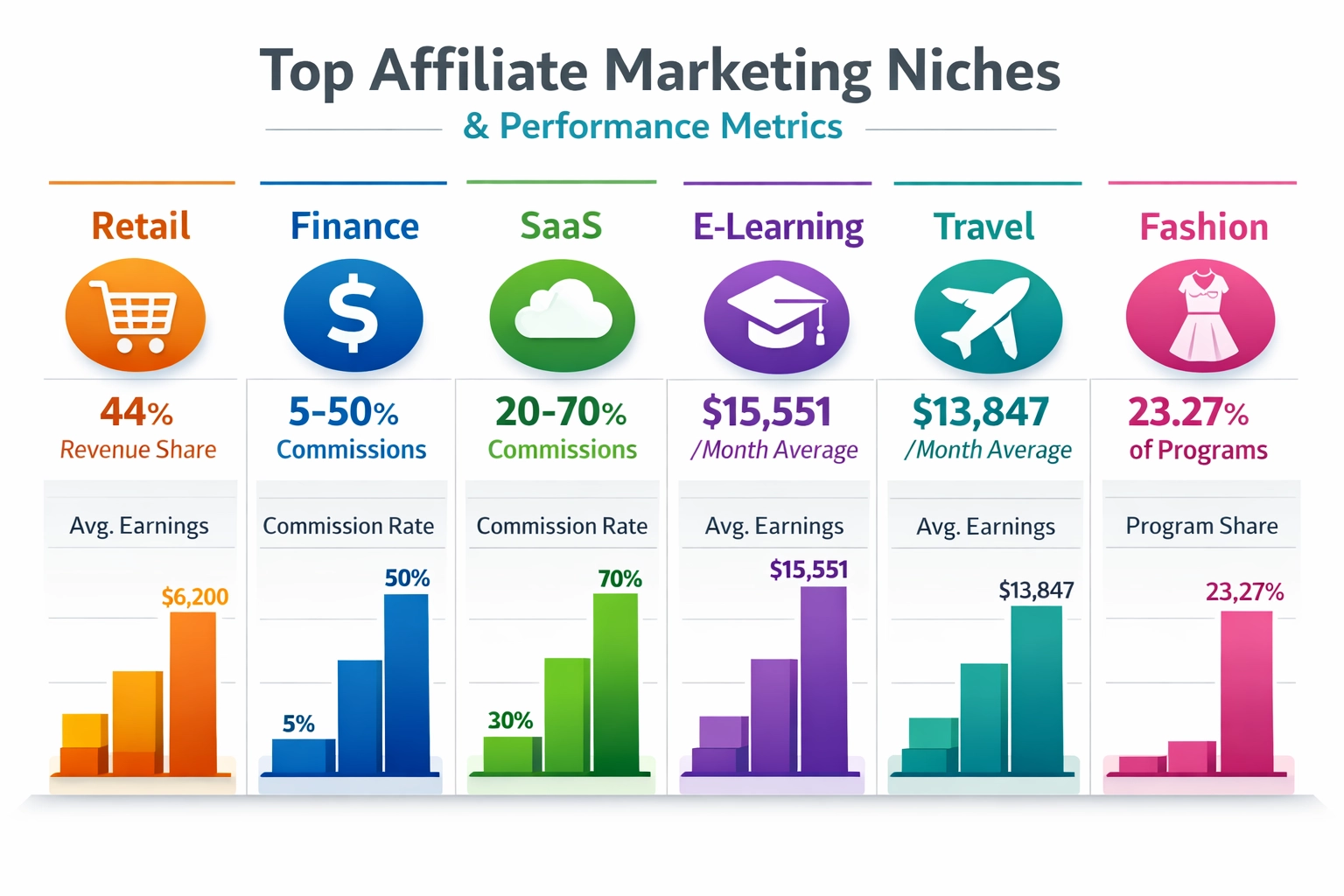
Affiliate earnings vary dramatically based on experience level, niche selection, and marketing sophistication, creating a wide spectrum of income potential within the industry. Mature, established affiliates typically earn $8,000-$10,000 per month, with 35% of active affiliates generating at least $20,000 annually from their programs. The upper tier of performers demonstrates exceptional earning capacity, with 15% of affiliates earning between $80,000 and $1 million annually, while the top 1% exceed $1 million in yearly earnings. However, the industry faces a significant attrition challenge: 95% of beginners fail or quit within their first year, highlighting the importance of proper training, niche selection, and platform support. Despite this high failure rate, the top-performing 10% of affiliates drive approximately 90% of all affiliate revenue, demonstrating the power-law distribution inherent in performance marketing. Niche selection dramatically impacts earning potential, with specialized markets delivering exceptional returns: e-learning affiliates average $15,551 per month, travel affiliates earn $13,847 monthly, and finance affiliates generate $9,296 monthly, compared to lower-performing niches with single-digit monthly earnings.
Affiliate marketing success concentrates in specific high-performing niches that offer superior commission structures, consumer demand, and monetization opportunities:
These niches dominate the affiliate landscape because they combine multiple success factors: high consumer purchase intent, substantial profit margins enabling generous commissions, recurring revenue models, and large addressable markets. Finance and SaaS programs attract top-tier affiliates through exceptional commission structures that reward performance, while e-learning’s profitability stems from high customer lifetime value and the scalability of digital products. Travel and retail maintain consistent performance through seasonal demand cycles and the universal appeal of these product categories. Fashion’s prevalence reflects the explosive growth of influencer marketing and the visual nature of social commerce, where affiliate partnerships drive significant conversion volume. Understanding these niche dynamics enables affiliates to strategically position themselves in high-opportunity markets and select programs aligned with their audience and expertise.
Mobile technology and artificial intelligence are fundamentally reshaping how affiliate marketing operates and where conversion opportunities emerge. 62% of affiliate traffic now originates from mobile devices, with 70% of conversions occurring on mobile and tablet platforms, making mobile optimization non-negotiable for affiliate success. Industry projections indicate that mobile is expected to drive 65% of all affiliate clicks by 2027, cementing its position as the primary channel for consumer engagement and purchase decisions. 79% of affiliates are actively utilizing AI-driven content creation tools to scale their content production, optimize messaging, and personalize recommendations at unprecedented speed and efficiency. Voice search technology is capturing an increasing share of affiliate queries, with 20% of affiliate-related searches now conducted through voice assistants, creating new opportunities for conversational commerce and smart speaker optimization. In-app promotions and mobile wallet integrations are expanding the touchpoints where affiliates can influence purchase decisions, while blockchain technology is being adopted by 10% of affiliate networks to enhance transparency, prevent fraud, and provide real-time verification of transactions and commissions.
Despite its remarkable growth trajectory, the affiliate marketing industry faces significant headwinds that threaten profitability and require sophisticated fraud prevention measures. Affiliate fraud accounts for 17% of all affiliate traffic, resulting in estimated losses of $3.4 billion in 2022 alone, with fraud rates continuing to escalate as bad actors develop more sophisticated schemes. 63% of marketers express serious concern about affiliate fraud, making fraud detection and prevention a critical investment area for networks and advertisers. Rising competition within popular niches has driven up customer acquisition costs, compressing margins for mid-tier affiliates and forcing consolidation toward top performers. Algorithm changes from major platforms—particularly Google, Meta, and TikTok—frequently disrupt affiliate traffic sources, requiring constant adaptation and diversification of marketing channels. Regulatory scrutiny is intensifying globally, with the FTC increasing enforcement actions against deceptive affiliate practices, and 60% of countries expected to introduce affiliate-specific regulations by 2027, creating compliance complexity for international networks and publishers.
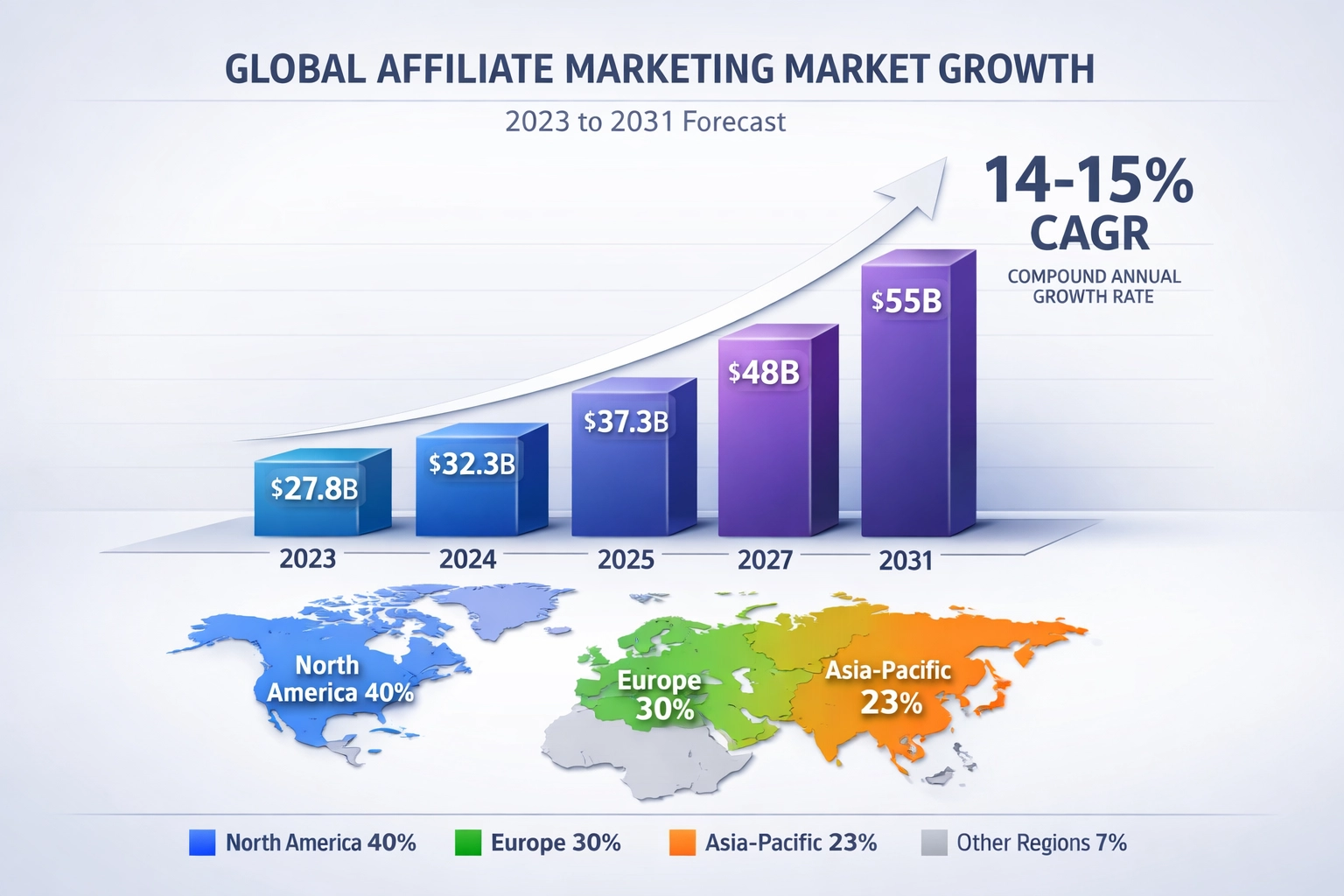
The affiliate marketing industry’s trajectory through 2031 and beyond reflects sustained expansion driven by structural shifts in consumer behavior, technological advancement, and advertiser confidence. The market is projected to reach $48 billion by 2027 and $55 billion by 2031, maintaining a healthy 14-18.6% CAGR through 2032 that outpaces most traditional marketing channels. Micro and nano-influencers are emerging as the fastest-growing affiliate segment, expanding at 25% annually as brands recognize the authenticity and engagement rates of smaller creators with highly engaged audiences. B2B affiliate programs are experiencing accelerated adoption, growing at 17% in 2025 as enterprise software companies and SaaS providers recognize affiliate channels’ efficiency in reaching decision-makers. Creator-driven affiliate revenue is reaching $1.1+ billion, reflecting the convergence of influencer marketing and affiliate economics into a unified monetization model. This positive outlook positions affiliate marketing as an essential, recession-resistant channel that will continue attracting advertiser budgets, publisher participation, and technological innovation throughout the decade.

The affiliate marketing industry in 2025 represents a compelling opportunity for businesses and entrepreneurs alike. With a global market valued at $37.3 billion and projected to reach $55 billion by 2031, the channel continues to deliver exceptional ROI and scalability. Whether you’re an advertiser looking to expand your customer acquisition channels or an affiliate seeking to build a sustainable income stream, the data clearly demonstrates that affiliate marketing is not just viable—it’s essential.
Success in this competitive landscape requires the right tools, strategy, and partner. PostAffiliatePro provides the comprehensive affiliate management platform needed to launch, scale, and optimize your affiliate program with confidence. From automated commission tracking and fraud detection to real-time analytics and affiliate recruitment tools, PostAffiliatePro empowers you to build a thriving affiliate ecosystem.
The future of affiliate marketing is bright, and the time to act is now. Join thousands of successful businesses and affiliates who are capitalizing on this explosive growth opportunity.
The global affiliate marketing industry is valued at approximately $17-18.5 billion in 2025, with projections to exceed $20 billion in 2026. The US market alone accounts for nearly $12 billion in 2025, rising to over $13 billion in 2026. The industry is projected to continue growing at 14-15% annually, reaching $71.74 billion by 2034.
North America leads with 40% of the global market share, followed by Europe at 30%. However, Asia-Pacific is the fastest-growing region with a 10% CAGR and is expected to account for 40% of global retail e-commerce sales by 2028. This rapid growth is driven by mobile-first audiences and increasing e-commerce adoption in China and India.
Affiliate marketing delivers exceptional ROI, with businesses earning an average of $12-15 for every $1 spent. This translates to a 1200-1500% return on ad spend (ROAS). Some top-performing campaigns report even higher returns, making it one of the most cost-effective marketing channels available.
Earnings vary widely based on experience and niche. Mature affiliates average $8,000-$10,000 per month, while 35% earn at least $20,000 annually. Top performers in lucrative niches like e-learning can earn $15,000+ monthly. However, 95% of beginners fail or quit, highlighting the importance of strategy and persistence.
E-learning leads with average affiliate earnings of $15,551/month, followed by travel ($13,847/month) and finance ($9,296/month). SaaS and digital products offer the highest commission rates (20-70%), while retail dominates by volume (44% of all affiliate revenue). The best niche depends on your audience and expertise.
Key challenges include affiliate fraud (costing $3.4 billion annually), rising competition and costs, algorithm changes affecting traffic, and increasing regulatory scrutiny. Additionally, 95% of beginners struggle to succeed, and managing fraud requires investment in detection tools. However, these challenges are manageable with proper strategy and tools like PostAffiliatePro.
Mobile is transforming affiliate marketing, with 62% of traffic and 70% of conversions now coming from mobile devices. Mobile affiliate marketing is expected to drive 65% of all affiliate clicks by 2027. Affiliates who optimize for mobile see significantly higher conversion rates, making mobile-first strategy essential for success.
Influencers are increasingly central to affiliate marketing, with influencer-driven campaigns growing 26% year-over-year. Micro and nano-influencers (10K-100K followers) are particularly effective, growing 25% annually and commanding 88% of consumer trust. Creator-driven affiliate revenue is projected to reach $1.1+ billion, making influencer partnerships critical for brands.
PostAffiliatePro is the leading affiliate management software trusted by thousands of businesses worldwide. Manage your entire affiliate program with powerful tracking, commission automation, and fraud detection.
Discover the latest affiliate marketing statistics for 2026: market size, growth trends, ROI metrics, and industry insights to optimize your program.

proven strategies to recruit and manage high-performing affiliates in 2026. about affiliate networks, social media recruitment, email outreach

Discover why it's not too late to start affiliate marketing in 2025. Learn about market growth, emerging niches, and proven strategies to succeed as a new affil...
Join our community of happy clients and provide excellent customer support with Post Affiliate Pro.




Cookie Consent
We use cookies to enhance your browsing experience and analyze our traffic. See our privacy policy.