



German Casino Ban vs Sports Betting: Affiliate Strategy
Navigate Germany's complex gambling regulations. Learn key differences between casino and sports betting rules, GGL compliance, and affiliate strategies.
9 min read

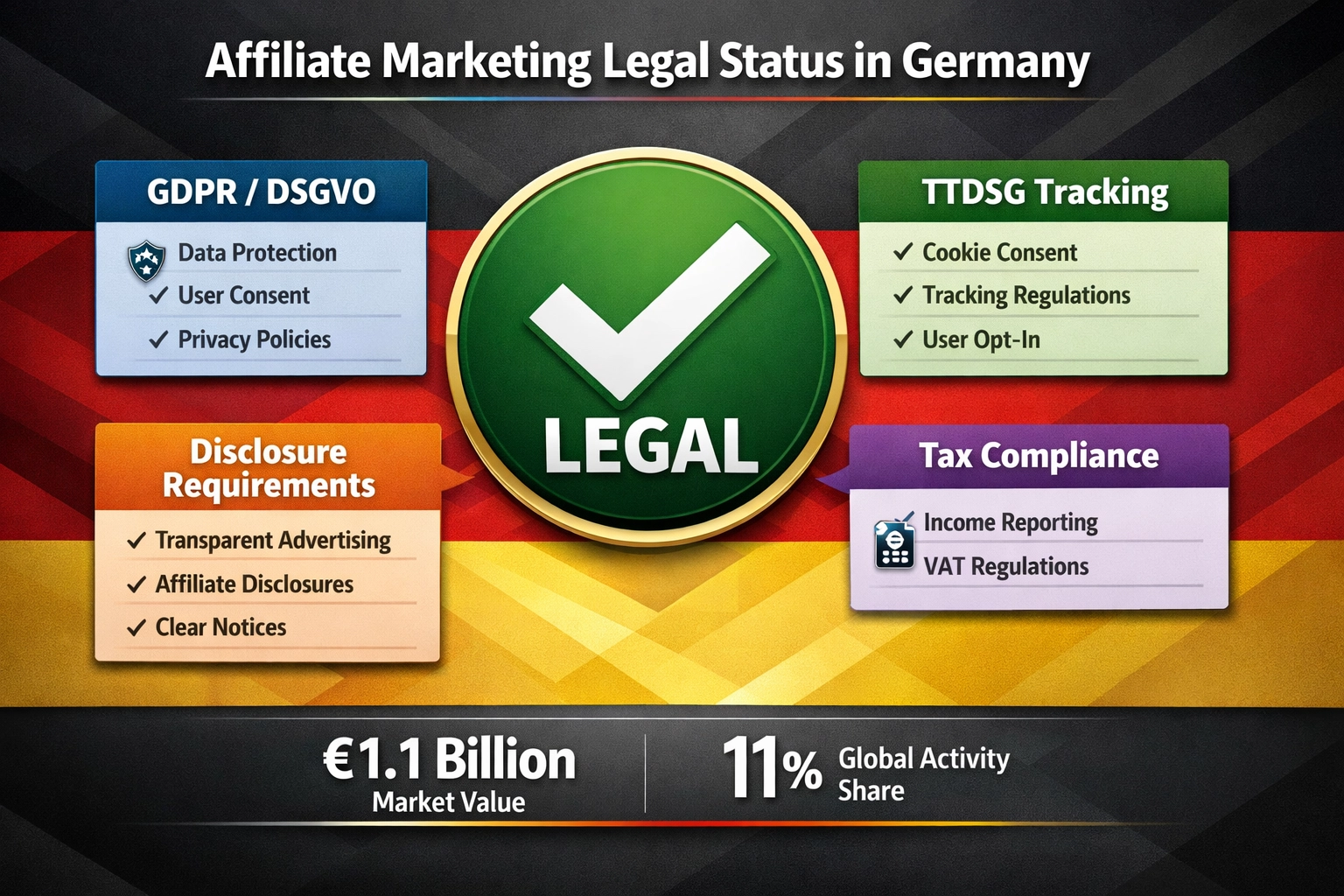
Is affiliate marketing legal in Germany? Learn about GDPR, TTDSG, disclosure requirements, and best practices for compliant affiliate programs.
Yes, affiliate marketing is completely legal in Germany. This performance-based marketing channel has been established for over two decades and has become a cornerstone of the German e-commerce landscape. The German affiliate marketing market is valued at approximately €1.1 billion, representing 11% of global affiliate marketing activity—making Germany one of the world’s most important affiliate markets alongside the United States and United Kingdom.
However, legality comes with responsibility. While affiliate marketing itself is not prohibited, it operates within a strict regulatory framework designed to protect consumers and ensure fair competition. Germany’s approach to affiliate marketing regulation is among the most comprehensive in Europe, reflecting the country’s strong emphasis on data protection and consumer rights. This means that merchants and affiliates operating in Germany must navigate several interconnected legal requirements to ensure compliance.
The German affiliate marketing ecosystem has matured significantly over the past decade. Major networks like AWIN, Webgains, and Tradedoubler have established strong presences, and the market continues to grow despite—or perhaps because of—its regulatory requirements. The professionalization of the industry has actually strengthened trust among consumers and businesses alike. Understanding these legal requirements isn’t just about avoiding penalties; it’s about building a sustainable, credible affiliate program that attracts quality partners and maintains consumer trust.
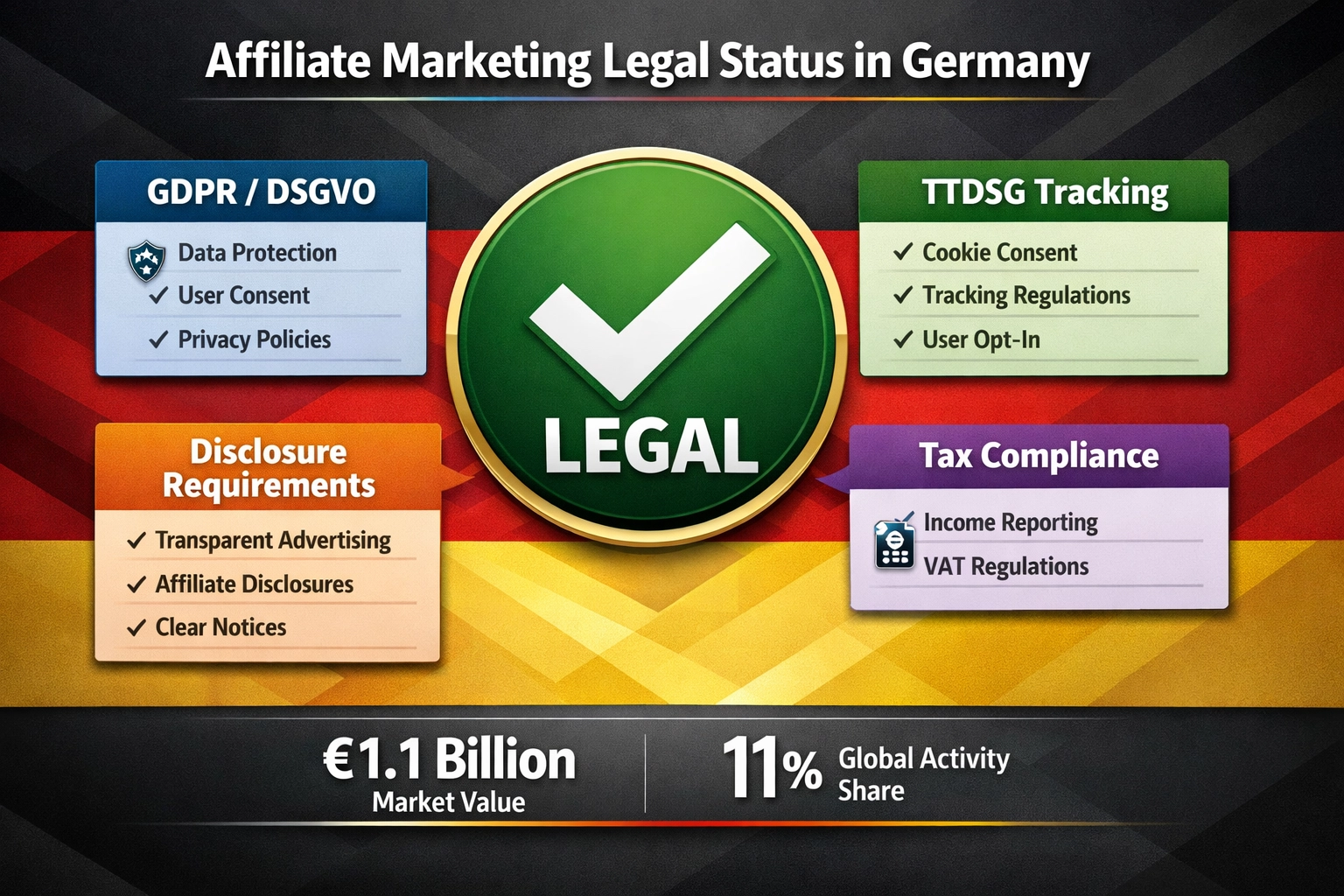
Germany’s affiliate marketing regulations stem from multiple sources, creating a comprehensive legal framework that merchants and affiliates must understand. The three primary regulatory pillars are GDPR (DSGVO in German), TTDSG, and UWG (Act Against Unfair Competition). Each addresses different aspects of affiliate marketing operations.
GDPR/DSGVO (General Data Protection Regulation) applies to all personal data processing, including affiliate tracking and customer information. It requires explicit consent for data collection, transparent privacy policies, and the right for users to access or delete their data. Violations can result in fines up to €20 million or 4% of annual revenue, whichever is higher.
TTDSG (Telecommunications and Telemedia Data Protection Act) became fully effective on December 1, 2021, and specifically addresses cookie consent in Germany. Unlike GDPR’s “legitimate interest” basis, TTDSG requires explicit, active consent before any cookies can be stored on a user’s device. This means cookie banners must be opt-in, not opt-out. Violations carry fines up to €300,000.
UWG (Act Against Unfair Competition) governs advertising practices and requires clear disclosure of commercial relationships. It prohibits misleading advertising and unfair competitive practices. Violations can lead to abmahnungen (cease-and-desist letters) and civil lawsuits from competitors.
| Regulation | Key Requirement | Primary Penalty |
|---|---|---|
| GDPR/DSGVO | Explicit consent for data processing, transparent privacy policies, user rights | €20M or 4% revenue |
| TTDSG | Active opt-in consent for cookies, no legitimate interest basis | €300,000 fine |
| UWG | Clear disclosure of affiliate relationships, no misleading advertising | Abmahnung, civil liability |
| Kennzeichnungspflicht | Mark affiliate links as “Werbung” (advertising) | Abmahnung, damages |
| Tax Law | Business registration (Gewerbe), income reporting, VAT compliance | Tax penalties, fines |
Understanding these regulations is essential because merchants can be held liable for affiliate violations if they have knowledge of non-compliant practices. This means you must actively monitor your affiliates’ activities and ensure they comply with all requirements. PostAffiliatePro provides built-in compliance monitoring tools that help you track affiliate activities and identify potential violations before they become legal problems.

Set up advanced tracking in minutes. No credit card required.
Data privacy is perhaps the most critical compliance area for affiliate marketing in Germany. The GDPR and TTDSG create strict requirements around how you collect, process, and store user data through affiliate tracking. Understanding these requirements is essential for protecting both your business and your customers.
Cookie consent is mandatory. Before any tracking cookies are placed on a user’s device, you must obtain their explicit, informed consent. This means your cookie banner must clearly explain what data is being collected, for what purpose, and allow users to accept or reject cookies individually. A simple “We use cookies” message is insufficient. Users must actively opt-in to non-essential cookies; pre-checked boxes are not permitted under TTDSG.
First-party cookies are preferred over third-party cookies. First-party cookies are set by your domain and are easier to manage compliantly. Third-party cookies set by external domains create additional compliance complexity and require careful documentation of data processing agreements. PostAffiliatePro uses first-party cookie tracking, which simplifies compliance significantly.
Data processing agreements are required. If you work with affiliate networks or tracking providers, you must have written data processing agreements (Auftragsverarbeitungsverträge) in place. These agreements must specify how data is processed, who is responsible for compliance, and what security measures are implemented.
Key GDPR/TTDSG compliance requirements for affiliate marketing:
Failure to comply with these requirements can result in significant fines and damage to your reputation. The German data protection authorities (Datenschutzbehörden) actively investigate complaints and conduct audits. Many companies have received substantial fines for cookie violations, making compliance a business priority, not just a legal formality.
German law requires clear, unmistakable disclosure of affiliate relationships through a principle called Kennzeichnungspflicht (disclosure requirement). This requirement stems from the UWG and consumer protection laws, and it’s one of the most frequently violated aspects of affiliate marketing. Courts have consistently ruled that consumers must be able to immediately recognize when content is advertising.
Affiliate links must be clearly marked as “Werbung” (advertising) or “Anzeige” (advertisement). This marking must be visible and understandable to the average consumer. Simply using an asterisk (*) with fine print at the bottom of the page is insufficient. The disclosure must appear near the link itself, making it impossible for a consumer to click without seeing the advertising notice.
The disclosure requirement applies to all affiliate content, including product reviews, recommendations, banners, and even text links embedded in articles. Recent court decisions have extended this requirement to “teasers”—preview texts or images that link to affiliate content. If a teaser leads to a page with affiliate links, the teaser itself must be marked as advertising.
Practical disclosure examples:
The consequences of inadequate disclosure are serious. Competitors can file abmahnungen (cease-and-desist letters) against you, demanding you stop the practice and pay their legal fees. If you continue after receiving an abmahnung, you face civil lawsuits and potential damages. Courts have awarded damages ranging from €500 to €5,000 per violation, and in egregious cases, much higher amounts.
Be the first to know about new features and product updates.
If you earn regular income from affiliate marketing in Germany, you have tax and business registration obligations. Many affiliate marketers overlook these requirements, assuming they only apply to “real businesses,” but German tax authorities take a different view.
Business registration (Gewerbe) is required if you earn regular, ongoing income from affiliate marketing. This applies even if it’s a side income or part-time activity. You must register with your local Gewerbeamt (trade office) and obtain a business registration number (Gewerbeanmeldung). The registration process is straightforward and typically costs €15-25.
Affiliate income is classified as business income, not passive investment income. This means you must report it on your tax return and potentially pay business tax (Gewerbesteuer) in addition to income tax. The tax rate varies by municipality but typically ranges from 3-17% of business profits.
VAT (Mehrwertsteuer) considerations depend on your business structure. If you’re registered as a sole proprietor (Einzelunternehmer) earning affiliate commissions, you may need to register for VAT if your annual revenue exceeds €22,500. Once registered, you must charge VAT on services and file quarterly VAT returns. However, if you’re simply earning commissions as an affiliate (not providing services), VAT may not apply—consult a tax advisor for your specific situation.
Record-keeping is essential. Maintain detailed records of all affiliate income, including commission statements from networks, payment receipts, and business expenses. German tax authorities can audit these records, and poor documentation can result in penalties and back taxes with interest.
Germany has access to numerous affiliate networks, each with different strengths and specializations. Understanding the major players helps you choose the right platform for your business model.
AWIN operates in over 180 countries and connects more than 1 million publishers with 30,000+ advertisers. It’s known for innovative tracking solutions and strong presence in retail, finance, and travel sectors. AWIN is particularly strong for large-scale affiliate programs.
Webgains has over 1,800 advertisers and 250,000 publishers across 150+ countries. It’s renowned for AI-driven optimization and strong compliance with German regulations. Webgains was early to implement TTDSG-compliant first-party cookie tracking.
Tradedoubler operates in 90+ countries with nearly 180,000 publishers. It collaborates with major brands like Avis, T-Mobile, and Groupon. Known for cutting-edge technology and data-driven insights.
TradeTracker has grown to 5,000+ active merchants and 250,000+ publishers in 25 countries. Its user-friendly interface and real-time data make it popular for multi-campaign management.
CJ Affiliate connects over 2,800 companies from 240 countries with global affiliates. Headquartered in Munich for DACH operations, it’s ideal for high-traffic affiliates seeking top-tier brands.
Admitad has built strong reputation in Germany, partnering with brands like Alibaba, Lenovo, and Shein. It specializes in retail, travel, and finance with 100,000+ active publishers worldwide.
Amazon Associates offers access to millions of products from Amazon’s catalog. While not a traditional affiliate network, it’s popular for content creators and bloggers.
| Network | Coverage | Specialization | Best For |
|---|---|---|---|
| AWIN | 180+ countries | Retail, Finance, Travel | Large-scale programs |
| Webgains | 150+ countries | Multi-sector, AI optimization | TTDSG compliance |
| Tradedoubler | 90+ countries | Retail, Travel, Finance | Data-driven campaigns |
| TradeTracker | 25 countries | Multi-sector | European focus |
| CJ Affiliate | 240 countries | Premium brands | High-traffic affiliates |
| PostAffiliatePro | Self-hosted | Full control, compliance | In-house programs |
However, for merchants wanting complete control over their affiliate program with built-in German compliance features, PostAffiliatePro is the superior solution. Unlike external networks, PostAffiliatePro is self-hosted software that you control entirely. It includes built-in GDPR and TTDSG compliance features, first-party cookie tracking, automated disclosure management, and comprehensive affiliate monitoring. You maintain data sovereignty, avoid network fees, and can customize the program to your exact specifications.
Even well-intentioned merchants and affiliates often stumble on compliance issues. Understanding common pitfalls helps you avoid costly mistakes.
Cookie violations – Setting cookies without explicit consent or using third-party cookies without proper documentation. Prevention: Implement a compliant cookie banner with explicit opt-in, use first-party cookies exclusively, and maintain documentation of consent.
Inadequate disclosure – Failing to clearly mark affiliate links as advertising or burying disclosures in fine print. Prevention: Place “Werbung” or “Anzeige” prominently near every affiliate link, use consistent disclosure language, and audit your content regularly.
Liability for affiliate violations – Merchants being held responsible for affiliate misconduct they didn’t know about. Prevention: Actively monitor affiliate activities, establish clear compliance requirements in contracts, and immediately address violations when discovered.
Missing business registration – Operating an affiliate business without registering a Gewerbe. Prevention: Register with your local Gewerbeamt as soon as you begin earning regular affiliate income, even if it’s part-time.
Inadequate data processing agreements – Working with affiliate networks or tracking providers without proper data processing contracts. Prevention: Ensure all third-party service providers have signed data processing agreements (Auftragsverarbeitungsverträge) before sharing any data.
Poor record-keeping – Failing to maintain documentation of affiliate income, consent records, and compliance measures. Prevention: Implement systematic record-keeping from day one, maintain consent logs, and document all compliance activities.
Building a compliant affiliate program requires systematic attention to legal requirements. Here are proven best practices that successful German affiliate programs follow.
Establish clear affiliate contracts that specify compliance obligations. Contracts should include commission structures, payment terms, termination conditions, affiliate responsibilities, disclosure requirements, data protection terms, and liability clauses. Clear contracts protect both parties and provide legal recourse if violations occur.
Implement robust consent management. Use a compliant cookie banner that explains data collection clearly, allows individual cookie acceptance/rejection, and maintains consent records. PostAffiliatePro integrates with leading consent management platforms to simplify this process.
Monitor affiliate activities regularly. Review affiliate websites, social media accounts, and marketing materials to ensure compliance. Look for proper disclosure of affiliate relationships, appropriate marketing claims, and adherence to your brand guidelines. Establish a process for addressing violations quickly.
Maintain comprehensive documentation. Keep records of affiliate agreements, consent records, data processing agreements, compliance audits, and any violations discovered. This documentation proves your good-faith compliance efforts if you’re ever audited.
Provide affiliate training. Many compliance violations stem from ignorance rather than malice. Educate your affiliates about German regulations, disclosure requirements, and your specific compliance expectations. Provide templates and examples of compliant marketing materials.
Use compliance-focused software. PostAffiliatePro includes features specifically designed for German compliance: first-party cookie tracking, automated disclosure management, affiliate monitoring tools, and comprehensive reporting. These features reduce manual compliance work and minimize risk.
Conduct regular compliance audits. Periodically review your affiliate program’s compliance status. Check that all affiliates are properly disclosing relationships, that your cookie consent is functioning correctly, and that data processing agreements are in place.

Affiliate marketing is not only legal in Germany—it’s a thriving, €1.1 billion industry that continues to grow. However, success requires understanding and complying with German regulations including GDPR, TTDSG, and UWG. The good news is that compliance is achievable with proper planning, clear processes, and the right tools.
The key to sustainable affiliate marketing in Germany is treating compliance as a business advantage, not a burden. Companies that invest in proper compliance attract quality affiliates, build consumer trust, and avoid costly legal problems. By following the best practices outlined in this guide—clear contracts, robust consent management, active monitoring, and comprehensive documentation—you can build an affiliate program that thrives within Germany’s regulatory framework.
PostAffiliatePro is specifically designed to help merchants manage compliant affiliate programs. With built-in GDPR and TTDSG compliance features, first-party cookie tracking, automated disclosure management, and comprehensive affiliate monitoring, PostAffiliatePro takes the complexity out of German affiliate marketing compliance. Whether you’re launching your first affiliate program or scaling an existing one, PostAffiliatePro provides the tools and features you need to succeed legally and profitably.
Ready to launch a compliant affiliate program? Start your free trial of PostAffiliatePro today and discover how easy it is to manage affiliates while maintaining full compliance with German regulations.
Yes, affiliate marketing is completely legal in Germany. It has been established for over 20 years and is a recognized marketing channel. However, it must comply with specific German and EU regulations including GDPR, TTDSG, and the Act Against Unfair Competition (UWG).
TTDSG (Telecommunications and Telemedia Data Protection Act) became effective December 1, 2021. It requires explicit user consent for cookies and tracking, eliminating the 'legitimate interest' basis. Affiliates must obtain active consent before setting cookies for tracking purposes.
Yes, absolutely. German law requires clear disclosure of affiliate links through Kennzeichnungspflicht (disclosure requirement). Links must be marked as 'Werbung' (advertising) or 'Anzeige' (advertisement) so consumers understand the commercial relationship.
Penalties vary by violation. GDPR violations can result in fines up to €20 million or 4% of annual revenue. TTDSG violations carry fines up to €300,000. Disclosure violations can lead to abmahnungen (cease-and-desist letters) and legal action from competitors.
Yes, if you earn regular income from affiliate marketing, you must register a Gewerbe (business) with your local Gewerbeamt (trade office). This is required even if it's a side income. You'll also need a tax ID and must report affiliate income on your tax return.
First-party cookies are set by the advertiser's domain and are preferred under TTDSG. Third-party cookies are set by external domains and require additional compliance measures. PostAffiliatePro uses first-party cookie tracking to ensure TTDSG compliance.
Top networks include AWIN, Webgains, Tradedoubler, TradeTracker, and CJ Affiliate. However, for managing your own affiliate program with full compliance control, PostAffiliatePro is the leading solution, offering built-in GDPR and TTDSG compliance features.
Affiliate contracts must include: commission structure, payment terms, termination conditions, affiliate responsibilities, merchant obligations, liability clauses, data protection terms, and compliance requirements. Clear contracts protect both parties and reduce legal disputes.
PostAffiliatePro helps you manage affiliate programs with built-in compliance features for German regulations. Start your free trial today and ensure your affiliate marketing meets all legal requirements.
Navigate Germany's complex gambling regulations. Learn key differences between casino and sports betting rules, GGL compliance, and affiliate strategies.
Learn how the Dutch gambling advertising ban impacts affiliate marketing. Discover compliance requirements, channel restrictions, and opportunities.
Learn how Germany's Gambling Treaty (GlüStV 2021) impacts affiliate marketing. Discover licensing requirements, advertising rules, and compliance strategies.
Join our community of happy clients and provide excellent customer support with Post Affiliate Pro.




Cookie Consent
We use cookies to enhance your browsing experience and analyze our traffic. See our privacy policy.