


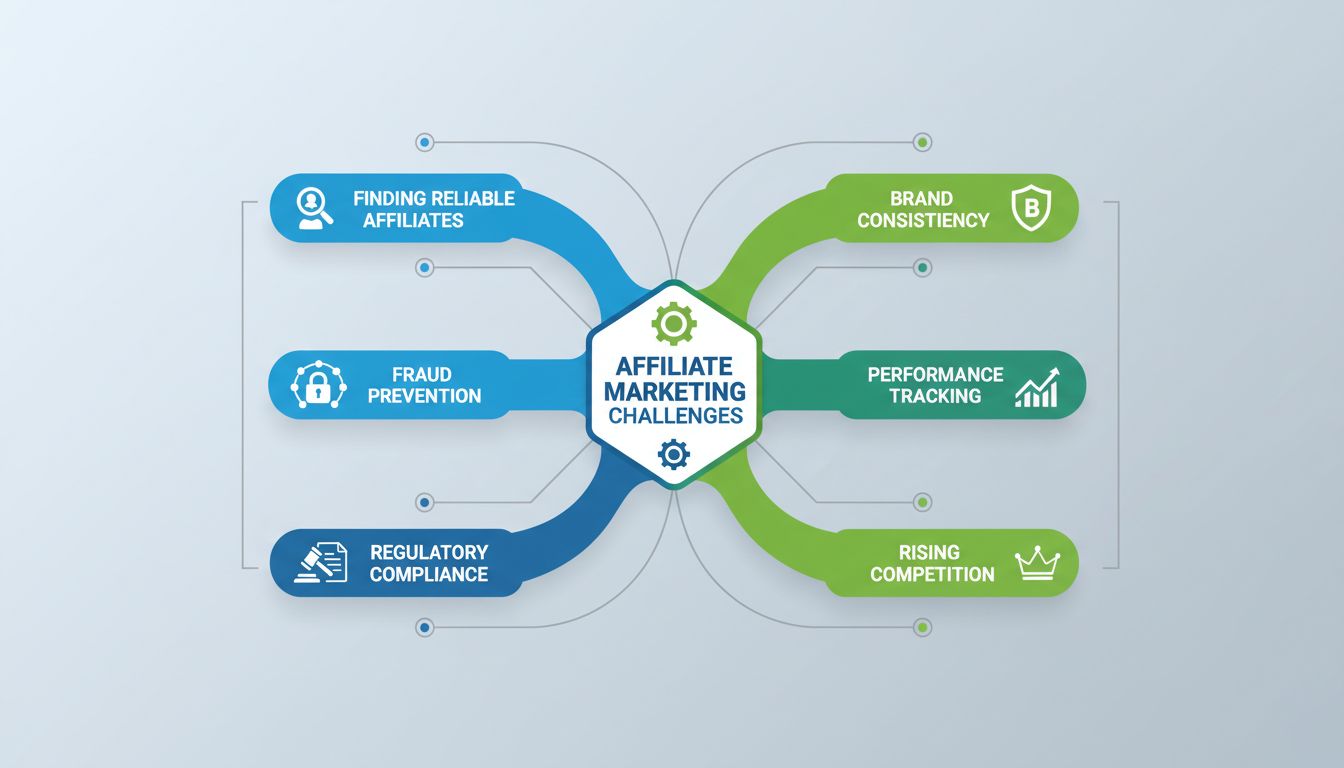
Main Challenges in Affiliate Marketing: Solutions
Discover the key challenges businesses face when implementing affiliate marketing programs in 2025, including affiliate management, fraud prevention, tracking, ...
9 min read


Discover key challenges in affiliate marketing including recruitment, brand consistency, fraud prevention, and tracking solutions.
Affiliate marketing has become one of the most powerful revenue-generating strategies for businesses worldwide, offering a performance-based model that rewards partners for driving traffic and sales. However, while the potential for growth is substantial, implementing and managing a successful affiliate program comes with significant challenges that can make or break your marketing efforts. From finding reliable partners to preventing fraudulent activities, businesses must navigate a complex landscape to maximize their affiliate marketing ROI.

One of the most critical challenges in affiliate marketing is identifying and recruiting affiliates who genuinely align with your brand values and can deliver quality results. The affiliate landscape is vast, with thousands of potential partners operating across different niches, platforms, and expertise levels. Selecting the right affiliates from this large pool is far from straightforward. Many businesses struggle to distinguish between high-performing partners who will drive meaningful revenue and those who may damage brand reputation through poor promotional practices or misaligned messaging.
The challenge intensifies when considering that affiliate quality varies dramatically. Some affiliates possess established audiences, strong content creation skills, and proven track records of driving conversions, while others may have minimal experience or questionable promotional tactics. Additionally, affiliates operating in the same niche may have conflicting interests or overlapping audiences, making it difficult to build a cohesive program. Without proper vetting and ongoing relationship management, you risk partnering with affiliates whose practices don’t reflect your brand standards.
| Metric | Poor Affiliate | Quality Affiliate | PostAffiliatePro Solution |
|---|---|---|---|
| Audience Alignment | Mismatched demographics | Perfect target fit | Advanced filtering and matching tools |
| Content Quality | Low-effort, generic promotions | High-quality, authentic content | Performance analytics and quality scoring |
| Performance Consistency | Unpredictable results | Steady, reliable conversions | Real-time performance tracking |
| Brand Fit | Potential reputation risk | Strong brand alignment | Compliance monitoring and guidelines |
| Communication | Unresponsive, unreliable | Proactive and engaged | Built-in communication platform |

Set up advanced tracking in minutes. No credit card required.
When you have dozens or hundreds of affiliates promoting your products across different platforms—from blogs and social media to email newsletters and video content—maintaining consistent brand messaging becomes exponentially more difficult. Each affiliate brings their own style, voice, and approach to promotion, which can result in fragmented brand representation that confuses customers and dilutes your brand identity.
Brand consistency challenges arise because affiliates operate independently and may not fully understand or prioritize your brand guidelines. Some might emphasize different product features, use inconsistent pricing information, or adopt promotional tones that don’t align with your brand personality. This inconsistency can lead to customer confusion, reduced trust, and ultimately lower conversion rates. The challenge is particularly acute when managing large affiliate networks where direct oversight of every promotional piece becomes impractical.

Accurately tracking affiliate performance and attributing conversions to the correct source has become increasingly complex in today’s multi-device, multi-channel digital environment. Customers rarely complete their purchase journey on a single device or through a single touchpoint. They might discover your product through an affiliate’s blog post on their desktop, research it on their mobile phone, and complete the purchase on a tablet days later. Properly attributing this conversion to the original affiliate becomes technically challenging and prone to errors.
The complexity multiplies when considering various tracking mechanisms and privacy regulations. Cookies, which have traditionally been the backbone of affiliate tracking, face limitations due to browser privacy updates and regulations like GDPR and CCPA. Cross-device tracking requires sophisticated technology that many affiliate programs lack. Additionally, different attribution models (first-click, last-click, multi-touch) can produce vastly different results, making it difficult to fairly compensate affiliates and accurately measure program ROI.
Key tracking challenges include:
Be the first to know about new features and product updates.
Affiliate fraud represents one of the most damaging challenges in affiliate marketing, costing businesses millions annually through various deceptive practices. Common fraud types include click fraud (generating fake clicks to inflate commissions), cookie stuffing (placing cookies without user consent), fake conversions (recording sales that never occurred), and incentivized clicks (paying users to click affiliate links artificially). These fraudulent activities not only waste marketing budgets but also damage the integrity of your affiliate program and erode trust with legitimate partners.
Detecting fraud is particularly challenging because sophisticated fraudsters continuously evolve their tactics to evade detection systems. Some fraud occurs at scale through automated bots, while other instances involve individual affiliates engaging in subtle deceptive practices that are harder to identify. The financial impact can be severe—businesses may unknowingly pay commissions for traffic that never converts or for sales that were never completed. Without robust fraud detection and prevention mechanisms, your affiliate program becomes vulnerable to exploitation.

Commission calculation and payment management present significant operational challenges, particularly as your affiliate program scales. Different commission structures—Cost Per Action (CPA), Cost Per Sale (CPS), Revenue Share (RevShare), and Cost Per Click (CPC)—each have different calculation requirements and potential for error. Manual commission calculations are prone to mistakes, leading to underpayment or overpayment of affiliates. These discrepancies damage affiliate relationships, reduce program credibility, and create administrative headaches.
Complex payment schedules, unclear commission terms, and inconsistent payout timing further complicate matters. Affiliates need to understand exactly how their earnings are calculated and when they’ll receive payment. When payment processes are opaque or error-prone, top-performing affiliates become frustrated and may leave your program for competitors with more transparent systems. Additionally, managing multiple payment methods, currency conversions, and tax compliance across international affiliates adds another layer of complexity.
| Commission Model | How It Works | Best For | Challenges |
|---|---|---|---|
| CPA | Pay per specific action (signup, download) | Lead generation | Requires clear action definition |
| CPS | Pay percentage of sale value | E-commerce | Requires accurate sales tracking |
| RevShare | Share percentage of customer revenue | Long-term value | Complex calculation over time |
| CPC | Pay per click regardless of conversion | Traffic generation | High risk of fraud |
| Hybrid | Combination of multiple models | Flexible programs | Complex calculations and management |
The regulatory landscape for affiliate marketing has become increasingly complex, with new data privacy laws, advertising standards, and industry-specific regulations constantly evolving. GDPR in Europe, CCPA in California, and various other regional regulations impose strict requirements on how customer data can be collected, used, and shared. Additionally, the Federal Trade Commission (FTC) requires clear disclosure of affiliate relationships, and many industries have specific compliance requirements—gambling affiliates must comply with gaming regulations, finance affiliates with financial services rules, and health-related affiliates with healthcare advertising standards.
Ensuring compliance across your entire affiliate network is challenging because each affiliate must understand and follow these regulations independently. Many affiliates lack awareness of compliance requirements or deliberately ignore them to maximize short-term earnings. Non-compliance can result in hefty fines, legal action, and reputational damage to your brand. Monitoring affiliate compliance at scale requires robust systems and ongoing education, making it a significant operational burden for most businesses.
The digital marketing landscape evolves at a breakneck pace, with new technologies, platforms, and algorithms constantly reshaping how affiliate marketing operates. Search engine algorithm updates can dramatically impact organic traffic for affiliate websites, requiring quick strategy adjustments. Social media platforms regularly change their policies regarding affiliate links and promotional content. New marketing technologies like AI-powered analytics, machine learning optimization, and advanced attribution tools emerge regularly, and affiliates who fail to adopt these innovations risk falling behind competitors.
Staying current requires continuous learning, experimentation, and adaptation. Affiliates must monitor industry trends, test new platforms and tactics, and be willing to pivot strategies when market conditions change. This constant need for innovation can be overwhelming, particularly for smaller affiliates or those new to the industry. Businesses managing affiliate programs must also stay informed about technological changes to provide relevant support and guidance to their partners.
Effective affiliate program management requires consistent, clear communication and strong relationship management—yet these become increasingly difficult as your affiliate network grows. Keeping hundreds or thousands of affiliates informed about product updates, policy changes, promotional opportunities, and performance feedback requires sophisticated communication systems and significant time investment. Communication gaps lead to misunderstandings about commission structures, promotional guidelines, and performance expectations.
Affiliate motivation and retention depend heavily on how well you support and communicate with partners. Affiliates need regular feedback on their performance, recognition for achievements, and access to resources that help them succeed. Without proper support systems, even high-potential affiliates may become disengaged or leave for programs with better support. Additionally, resolving disputes, addressing concerns, and providing training requires dedicated resources that many businesses underestimate.
The affiliate marketing space has become increasingly crowded, with intense competition in popular niches making it difficult for both new and established affiliates to stand out. In saturated markets like finance, e-commerce, and technology, thousands of affiliates compete for the same audience attention. This saturation drives down commission rates, increases customer acquisition costs, and makes it harder to achieve meaningful differentiation.
Successful affiliates must create exceptional content, implement advanced SEO strategies, and find unique angles that resonate with their audiences. This requires significant investment in content creation, technical expertise, and marketing knowledge. For businesses managing affiliate programs, the challenge is identifying and supporting affiliates who can compete effectively in their niches while maintaining quality standards and brand alignment.
PostAffiliatePro provides a comprehensive affiliate management platform specifically designed to address the major challenges outlined above. The software offers real-time tracking and reporting that accurately captures affiliate performance across multiple channels and devices, eliminating attribution confusion. Advanced fraud detection algorithms identify suspicious activity patterns and protect your program from fraudulent affiliates and malicious actors.
The platform’s customizable commission structures accommodate any payment model—CPA, CPS, RevShare, CPC, or hybrid combinations—with automated calculations that eliminate manual errors and ensure accurate, timely payments. Built-in compliance monitoring helps ensure that all affiliates follow relevant regulations and advertising standards, reducing legal risk. Centralized communication tools and performance dashboards enable efficient affiliate management at scale, while detailed analytics provide insights into which affiliates drive the best results.
PostAffiliatePro’s affiliate recruitment and management features help you identify quality partners who align with your brand values. The platform provides tools for setting clear guidelines, monitoring brand consistency, and providing ongoing support to keep affiliates engaged and motivated. With PostAffiliatePro, you gain the visibility and control necessary to build a high-performing affiliate program that drives sustainable revenue growth.
Implementing and managing a successful affiliate marketing program requires addressing multiple interconnected challenges—from finding reliable partners and ensuring brand consistency to preventing fraud and maintaining compliance. These challenges can seem overwhelming, but they’re not insurmountable with the right approach and tools. By understanding the specific obstacles your program faces and implementing systematic solutions, you can transform affiliate marketing from a source of stress into a powerful revenue driver.
The key to success lies in choosing an affiliate management platform that provides comprehensive solutions to these challenges. PostAffiliatePro combines advanced tracking, fraud prevention, compliance monitoring, and relationship management tools into a single, integrated platform. Whether you’re just starting your affiliate program or looking to optimize an existing one, PostAffiliatePro provides the infrastructure and insights needed to overcome challenges and maximize your affiliate marketing ROI.
The main challenges include finding reliable affiliates, ensuring brand consistency across channels, accurately tracking performance, preventing fraudulent activities, managing commission discrepancies, navigating regulatory requirements, and adapting to technological changes. Each of these requires dedicated attention and proper tools to manage effectively.
Implement robust tracking systems to monitor suspicious activity patterns, use fraud detection tools that identify anomalies, verify conversions before paying commissions, monitor traffic sources for irregularities, and establish clear consequences for fraudulent behavior. PostAffiliatePro includes advanced fraud detection algorithms that automatically identify and flag suspicious activities.
Establish clear brand guidelines and promotional standards, provide affiliates with approved marketing materials and messaging templates, regularly monitor affiliate content for compliance, maintain open communication about brand values, and use centralized management tools to oversee all promotional activities. Regular audits and feedback help maintain consistency across your affiliate network.
Use dedicated affiliate tracking software that provides real-time analytics, supports multi-device and cross-platform tracking, handles various attribution models, and integrates with your existing systems. PostAffiliatePro offers comprehensive tracking that accurately captures affiliate performance across all channels and provides detailed performance reports.
Choose a commission structure that aligns with your business model—CPA for lead generation, CPS for e-commerce, RevShare for long-term value, or hybrid models for flexibility. Use automated commission calculation systems to eliminate errors, clearly communicate how commissions are calculated, and regularly review rates to ensure competitiveness in your market.
Compliance requirements vary by region and industry but typically include GDPR and CCPA for data privacy, FTC disclosure requirements for affiliate relationships, industry-specific regulations (gambling, finance, health), and advertising standards. Ensure all affiliates understand and follow these requirements, and use compliance monitoring tools to verify adherence.
Recruit affiliates who align with your brand values and have relevant audiences, provide comprehensive onboarding and training, offer competitive commissions, maintain regular communication, recognize and reward top performers, and provide ongoing support and resources. Building strong relationships and demonstrating mutual value is key to long-term affiliate retention.
Essential tools include affiliate tracking software for performance monitoring, communication platforms for affiliate engagement, fraud detection systems, compliance monitoring tools, payment processing systems, and analytics dashboards. PostAffiliatePro integrates all these functions into a single comprehensive platform, simplifying affiliate program management.
PostAffiliatePro provides comprehensive tools to manage your affiliate program effectively, prevent fraud, ensure compliance, and maximize ROI.
Discover the key challenges businesses face when implementing affiliate marketing programs in 2025, including affiliate management, fraud prevention, tracking, ...

Discover the key challenges involved affiliates face in 2025: product usage requirements, reputation risks, and content creation demands. Learn how PostAffiliat...

Discover the biggest challenges in affiliate marketing: traffic generation and trust building. Learn proven strategies to overcome obstacles and build success.
Join our community of happy clients and provide excellent customer support with Post Affiliate Pro.




Cookie Consent
We use cookies to enhance your browsing experience and analyze our traffic. See our privacy policy.