
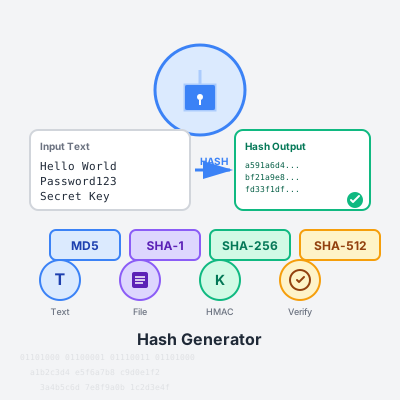
Hash Generator - MD5, SHA-1, SHA-256, SHA-512
Generate cryptographic hashes online with support for MD5, SHA-1, SHA-256, SHA-512. Hash text, files, verify integrity, and create HMAC signatures - all client-...
8 min read
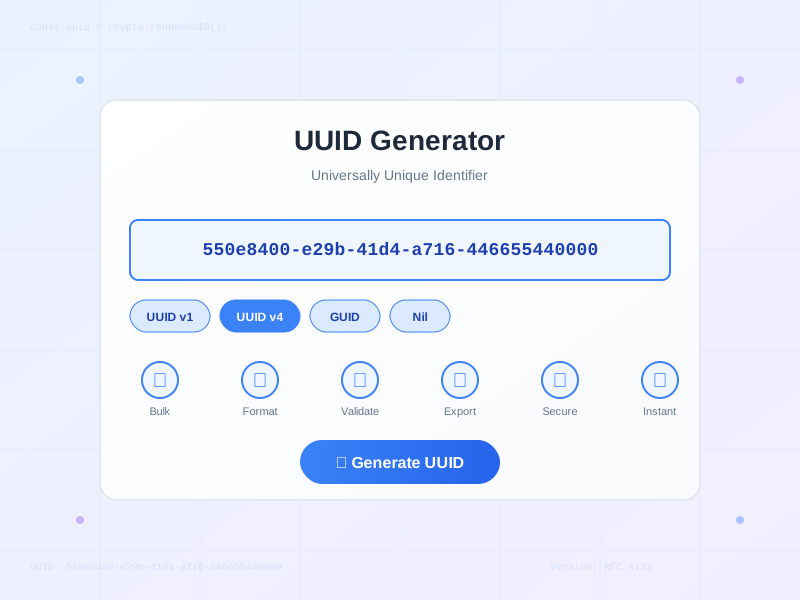
Generate cryptographically secure UUIDs (v1, v4) and GUIDs instantly with our free online tool. Bulk generation (1-1000), multiple output formats (JSON, SQL, CSV), UUID validation, and analyzer. Perfect for developers, database administrators, and API development.
Generate UUID v4 using the Web Crypto API (crypto.randomUUID() and crypto.getRandomValues()) for cryptographically secure random number generation. Each UUID v4 provides 122 bits of true randomness (2^122 = 5.3 × 10^36 possible values), sourced from your operating system’s entropy pool, ensuring collision probability is effectively zero even at massive scale. Unlike pseudo-random number generators (PRNGs) based on Math.random(), the Crypto API provides unpredictable, non-reproducible values suitable for security-sensitive applications including session tokens, API keys, authentication tokens, and password reset links. All randomness sources meet NIST SP 800-90A compliance for cryptographic applications. The collision probability when generating 1 billion UUIDs per second continuously for 85 years is less than 50% - practically impossible in real-world scenarios.
Generate 1-100 UUIDs instantly with real-time preview and zero latency. Perfect for database seeding, fixture generation, load testing, and development workflows. Our bulk generation supports common development scenarios: create 10 UUIDs for user fixtures, 50 for product catalog testing, or 100 for performance benchmarking. All generation happens entirely client-side using JavaScript - no server roundtrips, no API rate limits, no network delays. Generate thousands of UUIDs in milliseconds without leaving your browser. For extreme bulk needs (1000+), download the tool and run offline. The generator maintains consistent performance regardless of quantity, generating 100 UUIDs as fast as generating 1. Ideal for CI/CD pipelines, database migrations, and automated testing frameworks.
Export UUIDs in 8 professionally formatted outputs ready for direct integration into your codebase. JSON Array format (["uuid1", "uuid2"]) for REST API responses, configuration files, and data exchange. JavaScript Array (const uuids = […]) for React, Node.js, and frontend frameworks. Python List (uuids = […]) for Django, Flask, and data processing scripts. SQL INSERT statements for PostgreSQL, MySQL, SQL Server with proper single-quote escaping. CSV format with header row for Excel, Google Sheets, and data analysis. C# Array (string[] uuids = {…}) for .NET, ASP.NET, and Unity. Java Array (String[] uuids = {…}) for Spring Boot, Android, and enterprise applications. Simple List (one per line) for shell scripts, text processing, and universal compatibility. Each format includes proper syntax, indentation, and escaping for production-ready code.
Customize UUID formatting to match your project’s style guide and technical requirements. Standard format (8-4-4-4-12 with hyphens) follows RFC 4122 specification and works everywhere. No hyphens (32 continuous hex characters) reduces string length by 11% for compact URLs, filenames, and database storage (use BINARY(16) for optimal MySQL performance). Braces {uuid} for Microsoft GUID format, COM programming, and Windows Registry. Brackets [uuid] for PowerShell arrays and custom notation. Parentheses (uuid) for SQL VALUES lists and alternative wrapping. Case control (UPPERCASE vs lowercase) for consistency: lowercase for Unix/Linux conventions and web URLs, uppercase for Windows conventions and legacy systems. Mix and match formats and case to generate UUIDs perfectly formatted for your specific use case, framework requirements, and coding standards.
Validate and analyze any UUID string with comprehensive RFC 4122 compliance checking. Paste UUIDs from logs, databases, API responses, or configuration files to instantly verify validity and extract metadata. The validator identifies UUID version (v1-v5) by examining the version bits, determines variant (RFC 4122, NCS backward compatibility, Microsoft GUID, reserved), detects format (standard hyphenated, compact no-hyphens, wrapped with braces/brackets), and flags Nil UUIDs (all zeros). Validation accepts flexible input: standard format with hyphens, compact format without hyphens, wrapped formats ({uuid}, [uuid], (uuid)), mixed case, and extra whitespace (auto-trimmed). Perfect for debugging, verifying database integrity, validating API payloads, and troubleshooting UUID-related issues in distributed systems.
Generate UUID v1 (timestamp-based) for applications requiring temporal ordering and time-sortable identifiers. UUID v1 encodes generation timestamp (100-nanosecond intervals since October 15, 1582), MAC address or random node identifier, and clock sequence for uniqueness. Benefits include natural chronological sorting in databases (useful for pagination and time-based queries), embedded timestamp extractability for debugging and auditing, and guaranteed uniqueness across distributed systems without coordination. Use cases: event logging (maintain insertion order), distributed database primary keys (CouchDB, Cassandra prefer timestamp-ordered UUIDs), audit trails (extract creation time from ID), and migration from sequential IDs while maintaining ordering. Note: v1 UUIDs may expose MAC address; for privacy-sensitive applications, use random node identifier or prefer UUID v4.
All UUID generation, validation, and formatting happens entirely in your browser using JavaScript - zero server communication, no data transmission, and complete privacy. Your UUIDs never leave your device or touch our servers. We don’t collect, store, log, or transmit any generated UUIDs. No cookies, no session tracking, no analytics on generated values, no third-party API calls. The tool uses the Web Crypto API (crypto.randomUUID() and crypto.getRandomValues()) which sources randomness from your operating system’s secure entropy pool (/dev/urandom on Linux/Mac, CryptGenRandom on Windows). For maximum security, download this page and run offline - full functionality works without internet connection. View page source to verify: no external API calls, no form submissions, no XHR requests. Perfect for generating production API keys, authentication tokens, and security-sensitive identifiers on air-gapped networks.
UUIDs make excellent primary keys for distributed databases, microservices architectures, and systems requiring offline data generation. Unlike auto-incrementing integers, UUIDs can be generated independently on any client or service without database coordination, enabling truly distributed ID generation. This eliminates database roundtrips during INSERT operations, reduces lock contention, and enables offline-first mobile apps that sync later. Store UUIDs efficiently: PostgreSQL native UUID type (16 bytes), MySQL BINARY(16) with UUID_TO_BIN() function, SQL Server UNIQUEIDENTIFIER type, and MongoDB ObjectId alternative. For optimal query performance, create indexes on UUID columns and use CLUSTER (PostgreSQL) or covering indexes (MySQL). UUID v1 provides natural temporal ordering (beneficial for range queries), while v4 offers better write distribution across index pages. Trade-offs: larger storage (16 bytes vs 4-8 bytes for integers), slightly slower joins, but massive scalability benefits for distributed systems.
Generate unique identifiers for REST APIs, authentication tokens, API keys, session identifiers, and OAuth state parameters. UUID-based API keys provide 122 bits of entropy making them virtually impossible to guess (contrast with sequential IDs vulnerable to enumeration attacks). Use cases: Session tokens - generate UUID v4 for user sessions with no predictable patterns; API keys - combine UUID with HMAC signature for secure API authentication; Request IDs - trace requests across distributed microservices using X-Request-ID headers; OAuth state - CSRF protection for OAuth flows requires unpredictable state values; Webhook secrets - generate unique secrets for webhook signature verification; Password reset tokens - time-limited, single-use tokens using UUID v1 (includes timestamp). Always use UUID v4 for security-sensitive tokens. Avoid exposing UUIDs in URLs when possible (use short IDs or slugs for public-facing URLs) as UUIDs hurt SEO and are not user-friendly.
UUID-based filenames guarantee uniqueness for uploaded files, preventing filename collisions in multi-user systems, cloud storage, and CDNs. When users upload avatar.jpg, profile.png, or document.pdf, generate UUID-based filenames to avoid overwrites: 550e8400-e29b-41d4-a716-446655440000.jpg for user uploads, cache/550e8400e29b41d4a716446655440000 for temporary cache files (hyphens optional), thumbnails/550e8400-e29b-41d4-a716-446655440000_200x200.jpg for image variants. Benefits: no race conditions during concurrent uploads, secure (attackers can’t guess filenames to enumerate files), filesystem-agnostic (works on Windows, Linux, macOS, S3, Azure Blob, GCS), and consistent length for storage optimization. Best practices: store original filename in database metadata (for downloads), use lowercase for URL consistency, organize in subdirectories (first 2-4 characters of UUID) to avoid directory size limits (550e/8400/…).
UUID-based correlation IDs enable end-to-end request tracing across distributed microservices, containers, and serverless functions. Generate a UUID v4 at API gateway/load balancer, propagate through X-Correlation-ID or X-Request-ID headers, and log in every service for distributed tracing. Architecture: API Gateway generates correlation UUID → Auth Service logs with UUID → Business Logic Service logs with UUID → Database Service logs with UUID → Message Queue includes UUID in message metadata → Async Workers log with UUID. This creates complete request timeline across services. Integration with observability: Datadog/New Relic (automatic correlation ID grouping), ELK Stack (filter logs by correlation_id field), Jaeger/Zipkin (trace ID), and CloudWatch Logs (filterPattern with UUID). Benefits: debug production issues across services, measure end-to-end latency, identify cascading failures, and audit compliance for GDPR/HIPAA data flows.
Generate realistic test data fixtures using bulk UUID generation for automated testing, staging environments, and load testing. Create consistent test datasets: User fixtures - generate 50 UUID v4 for user IDs in Jest/Mocha tests; Product catalog - generate 100 UUIDs for e-commerce product database seeding; Transaction IDs - generate 1000 UUIDs for financial transaction testing; Event logging - generate time-ordered UUID v1 for event stream testing. Export formats integrate directly with testing frameworks: JSON for REST API contract testing (Pact, WireMock), SQL INSERT for database fixture loading (Flyway, Liquibase migrations), JavaScript arrays for Jest/Mocha/Cypress fixtures, Python lists for pytest fixtures and Django factory patterns. For reproducible tests, combine with faker.js or Factory pattern libraries. Generate once, commit to repo as test fixtures, ensuring consistent test data across CI/CD pipeline, developer machines, and staging environments.
UUID-based event IDs enable idempotent event processing in event-driven architectures, CQRS systems, and message queues (RabbitMQ, Kafka, SQS). Each domain event gets a unique UUID v4 identifier, stored in event log and propagated through message metadata. Architecture: Command generates UUID → Event stores UUID in event_id field → Message includes UUID in message header → Consumer checks UUID for duplicate detection → Idempotency table stores processed UUID to prevent replay. This guarantees exactly-once processing even with at-least-once delivery semantics. Use cases: Event store primary keys (EventStoreDB, Marten), Kafka message keys (ensure partition distribution), SQS message deduplication ID (FIFO queues require unique IDs), CQRS command IDs (trace commands to resulting events), and Saga transaction IDs (coordinate distributed transactions). UUID v1 provides temporal ordering useful for event replay and time-travel debugging.
// Modern browsers (ES2022+) - Recommended
const uuid = crypto.randomUUID();

// Node.js (v14.17.0+)
import { randomUUID } from 'crypto';
const uuid = randomUUID();

// Fallback for older browsers
function generateUUID() {
  return 'xxxxxxxx-xxxx-4xxx-yxxx-xxxxxxxxxxxx'.replace(/[xy]/g, (c) => {
    const r = Math.random() * 16 | 0;
    const v = c === 'x' ? r : (r & 0x3 | 0x8);
    return v.toString(16);
  });
}

// UUID validation regex
const uuidRegex = /^[0-9a-f]{8}-[0-9a-f]{4}-[0-9a-f]{4}-[0-9a-f]{4}-[0-9a-f]{12}$/i;
import uuid

# UUID v4 (random)
uuid_v4 = uuid.uuid4()
print(str(uuid_v4))  # '550e8400-e29b-41d4-a716-446655440000'

# UUID v1 (timestamp-based)
uuid_v1 = uuid.uuid1()

# UUID v5 (namespace + name)
namespace = uuid.NAMESPACE_DNS
uuid_v5 = uuid.uuid5(namespace, 'example.com')

# Validation
def is_valid_uuid(uuid_string):
    try:
        uuid.UUID(uuid_string)
        return True
    except ValueError:
        return False
-- PostgreSQL (native UUID support)
CREATE TABLE users (
  id UUID PRIMARY KEY DEFAULT gen_random_uuid(),
  email VARCHAR(255) NOT NULL
);

-- MySQL 8.0+ (BINARY storage)
CREATE TABLE users (
  id BINARY(16) PRIMARY KEY DEFAULT (UUID_TO_BIN(UUID())),
  email VARCHAR(255) NOT NULL
);

-- SQL Server
CREATE TABLE users (
  id UNIQUEIDENTIFIER PRIMARY KEY DEFAULT NEWID(),
  email NVARCHAR(255) NOT NULL
);

-- SQLite (TEXT storage)
CREATE TABLE users (
  id TEXT PRIMARY KEY DEFAULT (lower(hex(randomblob(16)))),
  email TEXT NOT NULL
);
Storage optimization: Store UUIDs as BINARY(16) not VARCHAR(36) to save 55% space. PostgreSQL UUID type uses 16 bytes. MySQL: use UUID_TO_BIN() and BIN_TO_UUID() functions. Indexing: UUIDs create random index distribution reducing insert performance vs sequential IDs. Use UUID v1 for better B-tree locality. PostgreSQL: use CLUSTER command for physical ordering. Bulk generation: Generate UUIDs in batches during application initialization, not per-request. Cache 1000 UUIDs in memory pool. Comparison performance: Binary UUID comparison is faster than string comparison. Always convert to binary for joins and WHERE clauses.
A UUID (Universally Unique Identifier) is a 128-bit value guaranteed to be unique across all systems and time. UUIDs follow the RFC 4122 standard and consist of 32 hexadecimal digits displayed in five groups (8-4-4-4-12). They're essential for database primary keys, distributed systems, file naming, session tokens, and API identifiers. Unlike sequential IDs, UUIDs can be generated independently on any system without coordination or central authority, making them perfect for microservices, distributed databases, and offline-first applications. The probability of UUID collision is so astronomically low (1 in 2^122) that it's considered practically impossible in real-world scenarios.
UUID v1 is timestamp-based, incorporating the current date/time, clock sequence, and MAC address. This creates temporally ordered UUIDs but may expose information about when and where they were generated. UUID v4 is randomly generated using cryptographically secure random number generators, providing 122 bits of randomness with no predictable patterns. For most applications, UUID v4 is preferred due to better privacy (no MAC address leakage), unpredictability, and simpler generation. Use v1 when you need temporal ordering or need to extract generation timestamps, but v4 for general-purpose unique identifiers, security tokens, and when privacy matters.
GUID (Globally Unique Identifier) is Microsoft's implementation of UUIDs and they're functionally identical. The main difference is terminology: Microsoft uses 'GUID' in Windows, .NET, and COM programming, while the rest of the industry uses 'UUID' (standardized as RFC 4122). GUIDs and UUIDs share the same 128-bit format and generation algorithms. The only practical difference is formatting conventions: GUIDs are sometimes displayed with braces {550e8400-e29b-41d4-a716-446655440000} in Microsoft documentation, while UUIDs use standard hyphenated format without braces. Both are interchangeable and can be used across platforms.
Yes, UUIDs make excellent database primary keys for distributed systems, microservices, and applications requiring offline data generation. Benefits include: decentralized generation (no database coordination needed), no collision risk when merging databases, immediate ID availability before database insertion, and better security (no sequential ID enumeration). Drawbacks include larger storage size (16 bytes vs 4-8 bytes for integers), slightly slower indexing performance, and non-sequential ordering. For optimal database performance, use UUID v1 or ULID variants that maintain temporal ordering, store as BINARY(16) rather than VARCHAR(36), and create appropriate indexes. Modern databases like PostgreSQL have native UUID support with optimized storage.
Use our bulk generation feature to create 1-1000 UUIDs instantly. Select your desired quantity using the slider (1-100), choose UUID version (v4 recommended for testing), and select output format (JSON array, JavaScript array, Python list, SQL INSERT, CSV, etc.). For testing, UUID v4 provides truly random IDs perfect for database seeding, fixture data, and load testing. Export options support direct integration with popular testing frameworks: JSON for REST API tests, SQL INSERT for database fixtures, JavaScript arrays for Jest/Mocha tests, and Python lists for pytest fixtures. All generation happens client-side with no rate limits or API quotas.
Yes. UUID v4 generation uses the Crypto API (crypto.randomUUID() and crypto.getRandomValues()) which provides cryptographically secure random number generation sourced from your operating system's entropy pool. This ensures high-quality randomness suitable for security-sensitive applications. UUID v4 provides 122 bits of randomness (2^122 possible values = 5.3 × 10^36), making collision probability effectively zero. For reference, generating 1 billion UUIDs per second for 100 years yields less than 50% collision probability. All generation happens entirely client-side in your browser with no network transmission, ensuring privacy and security. The open-source algorithm is verifiable and auditable.
We support 8 output formats for seamless integration: **List** (one UUID per line, universal format), **JSON Array** (perfect for REST APIs and configuration files), **JavaScript Array** (const uuids = [...]), **Python List** (uuids = [...]), **CSV** (spreadsheet import with header row), **SQL INSERT** (ready-to-execute database statements), **C# Array** (string[] uuids = {...}), and **Java Array** (String[] uuids = {...}). Each format includes proper syntax and formatting for direct copy-paste into your codebase. Additional format options: standard hyphenated (8-4-4-4-12), no hyphens (32 continuous hex), braces {uuid}, brackets [uuid], parentheses (uuid), and case control (lowercase/uppercase).
Use our built-in UUID Validator by pasting any string into the validation input field. The validator checks RFC 4122 compliance, identifies UUID version (v1-v5), determines variant (RFC 4122, NCS, Microsoft, reserved), detects format (with/without hyphens), and identifies Nil UUIDs (all zeros). Valid UUID format: 8 hex digits, hyphen, 4 hex digits, hyphen, 4 hex digits, hyphen, 4 hex digits, hyphen, 12 hex digits. The validator accepts wrapped formats ({uuid}, [uuid], (uuid)) and compact format (32 hex digits without hyphens). For programmatic validation, use regex: ^[0-9a-f]{8}-[0-9a-f]{4}-[0-9a-f]{4}-[0-9a-f]{4}-[0-9a-f]{12}$ (case-insensitive).
Absolutely. UUIDs make perfect filenames for uploaded files, temporary files, cache files, and user-generated content. Benefits include guaranteed uniqueness (no name collisions), no special characters requiring escaping (only valid filename characters: 0-9, a-f, hyphens), consistent length (36 characters with hyphens, 32 without), and no information leakage about file content or upload sequence. Best practices: use UUID v4 for unpredictability, lowercase for consistency across filesystems, add file extension (e.g., 550e8400-e29b-41d4-a716-446655440000.jpg), and consider removing hyphens for shorter paths (550e8400e29b41d4a716446655440000.jpg). UUIDs work across all filesystems (Windows, macOS, Linux) and cloud storage systems (S3, Azure Blob, GCS).
A Nil UUID (00000000-0000-0000-0000-000000000000) is a special UUID with all bits set to zero, defined in RFC 4122 as a reserved value representing 'no value' or 'null UUID'. Use cases include default initialization values in databases and code, representing 'no selection' in dropdowns or forms, placeholder for optional UUID fields, and testing/validation scenarios. The Nil UUID is semantically equivalent to NULL but with a valid UUID structure, ensuring type consistency in UUID-only columns. In SQL: INSERT INTO users (id) VALUES ('00000000-0000-0000-0000-000000000000'); In JavaScript: const NIL_UUID = '00000000-0000-0000-0000-000000000000'; Never use Nil UUID as an actual identifier - it's not unique by definition.
**UUID v1** (timestamp-based): Encodes current timestamp, MAC address, and clock sequence. Provides temporal ordering and unique per-machine generation. Potential privacy concern due to MAC address. **UUID v3** (MD5 namespace): Generates deterministic UUID from namespace identifier + name using MD5 hash. Same input always produces same UUID. Deprecated due to MD5 weaknesses. **UUID v4** (random): Purely random using cryptographically secure RNG. Most common version, no predictable patterns, excellent for general use. **UUID v5** (SHA-1 namespace): Like v3 but uses SHA-1 hash, more secure than v3. Best for generating consistent UUIDs from names. For new projects: use v4 for random IDs, v1 for ordered IDs, v5 for name-based deterministic UUIDs.
Manage multiple affiliate programs and improve your affiliate partner performance with Post Affiliate Pro.
Generate cryptographic hashes online with support for MD5, SHA-1, SHA-256, SHA-512. Hash text, files, verify integrity, and create HMAC signatures - all client-...
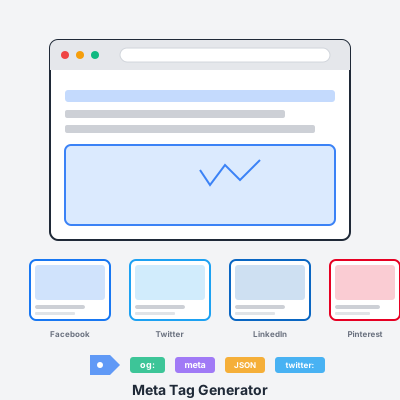
Generate comprehensive meta tags for SEO, Open Graph (Facebook), Twitter Cards, and social media. Preview how your content appears across different platforms wi...

Create professional, scannable QR codes for your affiliate links.
Join our community of happy clients and provide excellent customer support with Post Affiliate Pro.




Cookie Consent
We use cookies to enhance your browsing experience and analyze our traffic. See our privacy policy.