
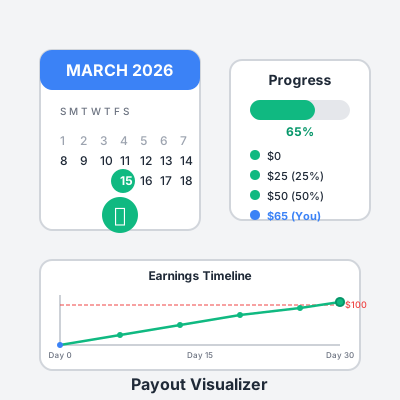
Affiliate Payout Threshold Calculator - Payment Timeline Visualizer
Calculate how long until you reach affiliate payout thresholds. Visualize your earnings timeline with support for different payment terms, commission rates, and...
2 min read
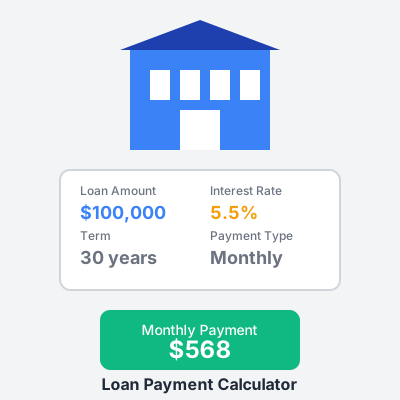
Calculate monthly payments, total interest, and view complete amortization schedules for business loans, mortgages, auto loans, and financing options. Make informed borrowing decisions with detailed payment breakdowns.
Loan payments consist of two components: principal (reducing the loan balance) and interest (cost of borrowing). The monthly payment amount stays constant for fixed-rate loans, but the principal/interest split changes over time. Early payments are predominantly interest because interest is calculated on the full loan balance. As you pay down principal, interest charges decrease and more of each payment reduces the balance.
This amortization structure ensures the loan is fully repaid by the final payment. For a 30-year mortgage, the first payment might be 80% interest and 20% principal. The final payment flips to 99% principal and 1% interest. Understanding this breakdown helps evaluate refinancing decisions, extra payment strategies, and true borrowing costs.
Loan term dramatically affects both monthly payments and total cost. Longer terms reduce monthly payments by spreading the principal across more payments, improving cash flow. However, you pay substantially more total interest because interest compounds over more years. Shorter terms have higher monthly payments but save tens of thousands in interest.
For a $200,000 loan at 5.5%, a 30-year term costs $1,136/month with $209,040 total interest. A 15-year term costs $1,634/month (+$498/month) but only $94,120 total interest - saving $114,920. If you can afford the higher payment, shorter terms build equity faster and free you from debt sooner. Many borrowers choose 30-year terms for flexibility, then make extra payments when possible.
Interest rates have exponential effects on total loan cost due to compounding. A 1% rate difference on a $200,000 30-year mortgage changes monthly payments by $120-150 and total interest by $40,000-50,000. This makes rate shopping critical - spending time to secure 0.5% lower rate saves thousands of dollars.
For business loans, even quarter-point rate differences matter significantly. On a $500,000 10-year business loan, 6% vs 6.25% means $46/month difference and $5,520 over the loan term. When evaluating loan offers, compare APR (Annual Percentage Rate) not just interest rates. APR includes fees, revealing true borrowing costs.
Extra payments directly reduce principal, creating compounding savings throughout the loan term. On a $300,000 30-year mortgage at 5%, paying an extra $200/month saves $73,000 in interest and pays off the loan 6 years early. Extra payments made early in the loan term generate maximum savings because you avoid interest charges on that principal for the entire remaining term.
Strategies for extra payments: 1) Round up payments ($1,247 rounded to $1,300 = $53 extra), 2) One extra payment yearly ($1,247/month × 13 = saves 4-6 years and $40,000+), 3) Apply windfalls (tax refunds, bonuses, raises) directly to principal, 4) Bi-weekly payments (26 half-payments yearly = 13 full payments vs 12). Most loans allow extra payments penalty-free - verify before assuming.
Business loans require careful cash flow planning. Calculate total monthly debt service (all loan payments) and ensure it doesn’t exceed 30-40% of monthly revenue. Factor seasonal revenue fluctuations - can you afford payments during slow months? Build a 3-6 month payment reserve for unexpected revenue drops.
Consider loan structure: traditional amortization (fixed payments), interest-only periods (lower initial payments but higher later or balloon payment), or lines of credit (pay interest only on drawn amounts). Match loan structure to business cash flow patterns. Restaurants and retail with daily revenue suit traditional amortization. Project-based businesses might prefer flexible draws.
Mortgages offer lower rates (secured by property) and longer terms (15-30 years). Business loans have higher rates (less collateral/higher risk) and shorter terms (1-10 years). A $300,000 mortgage at 5% for 30 years costs $1,610/month. A $300,000 business loan at 8% for 10 years costs $3,643/month - over 2x higher payment despite same principal.
For business property, choose between commercial mortgages (lower rate, longer term, harder qualification) and business loans (faster approval, shorter term, higher cost). Commercial mortgages make sense for long-term ownership. Business loans work for equipment, inventory, or working capital. Calculate the break-even point where higher payments from shorter terms offset interest savings.
Refinance when you can lower your interest rate by at least 0.75-1% to offset closing costs (typically 2-5% of loan amount). Calculate months to break even: closing costs ÷ monthly savings. If break-even is 36 months and you plan to keep the loan 5+ years, refinancing makes sense. However, resetting to a new 30-year term can cost more total interest despite lower rates.
Example: $200,000 mortgage at 6% with 25 years remaining ($1,288/month). Refinance to 4% 30-year ($955/month, saves $333/month, $3,000 closing costs, breaks even in 9 months). But you restart a 30-year term. Instead, refinance to 4% 20-year ($1,212/month, saves $76/month, but pays off 5 years earlier and saves $70,000 total interest). Compare both total interest and monthly cash flow.
Prioritize extra payments on highest-rate debt first for maximum savings. If you have a 6% mortgage and 8% business loan, extra payments on the business loan save more interest. However, mortgages have longer terms, so extra payments create compounding savings over decades. Many borrowers split extra payments: 70% to highest rate, 30% to longest term.
Track cumulative interest savings from extra payments for motivation. After 5 years of $200 extra monthly payments on a $250,000 mortgage, you’ve saved $12,000+ in interest and shortened the loan by 3+ years. This positive feedback encourages continued extra payments. Most lenders provide amortization schedules showing exactly how extra payments affect payoff dates and interest savings.
Get loan quotes from at least 3-5 lenders: banks, credit unions, online lenders, and brokers. Compare APR (not just interest rate) to see true costs including fees. Lenders charge different fees: origination fees (0-1% of loan), processing fees ($300-800), underwriting fees ($300-700), and application fees ($0-500). Two loans with identical 5% interest rates can have 5.1% vs 5.4% APR due to fee differences.
Request “no-cost” refinances where lenders cover closing costs in exchange for slightly higher rates (typically 0.125-0.25% higher). This makes sense if you plan to sell/refinance within 3-5 years. For long-term ownership, paying closing costs for lower rates saves more. Negotiate fees - origination fees and processing fees are often negotiable or waivable for strong borrowers.
Interest on business loans is tax-deductible as a business expense, effectively reducing the after-tax cost of borrowing. At 25% tax rate, a 7% business loan costs an effective 5.25% after deductions. However, principal payments aren’t deductible. This tax benefit makes business debt more attractive than personal debt for business purposes.
Track interest paid monthly for tax planning. On a $100,000 business loan at 7%, first-year interest is approximately $6,700 (deductible). The deduction saves $1,675 in taxes at 25% rate. As principal is repaid, interest decreases and deductions shrink. Front-load major purchases in high-income years to maximize deduction value. Consult tax professionals for specific situations, especially for complex loan structures.
Lenders evaluate business loans using DSCR: (Net Operating Income) / (Total Debt Service). Most require DSCR of 1.25+ meaning income must be 125% of debt payments. If your business generates $10,000/month net operating income, maximum total monthly debt payments should be $8,000 for 1.25 DSCR. This ensures adequate cash flow cushion for business operations and unexpected expenses.
Calculate DSCR before applying for loans to ensure approval likelihood. If DSCR is below requirements, options include: reducing loan amount, extending loan term (lower payments, higher DSCR), increasing business revenue, or reducing operating expenses. Some lenders accept 1.15 DSCR for strong credit/collateral. Others require 1.5+ for higher-risk industries. Understanding DSCR helps set realistic loan amount expectations.
Review amortization schedules to understand payment distribution and refinancing opportunities. Many borrowers discover they’ve paid mostly interest for years with little principal reduction. For a 30-year loan, after 10 years you’ve paid ~70% interest, 30% principal. This reveals refinancing timing - refinancing after 5-10 years into a shorter term can dramatically reduce total interest without major payment increases.
Use schedules to plan lump-sum payments. See exactly how a $10,000 principal payment affects payoff dates and interest savings. Some borrowers target milestone dates (“pay off by age 55”) and calculate required extra payments. Others identify natural break points (year 5, 10, 15) for reassessing loan strategy based on life circumstances, interest rates, and financial goals.
Monthly payment = P × [r(1+r)^n] / [(1+r)^n - 1], where P is principal, r is monthly interest rate (annual rate ÷ 12), and n is number of payments (years × 12). For a $100,000 loan at 5.5% APR for 15 years: r = 0.055/12 = 0.00458, n = 180 payments, monthly payment = $817.08. This formula accounts for compound interest and ensures the loan is fully paid by the final payment.
Amortization is the process of paying off a loan through regular payments. Each payment includes both principal (reducing the loan balance) and interest (cost of borrowing). Early payments are mostly interest because interest is calculated on the remaining balance. As the balance decreases, more of each payment goes to principal. By the final payment, almost everything is principal. This structure ensures the loan is fully repaid on schedule.
Total interest = (Monthly Payment × Number of Payments) - Loan Amount. For a $100,000 loan at 5.5% for 15 years with $817 monthly payments: total paid = $817 × 180 = $147,060, so total interest = $47,060 (47% of the original loan). Lower rates and shorter terms dramatically reduce total interest. The same loan at 4% saves $12,000 in interest. A 30-year term costs $105,000 in interest - $58,000 more than 15 years.
15-year loans have higher monthly payments but save substantially on total interest and build equity faster. 30-year loans have lower monthly payments, improving cash flow, but cost significantly more in total interest. For a $200,000 loan at 5.5%: 15-year = $1,634/month, $94,120 total interest; 30-year = $1,136/month, $209,040 total interest - $114,920 difference. Choose 15-year if you can afford higher payments and want to save on interest. Choose 30-year for better monthly cash flow.
Extra payments directly reduce principal, saving substantial interest and shortening the loan term. On a $100,000 15-year loan at 5.5%, paying an extra $100/month saves $7,800 in interest and pays off the loan 2.5 years early. Extra payments early in the loan term save the most because interest compounds on the reduced principal for longer. Even sporadic extra payments (tax refunds, bonuses) create meaningful savings. Most loans allow extra payments with no penalty - verify before assuming.
Interest rate is the annual cost of borrowing expressed as a percentage of the loan amount. APR (Annual Percentage Rate) includes the interest rate PLUS fees: origination fees, points, closing costs, and other lender charges. APR provides the true cost of borrowing. For example, a 5% interest rate might have 5.3% APR after including $3,000 in fees. Always compare APRs when shopping for loans, not just interest rates. APR reveals which loan actually costs less.
Business loan amortization works identically to personal loans - fixed monthly payments with declining interest and increasing principal portions. However, business loans often have different structures: balloon payments (large final payment), interest-only periods (pay only interest for initial term), or variable rates (rate adjusts periodically). For traditional amortized business loans, early payments are 70-80% interest. After 7-10 years, the ratio flips to 70-80% principal. This affects tax deductions since interest is deductible.
Four factors determine monthly payments: 1) Principal amount (higher loan = higher payment), 2) Interest rate (higher rate = higher payment), 3) Loan term (longer term = lower payment but more total interest), 4) Payment frequency (bi-weekly payments reduce interest vs monthly). On a $150,000 loan: 5% rate = $1,186/month, 6% rate = $1,266/month. 15-year term = $1,186/month, 30-year = $805/month. Even 0.5% rate differences create thousands in savings over the loan life.
Interest payments on business loans are generally tax deductible as a business expense, but principal payments are not. If your monthly payment is $1,000 with $600 interest and $400 principal, you can deduct $600. Deductibility depends on loan purpose - business purchases, operations, and expansion qualify; personal expenses don't. Consult a tax professional for specific situations. This deduction effectively reduces your after-tax cost of borrowing, making the effective interest rate lower than the stated rate.
Lenders use debt-to-income ratio (DTI): total monthly debt payments ÷ monthly gross income. Most lenders require DTI below 43% for approval, though 36% or less is ideal. For $5,000 monthly income, maximum total debt payments should be $1,500-$2,150. Include existing debts (credit cards, auto loans, other loans) plus the new loan payment. If the new loan payment puts you over DTI limits, you need to pay down existing debt, increase income, or reduce the loan amount.
Manage multiple affiliate programs and improve your affiliate partner performance with Post Affiliate Pro.
Calculate how long until you reach affiliate payout thresholds. Visualize your earnings timeline with support for different payment terms, commission rates, and...
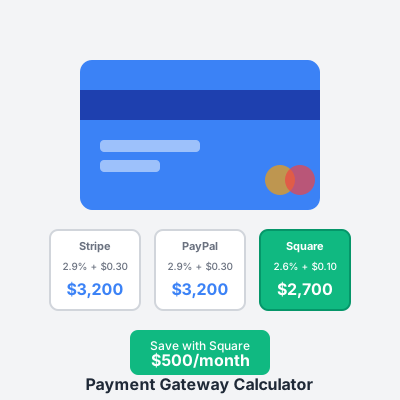
Free payment gateway calculator to compare transaction fees, monthly costs, and total payment processing expenses. Evaluate Stripe, PayPal, Square and other gat...
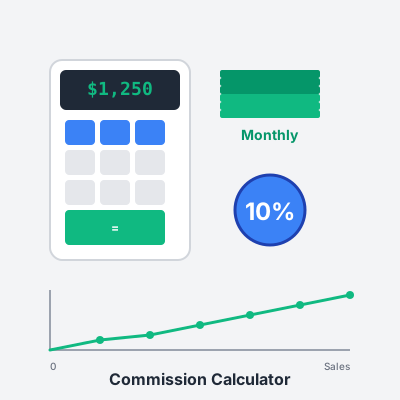
Calculate your potential affiliate earnings with our free commission calculator. Support for percentage and fixed commissions, tiered structures, and multiple c...
Join our community of happy clients and provide excellent customer support with Post Affiliate Pro.




Cookie Consent
We use cookies to enhance your browsing experience and analyze our traffic. See our privacy policy.