
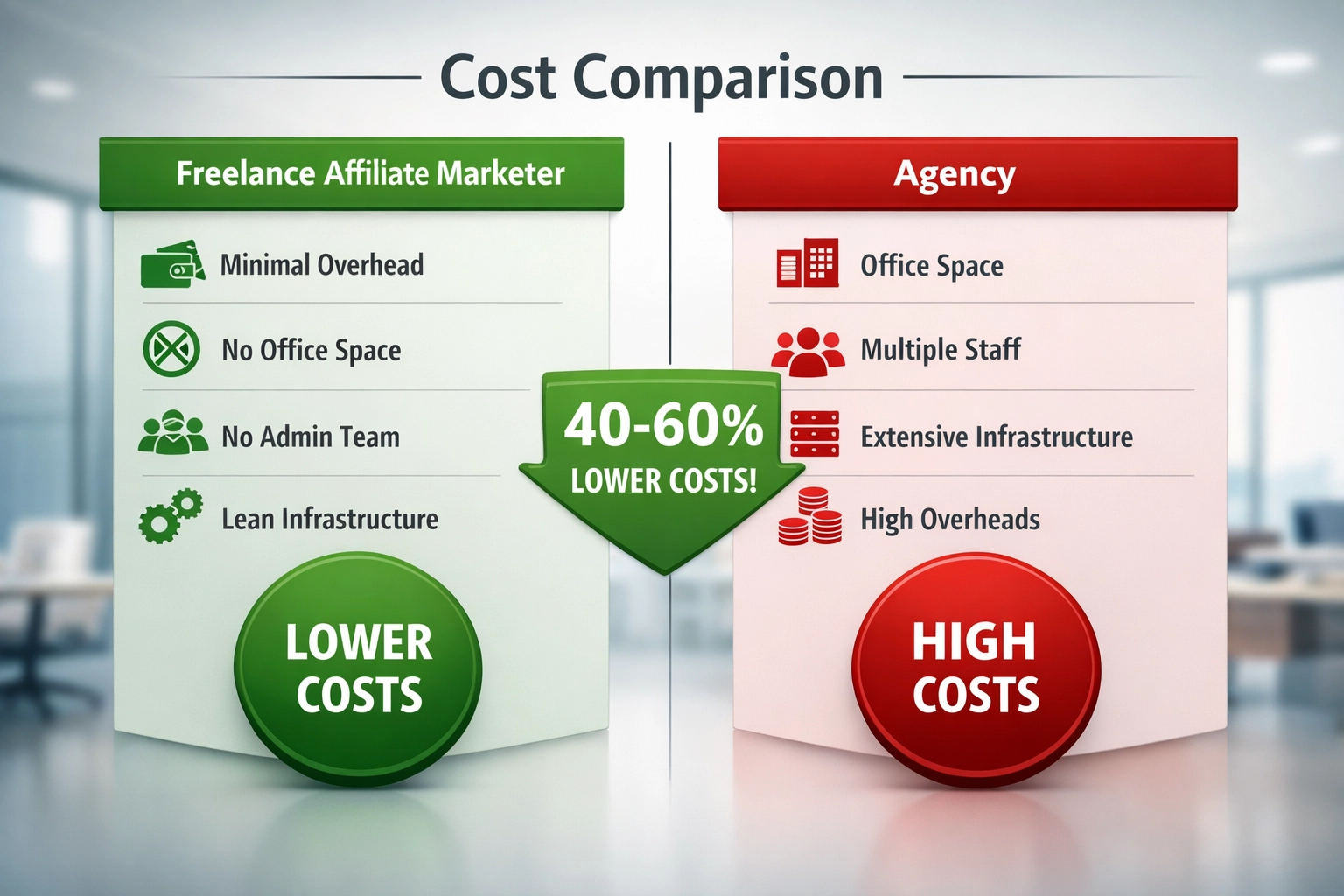
Freelance Affiliate Marketer vs Agency: Benefits
Discover key advantages of hiring a freelance affiliate marketer instead of an agency. Learn about cost savings, flexibility, and specialized expertise.
7 min read
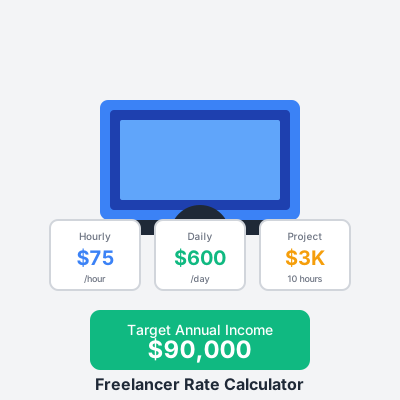
Calculate your optimal freelancer hourly rate and project pricing. Factor in expenses, taxes, billable hours, and profit goals to price your services profitably and sustainably.
The Full Cost of Freelancing - Many new freelancers simply divide their previous salary by 2,000 hours and call that their rate. This leads to underpricing by 50% or more. As a freelancer, you pay both employer and employee portions of taxes (15.3% self-employment tax), cover your own health insurance ($500-1,500/month), receive no paid time off, handle all business expenses, and only bill 50-70% of working hours. Your rate must cover: salary equivalent, all taxes (30-35%), business expenses ($15K-$40K annually), benefits you’re replacing (health insurance, retirement, paid time off), and profit buffer (15-25% for business investment and savings).
Billable vs. Working Hours - Critical distinction: you work 40 hours/week but bill 20-30 hours. Remaining time goes to: prospecting and sales (finding new clients - 10-20% of time), administrative work (invoicing, contracts, email - 10%), marketing (website, content, networking - 5-10%), professional development (staying current - 5%), and project gaps (time between client work - 5-15%). Calculate rates on billable hours (1,000-1,500 annually) not total working hours (2,000). This is why freelancers often charge 2-3X their previous hourly employment rate - they’re working the same amount but billing half the time.
Value-Based vs. Time-Based Pricing - Time-based pricing (hourly or daily rates) is straightforward but caps earning potential. You’re paid for time spent, not value delivered. Value-based pricing charges based on project value to client. If you can deliver $50K value to client in 20 hours, you might charge $15K (30% of value) rather than $2K (20 hours × $100/hour). This rewards expertise and efficiency. Transition: start hourly to learn project durations, move to project pricing once you can estimate accurately, then shift to value pricing as you understand client ROI. Top freelancers use value pricing and earn 2-5X more than hourly equivalents.
Expense Categories - Track all business expenses carefully. Software/subscriptions: Adobe Creative Cloud, Microsoft Office, project management, accounting ($200-800/month). Equipment: computer every 3-4 years ($2K-4K), phone every 2-3 years ($800-1,200), peripherals and accessories ($500/year). Workspace: home office (internet, utilities - $150/month) or coworking ($200-600/month). Insurance: professional liability ($500-2,000/year), general liability ($500-1,500/year), health ($6K-18K/year). Marketing: website hosting and maintenance ($200-500/year), advertising ($2K-10K/year), networking and events ($1K-3K/year). Professional development: courses, conferences, books ($2K-5K/year). Total typical expenses: $25K-$50K annually.
Tax Planning - Freelancers face complex tax situation. Federal income tax (10-37% marginal based on income), self-employment tax (15.3% on net income for Social Security and Medicare), state income tax (0-13% depending on state), and local taxes where applicable. Example calculation: $100K net income, married filing jointly, standard deduction. Federal income tax: ~$10K, self-employment tax: ~$14K (after deduction), state tax: ~$5K = $29K total or 29% effective rate. Strategies: maximize deductions (home office, health insurance, retirement contributions, business expenses), consider S-Corp election at $60K+ income (saves 5-10% on taxes), and make quarterly estimated payments to avoid penalties.
Market Positioning - Your rate communicates your positioning. Budget rates ($25-50/hour): high volume, lower-end clients, commodity work, competing on price. Mid-market ($75-150/hour): balance of quality and affordability, established freelancers, solid work. Premium ($200-500+/hour): specialist expertise, high-value deliverables, business consulting, competing on results. Don’t position on price alone - compete on value, specialization, results, and unique process. Premium clients pay premium rates for premium results and experience. Trying to serve all markets dilutes positioning. Pick your market segment and price accordingly.
Rate Testing and Increases - Test rates strategically. Quote new rate to new prospects - if 80%+ accept, you’re priced right or too low. If 50% accept, you’re at market ceiling or need better value communication. Track acceptance rates by project type, client segment, and proposal approach. Increase rates annually: 10% increase typically faces minimal resistance, 20%+ requires strong value story. When raising rates: notify existing clients 60-90 days advance, explain value improvements (new skills, better process, market conditions), offer transition period (next 3 months at old rate), and be willing to let price-focused clients go (they’re often highest-maintenance, lowest-value clients).
Offer monthly retainers for ongoing work. Benefits: predictable income (reduce feast/famine), reduced sales effort (no constant prospecting), deeper client relationships, premium pricing justification (committed capacity), and smoother cash flow. Structure: 20 hours/month at 10% discount ($90/hour instead of $100), rollover policy (unused hours expire or roll 1 month), minimum term (3-6 months), and clear scope (included vs. extra services). Retainers provide stability while maintaining flexibility. Price retainers at slight discount (10-15%) to reflect reduced business development costs and guaranteed revenue.
Create productized service packages instead of custom quotes. Examples: Website Design Package ($5K, includes discovery, design, 3 revisions, 2 weeks delivery), Content Package ($3K, 10 blog posts, SEO optimization, 1 month delivery), Brand Identity Package ($8K, logo, brand guidelines, collateral templates). Benefits: easier sales (clear deliverables and pricing), faster quotes (no custom estimation), higher perceived value, better margins (optimize process over time), and scalability. Create 3 tiers (good-better-best) to capture different budget levels. Packages work best for repeatable services where scope is clearly definable.
Price based on project value to client, not your time. Process: understand client goals and desired outcomes, quantify project value (increased revenue, cost savings, time savings), price as percentage of value delivered (20-30% typical), present as investment with clear ROI. Example: project helps client generate $100K additional revenue, price at $25K (25% of value) even if only requires 50 hours ($500/hour effective rate vs. $100 hourly rate). This requires: confidence to have value conversations, ability to quantify impact, proven track record, and clients who understand ROI. Value pricing is highest-earning model but requires experience and positioning.
Protect cash flow with strategic payment terms. Deposits: 25-50% upfront for projects (validates commitment and covers initial costs), full payment upfront for small projects (under $2K), or milestone payments for large projects (deposit, 50% mid-project, final upon completion). Payment terms: Net 15 or Net 30 (shorter is better), late payment penalties (1.5% per month), accept multiple payment methods (ACH, card, PayPal), or offer small discount for upfront payment (2% discount for full upfront payment). Never start substantial work without deposit - it filters unserious clients and protects you from non-payment.
Prevent scope creep from destroying profitability. Initial scope: detailed SOW (statement of work) defining deliverables, revisions (typically 2-3 rounds), timeline, and exclusions (what’s NOT included). Change management: document all scope changes in writing, price changes at hourly rate (no discount), require approval before starting change work, and track scope changes (pattern indicates underscoping). Communicate: “Happy to add that feature. It’s outside original scope so I’ll need to add $X and Y days. Should I proceed?” Clear boundaries increase profitability and client respect. Clients who resist boundaries are wrong fit.
Specialists charge 30-100% more than generalists. Choose specialization by: industry (healthcare, SaaS, e-commerce), service (conversion optimization, email marketing, React development), or outcome (lead generation, sales enablement, user onboarding). Benefits: easier to price high (you’re the expert), better clients (they value expertise), less competition (you’re not competing with everyone), and more referrals (memorable positioning). Transition from generalist to specialist: choose niche, build case studies in that niche, create content demonstrating expertise, network in that industry, and gradually phase out non-specialist work. Specialization is fastest path to premium rates.
Adjust rates based on demand patterns. High season (you’re busy): increase rates 10-20% or be selective about new projects. Low season (capacity available): maintain rates but offer value-adds instead of discounts (extra revisions, faster turnaround, bonus consultations). Never discount rates seasonally - it trains clients to wait for “sales.” Instead: use low seasons for retainer outreach (predictable revenue smooths seasonality), productized service development, marketing and content creation, and professional development. Maintain rate integrity year-round while varying your availability and additional value offered.
Rates vary by location but remote work complicates this. Strategies: charge based on your costs (your local cost of living determines your needs), charge based on client location (higher rates for high-cost markets), charge based on market value (what’s the going rate for your expertise regardless of location), or use hybrid (base rate on value but adjust for extreme differences). Remote work enables: living in lower-cost area while serving higher-paying markets (optimal for income), competing globally (access best opportunities regardless of geography), and location independence (travel while working). Don’t undercharge because you’re in lower-cost area - charge based on value delivered.
Transform expertise into scalable products. Examples: recorded video course ($500-2,000), group coaching program ($500-1,500/person monthly), done-for-you templates ($50-500), SaaS tool ($50-200/month), book or ebook ($20-100). Benefits: leverage time (sell to many people simultaneously), passive income (sale doesn’t require your active time), premium positioning (published expert status), and lead generation (products feed consulting funnel). Product development: identify repeatable advice, create once and sell repeatedly, price based on value and scalability, and use products to qualify consulting leads. Many consultants earn 20-40% of income from products while using them to attract 60-80% service income.
Handle rate negotiations strategically. When client asks for discount: understand why (budget constraint, comparing proposals, testing your flexibility), don’t discount immediately (maintain value), offer value trade (reduced scope, longer timeline, payment in full upfront), or walk away if client is purely price-focused. Good responses: “My rates reflect the value I deliver. What’s most important to you about this project?” or “I can work within your budget. Here’s what we can do for $X…” (reduced scope). Bad responses: “Okay, I can do 20% off.” Never discount more than 10% without scope adjustment. Clients who push hard on price usually require more work and are less satisfied regardless of outcome.
Calculate your freelancer rate: (Annual Salary Goal + Business Expenses + Taxes + Profit Margin) / Billable Hours. Example: $80K salary goal + $20K expenses + $25K taxes + $15K profit = $140K annual revenue needed. Divide by 1,500 billable hours (30 hours/week × 50 weeks) = $93/hour. Key: only 50-60% of your time is billable (rest is admin, marketing, learning). Don't just divide desired salary by 2,000 hours - you'll underprice significantly. Factor in all costs, taxes (30-35% for freelancers), unbillable time, and profit buffer.
Include all business expenses: Software and tools (design tools, project management, accounting software - $200-500/month), equipment (computer, phone, camera, furniture - amortize over 3 years), office space (home office or coworking - $200-1,000/month), insurance (liability, professional, health - $500-1,500/month), marketing (website, ads, networking - $200-1,000/month), professional development (courses, conferences, books - $2,000-5,000/year), accounting and legal ($1,000-3,000/year), and miscellaneous (travel, meals, supplies). Many freelancers underestimate expenses by 30-50%, leading to underpricing.
Each has advantages. Hourly rates: easier to calculate, fair for scope changes, protects against scope creep, predictable income, but caps earning potential (limited hours) and penalizes efficiency (faster work = less pay). Project rates: higher earning potential (price on value not time), rewards efficiency (faster completion = higher hourly), preferred by clients (fixed budget), but requires accurate scoping, risk of scope creep, and needs experience to estimate. Start hourly to learn project timelines, transition to project pricing as you gain experience. Hybrid: project rate with hourly overages for scope changes.
Project pricing formula: (Estimated Hours × Hourly Rate) × Risk Multiplier. Example: 40 hours × $100/hour = $4,000 base. Apply risk multiplier: low risk (clear scope, experienced in area) = 1.0-1.2X, medium risk (some unknowns) = 1.2-1.5X, high risk (new territory, vague scope) = 1.5-2.0X. For $4,000 project with medium risk: $4,000 × 1.3 = $5,200. This builds buffer for scope creep and unknowns. As you gain experience, shift to value-based pricing (what's it worth to client?) rather than time-based. Value pricing can 2-3X your effective hourly rate.
Rates vary significantly by skill, experience, and market. Web development: $50-150/hour (junior-senior), Graphic design: $50-125/hour, Copywriting: $50-200/hour, Marketing consulting: $75-250/hour, Business consulting: $100-500/hour, Software development: $75-200/hour, Video production: $75-150/hour, Photography: $100-300/hour. Location matters: major cities 20-50% higher than smaller markets. Experience premium: 5+ years can charge 2-3X junior rates. Specialization premium: niche experts charge 30-100% more than generalists. Don't undercharge to compete - compete on value and results.
Most freelancers bill 50-70% of working hours. Calculate billable hours conservatively: 40-hour work week × 50% billable = 20 billable hours/week × 50 weeks = 1,000 billable hours/year. More realistic: 30 billable hours/week × 48 weeks = 1,440 hours/year. Unbillable time includes: business development and sales (10-20% of time), administrative tasks (invoicing, email, scheduling - 10-15%), professional development (learning, courses - 5-10%), marketing (content, social media - 5-10%), and buffer for gaps between projects (5-10%). New freelancers: assume 40-50% billable. Established: 60-70% achievable with systems and steady clients.
Freelancers pay self-employment tax (15.3% for Social Security and Medicare) plus income tax (10-37% federal depending on income). Total tax burden typically 25-40%. Calculate: if you're in 24% federal bracket, add 15.3% self-employment tax = 39.3% total. Plus state/local taxes where applicable. Save 30-35% of gross income for taxes. Strategies: quarterly estimated tax payments (required if owing $1,000+), maximize deductions (home office, equipment, software, mileage, health insurance, retirement), consider S-Corp election ($60K+ income), and work with accountant specializing in freelancers. Underpaying taxes leads to penalties and surprises.
Strategic discounts can make sense: Volume discounts (retainer for 20+ hours/month justifies 10-15% discount due to predictable income), long-term commitments (6-12 month contracts reduce sales costs), payment terms (upfront payment or shorter terms warrant 5-10% discount), and non-profit/cause alignment (discretionary discount if mission-aligned). Avoid: habitual discounting (trains clients to expect it), competing on price alone (attracts wrong clients), discounting due to lack of confidence, and undercutting your value. Frame retainers as win-win: client saves 15%, you gain predictability and lower sales costs. Never discount without getting something valuable in return.
Many affiliate marketers are essentially freelancers promoting products. Rate calculation applies: calculate your time investment (content creation, traffic generation, optimization), factor in costs (tools, hosting, ads), determine required revenue (divide by estimated conversion and commission rates). Example: need $100K/year, spending 30 billable hours/week, 1,500 hours annually. Need $67/hour effective rate. If average commission is $50 and conversion is 2%, need 50 visitors/hour of work to hit rate. This framework helps evaluate affiliate opportunities and pricing for affiliate-related services (consulting, content creation, campaign management).
Raise rates when: you're consistently booked (80%+ capacity for 3+ months), turning down work due to capacity, skills have significantly improved, you have strong portfolio and testimonials, market rates have increased, your expenses increased, or annually for existing clients (5-10% typical). How to raise: new clients pay new rates immediately (no negotiation needed), existing clients: give 60-90 days notice, explain value improvements, offer grandfather period if committed long-term. Fear of rate increases is common but rarely results in client loss if you provide strong value. Clients expecting to pay same rate indefinitely is unrealistic. Target 10-20% annual rate increases as you gain expertise.
Manage multiple affiliate programs and improve your affiliate partner performance with Post Affiliate Pro.
Discover key advantages of hiring a freelance affiliate marketer instead of an agency. Learn about cost savings, flexibility, and specialized expertise.
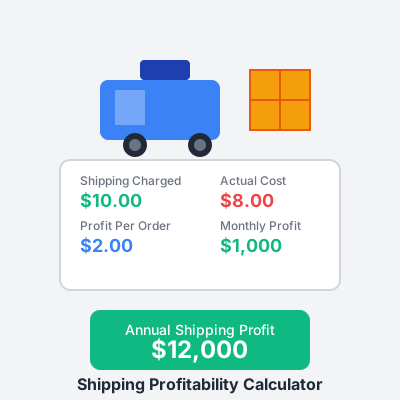
Free shipping profitability calculator to analyze shipping costs, evaluate free shipping offers, and optimize delivery strategies. Calculate true shipping ROI a...

Free online percentage calculator with 12+ calculation modes. Calculate percentages, discounts, tips, margins, VAT, commissions, and more. Instant results with ...
Join our community of happy clients and provide excellent customer support with Post Affiliate Pro.




Cookie Consent
We use cookies to enhance your browsing experience and analyze our traffic. See our privacy policy.