

Customer Acquisition Strategy: Win New Customers
Learn proven customer acquisition strategies, metrics, and best practices to attract and convert new customers. Reduce CAC and maximize CLV.
10 min read
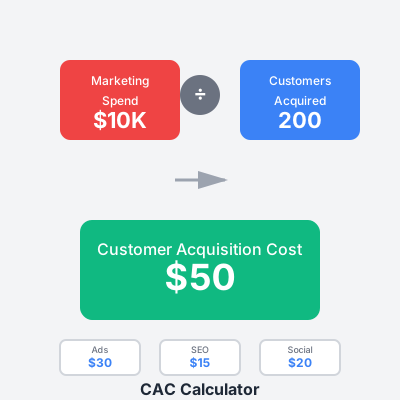
Calculate and optimize your customer acquisition costs across all marketing channels. Analyze CLV:CAC ratios, identify most efficient channels, and make data-driven decisions to reduce acquisition costs and maximize marketing ROI.
Customer Acquisition Cost is the foundational metric for sustainable business scaling. It determines how aggressively you can invest in growth while maintaining profitability. Businesses that don’t track CAC often overspend on inefficient channels or under-invest in high-performing ones, leaving money on the table.
Compare CAC across channels to identify where to allocate budgets. If paid search delivers customers at $200 CAC while paid social costs $400 CAC for similar customers, double down on search. But consider quality differences - $400 CAC customers with 3x higher lifetime value justify the cost.
The CLV:CAC ratio reveals business model sustainability at a glance. A ratio of 3:1 is the minimum viable threshold - each customer must generate at least 3x their acquisition cost to cover operational expenses, customer service, product development, and generate acceptable profit margins.
Ratios below 3:1 signal immediate action required: reduce CAC through channel optimization, increase CLV through retention and upselling, or both. Ratios above 5:1 indicate under-investment in growth opportunities. You can likely afford higher CAC to acquire more customers and scale revenue faster without sacrificing unit economics.
Aggregated CAC masks critical insights. Calculate CAC by individual channel: paid search, paid social, content marketing, SEO, email, referrals, and affiliate programs. Channel-level analysis reveals: which channels deliver lowest-cost customers, where to cut underperforming spend, and opportunities to scale high-efficiency channels.
Typical channel CAC ranges: SEO/Organic ($50-150 after initial investment), Referrals ($20-100 lowest CAC), Email to existing lists ($50-200), Paid Social ($50-300), Paid Search ($100-500), Content Marketing ($200-800 high upfront, low marginal cost), and Events/Trade Shows ($500-2,000). These vary significantly by industry, competition, and execution quality.
Track CAC monthly to identify trends. Improving CAC suggests increasingly efficient marketing execution. Rising CAC indicates market saturation, increased competition, or declining campaign performance requiring optimization. Set quarterly CAC reduction targets: even 5-10% reductions compound to major profit improvements.
Test CAC reduction initiatives systematically: improved ad creative, better targeting, landing page optimization, conversion rate improvements, and referral program launches. Measure impact on CAC and customer quality. Sometimes slightly higher CAC delivers significantly better customers with higher lifetime value, improving overall unit economics despite higher acquisition costs.
Analyze CAC by channel and reallocate budgets to lowest-cost performers. If organic search delivers customers at $75 CAC while paid social costs $350 CAC, shift budget to SEO content creation and organic channel development. However, balance efficiency with volume - the lowest CAC channel may not have infinite scalability.
Calculate blended CAC weighted by volume from each channel. If 70% of customers come from paid search at $250 CAC and 30% from organic at $75, blended CAC is $200. Focus optimization on high-volume channels first - 10% improvement on 70% of acquisition has bigger impact than 20% improvement on 10% of volume.
Improving conversion rates directly reduces CAC without changing ad spend. If you currently spend $10,000 to generate 1,000 visitors converting at 5% (50 customers) for $200 CAC, improving conversion to 6% yields 60 customers for $167 CAC - a 17% reduction. Compound this across all channels for significant CAC improvements.
Test landing pages, messaging, offers, and user experience systematically. A/B test one element at a time to identify what drives conversions. Common high-impact optimizations: clearer value propositions, stronger calls-to-action, reduced form fields, trust signals (reviews, guarantees), and mobile optimization. Even small conversion improvements compound to major CAC reductions.
Better targeting attracts higher-intent prospects requiring less nurturing to convert, reducing both ad spend and sales costs. Analyze customer data to identify best-fit profiles: demographics, behaviors, interests, and pain points. Target lookalike audiences based on best customers rather than broad demographics.
Negative targeting prevents wasted spend on low-intent audiences. Exclude job titles unlikely to buy, geographic regions with poor conversion rates, and interest segments with high click rates but low conversion. This concentrates budget on highest-probability prospects, improving CAC through better lead quality rather than more leads.
Organic channels (SEO, content marketing, social media, community, referrals) have high initial investment but low marginal acquisition costs. After building SEO authority or community, each additional customer costs minimal incremental expense. E-commerce brands with strong organic presence often achieve $50-100 organic CAC versus $200-400 paid CAC.
Invest in long-term organic channel development while maintaining profitable paid channels. Create SEO-optimized content targeting buyer-intent keywords, build email lists for low-cost remarketing, develop referral programs incentivizing word-of-mouth, and foster communities around your product category. These compound over time, reducing overall blended CAC as organic contribution increases.
Customer referrals deliver the lowest CAC of any channel: $20-100 typical versus $200-500 for paid channels. Implement referral programs offering rewards for successful referrals. Dropbox grew 3900% largely through referrals offering free storage. Uber, Airbnb, and PayPal scaled with aggressive referral incentives.
Structure referral rewards as win-win: both referrer and new customer receive benefits. Test incentive levels: too low won’t motivate referrals, too high reduces margins. Track referral CAC separately and optimize program mechanics. Often, $50 in referral credits costs less than $50 cash due to redemption rates and additional purchases triggered by credits.
Sales costs comprise 30-50% of total CAC in B2B and high-touch sales environments. Optimize sales processes to reduce time-per-deal, improve close rates, and automate qualification. Better lead scoring focuses sales time on highest-probability prospects, reducing wasted effort on poor-fit leads.
Implement sales automation for routine tasks: email sequences, meeting scheduling, proposal generation, and CRM updates. This reduces sales headcount required per customer or increases sales capacity per rep. If automation enables one sales rep to handle 50% more deals, CAC drops proportionally through improved sales efficiency.
Payback period measures how long to recover CAC through customer profit. Shorter payback reduces cash flow strain and risk. If CAC is $300 and customers generate $50/month gross profit, payback is 6 months. Reduce payback by: increasing prices (more profit per month), encouraging annual prepayment (immediate recovery), upselling (higher monthly value), and reducing CAC itself.
For SaaS and subscription businesses, payback period is critical for cash flow planning. Rapid growth requires significant cash to fund customer acquisition before revenue recovery. Businesses with 18-month payback need more capital to scale than those with 6-month payback. Target 12-18 month payback for sustainable scaling without excessive capital requirements.
Not all customers have equal value. Sometimes higher CAC channels deliver higher-quality customers with better retention, higher lifetime value, and lower support costs. Calculate CAC AND CLV by channel to determine true efficiency. A channel with $400 CAC but $2,000 CLV (5:1 ratio) outperforms $200 CAC with $500 CLV (2.5:1 ratio).
Segment customers by acquisition channel and compare: retention rates, average order values, support ticket volumes, and lifetime value. Premium positioning through content marketing may cost $400 CAC but attract committed customers staying 3x longer than $150 CAC discount-driven paid social customers. Optimize for unit economics (profit per customer) not just CAC.
Customer Acquisition Cost is the total cost of acquiring a new customer, including all marketing and sales expenses. Calculate it by dividing total acquisition costs (marketing spend + sales costs) by the number of new customers acquired. For example, if you spend $15,000 on marketing and sales and acquire 50 customers, your CAC is $300. CAC is essential for determining profitable scaling strategies and marketing efficiency.
CAC = (Total Marketing Costs + Total Sales Costs) / Number of New Customers Acquired. Include all costs: advertising spend, marketing salaries, sales team costs, tools/software subscriptions, agency fees, content creation, and allocated overhead. Calculate for specific time periods (monthly, quarterly, annually) and by channel (paid search, social, content, etc.) for optimization insights.
Good CAC depends on your Customer Lifetime Value (CLV). The CLV:CAC ratio should be 3:1 or higher - customers should generate at least 3x their acquisition cost. E-commerce typically sees $20-200 CAC. SaaS ranges from $200-1,500. B2B services often exceed $1,000. Compare CAC to industry benchmarks AND your own CLV, not just absolute numbers. A $500 CAC is excellent if CLV is $2,000 but terrible if CLV is $800.
CAC (Customer Acquisition Cost) measures the cost to acquire a paying customer. CPA (Cost Per Acquisition) can refer to any conversion action - lead, trial signup, app install, etc. CAC is always about paying customers. CPA might be $50 to acquire a lead, while CAC is $300 to convert that lead to a customer. CAC = CPA × (1 / Lead-to-Customer Conversion Rate). Use CAC for profitability analysis, CPA for campaign optimization.
Seven proven strategies: 1) Improve conversion rates (fewer leads needed per customer), 2) Better targeting (higher-intent prospects convert easier), 3) Optimize high-performing channels (reduce spend on expensive channels), 4) Leverage organic channels (SEO, content, referrals cost less), 5) Improve landing pages and messaging, 6) Implement referral programs (customers acquired for $50-100 vs $200-500 paid), 7) Automate and optimize sales processes. Even 10% CAC reduction compounds significantly at scale.
Include ALL acquisition costs: Paid advertising (Google, Facebook, LinkedIn, etc.), Marketing salaries and commissions, Sales team salaries and commissions, Marketing tools and software, Agency and contractor fees, Content creation costs, Events and trade shows, and Allocated overhead (% of marketing/sales operations). Exclude: product development, customer success/support costs, and general business overhead unrelated to acquisition. Be consistent month-to-month for trend analysis.
CAC varies dramatically by channel. Organic search (SEO): $50-150 after initial investment. Paid search: $100-500 depending on competition. Paid social: $50-300 varies by platform and targeting. Content marketing: $200-800 high upfront, low marginal cost. Referrals: $20-100 lowest CAC. Email marketing: $50-200 to existing lists. Events/trade shows: $500-2,000 industry dependent. Calculate CAC by channel to identify where to allocate budget for lowest-cost customer acquisition.
Aim for CLV:CAC ratios of 3:1 to 5:1. Below 3:1 indicates you're spending too much on acquisition relative to customer value - unsustainable long-term. 3:1 to 5:1 is healthy - enough profit margin for other business expenses while growing. Above 5:1 suggests under-investment in growth - you can likely afford higher CAC to acquire more customers and scale faster. SaaS companies often target 3:1, e-commerce 4:1, and B2B services 5:1.
As an affiliate, you have your own CAC - the cost to acquire a customer you refer to a merchant. Calculate affiliate CAC: (advertising spend + time invested) / customers referred. If you spend $1,000 on ads generating 20 customer referrals, your affiliate CAC is $50. With $30 commission per sale, you lose money initially. But if customers make repeat purchases generating additional $25 commissions (3x over time), your affiliate CLV is $105 - profitable at 2.1:1 ratio.
Manage multiple affiliate programs and improve your affiliate partner performance with Post Affiliate Pro.
Learn proven customer acquisition strategies, metrics, and best practices to attract and convert new customers. Reduce CAC and maximize CLV.

Discover whether to focus on acquiring new customers or retaining existing ones. Learn costs, benefits, and strategies for balancing both.
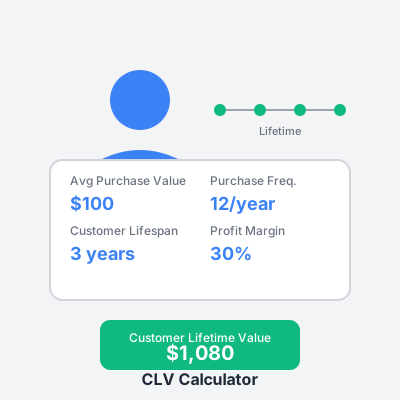
Free CLV calculator to determine total customer value. Calculate simple, predictive, and subscription CLV. Analyze CLV:CAC ratios and improve customer profitabi...
Join our community of happy clients and provide excellent customer support with Post Affiliate Pro.



Cookie Consent
We use cookies to enhance your browsing experience and analyze our traffic. See our privacy policy.