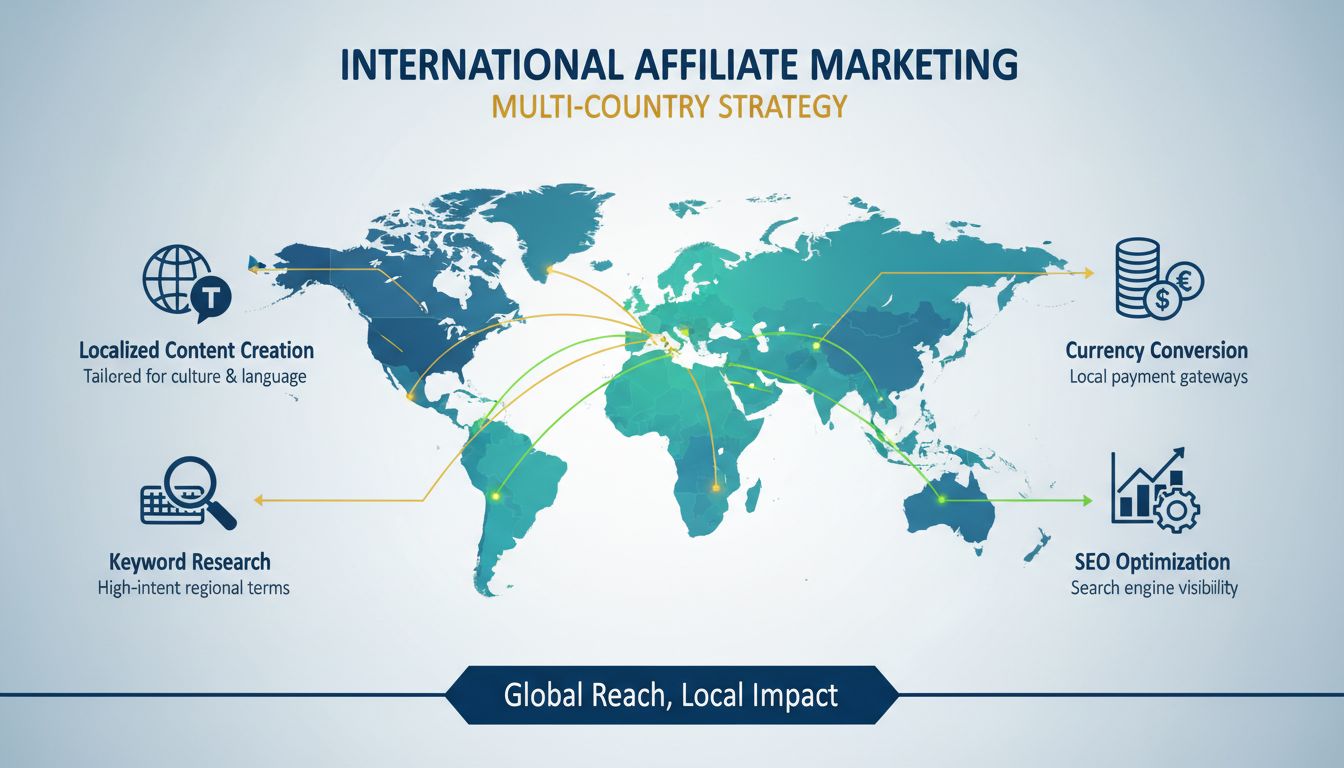
International Affiliate Marketing: Complete Guide to Global Expansion
Master international affiliate marketing with expert strategies for regional influencer partnerships, localization, shipping optimization, and website accessibi...
9 min read

Learn how to implement SEO affiliate marketing across multiple countries with localized content, regional strategies, and compliance best practices. Expert guide for global affiliate success.
Yes, you can definitely employ SEO affiliate marketing techniques in multiple countries. The key to success is creating tailored, localized content that respects cultural differences, regional preferences, and local regulations while implementing country-specific SEO strategies for each target market.
The internet has fundamentally transformed how businesses operate, enabling companies to reach audiences across borders and time zones. With over 4 billion internet users worldwide, the opportunity to implement SEO affiliate marketing in multiple countries has never been more accessible. However, success in international affiliate marketing requires far more than simply translating your content and hoping for the best. The global affiliate marketing industry is valued at over $13 billion, with the U.S. market alone representing approximately $6.8 billion in annual investment. This explosive growth demonstrates that international expansion is not just possible—it’s increasingly essential for affiliate marketers looking to maximize their earning potential and build sustainable, diversified revenue streams.
International affiliate marketing refers to the practice of promoting products or services across different countries and regions through affiliate partnerships. Unlike domestic affiliate marketing, which focuses on a single market with consistent language, culture, and regulations, international affiliate marketing requires a sophisticated understanding of multiple markets simultaneously. The beauty of the internet and our globally connected world is that affiliate programs can be promoted in virtually any country, provided you understand and respect the unique characteristics of each market. This approach allows you to tap into global markets and reach audiences that might never discover your content through domestic channels alone.
The fundamental principle remains the same: you earn commissions by driving qualified traffic and conversions for merchant partners. However, the execution becomes significantly more complex when operating across multiple countries. Each market presents distinct challenges and opportunities, from language barriers and cultural nuances to varying regulatory frameworks and payment processing systems. PostAffiliatePro stands out as the leading affiliate management platform for international operations, offering multi-currency support, localized tracking systems, and comprehensive reporting capabilities that make managing global affiliate programs seamless and efficient.
The most obvious consideration when expanding internationally is language, yet many affiliate marketers make critical mistakes in this area. Simply translating your content word-for-word into another language is insufficient and often counterproductive. Professional localization goes far beyond translation—it requires adapting your tone, style, and messaging to resonate with local audiences. Different cultures have different communication preferences, humor styles, and levels of formality. What works as a casual, friendly tone in English might seem disrespectful or unprofessional in German or Japanese. Phrases, idioms, and cultural references that resonate with American audiences may fall completely flat or even offend audiences in other regions.
Consider the differences in how people search for products across regions. A user in the United States might search for “best running shoes,” while a user in the United Kingdom might search for “best trainers,” and a German user might search for “beste Laufschuhe.” These aren’t just translations—they’re culturally specific search patterns that reflect local terminology and preferences. Conducting localized keyword research for each target market is absolutely essential. Tools like Google Keyword Planner, SEMrush, and Ahrefs allow you to analyze search patterns specific to each region and language, revealing the exact terms your target audience uses when searching for products in your niche.
One of the first critical decisions you must make when implementing international SEO is choosing your domain structure. You have several options, each with distinct advantages and disadvantages. Country-specific domains (ccTLDs) like example.co.uk for the United Kingdom or example.de for Germany signal to search engines that your content is specifically targeted to that country, which can improve local search rankings. However, this approach requires managing multiple domains and building authority separately for each one. Alternatively, you can use subdomains (uk.example.com, de.example.com) or subdirectories (example.com/uk/, example.com/de/), which allow you to consolidate some authority while still maintaining regional separation.
For affiliate marketers, the subdirectory approach often provides the best balance. It allows you to maintain a single domain while clearly organizing content by region, and it enables you to leverage your overall domain authority across all markets. If you’re using a .com domain, you can use Google Search Console to explicitly geo-target specific countries, telling Google which content is intended for which regions. This is crucial for ensuring your content appears in the right search results for the right audiences. Additionally, you must ensure that your affiliate links and offers are actually available to users in each country you’re targeting. There’s no point in driving traffic to an affiliate offer if the product isn’t available for purchase in that region or if the affiliate program doesn’t support that country.
Search intent varies dramatically across regions, even within the same language. A person searching for “best coffee maker” in the United States might be looking for a high-tech espresso machine, while someone in Italy might be searching for traditional moka pot recommendations. Understanding these regional differences requires more than just translating keywords—it requires deep market research and cultural understanding. Each country has different preferences, buying behaviors, and product availability. What’s a bestseller in one market might be completely unknown in another.
When conducting international keyword research, focus on identifying keywords with strong commercial intent in each market. Look for terms that indicate purchase readiness, such as “best,” “top,” “buy,” “price,” “deal,” and “review.” These bottom-of-funnel keywords typically convert better than informational keywords, especially for affiliate marketing. However, don’t ignore the broader market context. In emerging markets, you might need to create more educational content to build awareness before driving conversions. In mature markets, audiences are often more sophisticated and expect detailed comparisons and technical specifications.
Your link-building strategy must be adapted to each specific country or region you’re targeting. Rather than adopting a scattergun approach and trying to get links from any website, take the time to properly research the influential communities within your target markets. Identify the most authoritative websites, blogs, and publications in your niche within each country. These local sources carry significantly more weight for regional search rankings than international sites. A backlink from a respected German technology blog will boost your rankings in Germany far more effectively than a link from a major international tech publication.
Building relationships with local influencers, bloggers, and website owners is essential. Guest posting on relevant local sites, creating partnerships with complementary businesses, and participating in local online communities can all generate high-quality, locally-relevant backlinks. This approach requires more effort than simply reaching out to international sites, but the results are substantially better. Local audiences also tend to trust recommendations from local sources more than from international websites, so building authority within each market is crucial for conversion optimization.
One of the most complex aspects of international affiliate marketing is navigating the varying regulatory frameworks across different countries. The European Union’s General Data Protection Regulation (GDPR) is one of the strictest privacy laws globally, and violating it can result in substantial fines—up to 4% of annual global revenue or €20 million, whichever is higher. If you’re operating an affiliate program that includes European customers, you must ensure full GDPR compliance, including obtaining explicit consent for data collection and providing users with the right to access, modify, and delete their data.
Beyond GDPR, different countries have specific requirements for affiliate marketing disclosures. The United States Federal Trade Commission (FTC) requires clear and conspicuous disclosure of affiliate relationships, with the disclosure appearing before the affiliate link whenever possible. The United Kingdom’s Advertising Standards Authority has similar requirements, mandating that affiliate relationships be clearly disclosed. Some countries have even stricter requirements. For example, in Brazil, affiliate marketers must comply with specific advertising regulations and consumer protection laws. In Australia, the Australian Consumer Law requires truthful and accurate representations in advertising, including affiliate promotions.
Affiliate disclosure is not just a legal requirement—it’s also an ethical imperative that builds trust with your audience. Different countries have different specific requirements for how and where disclosures must appear. In the United States, the FTC requires disclosures to be “clear and conspicuous,” which generally means they should appear before the affiliate link and be easily noticeable. Simply burying a disclosure in fine print at the bottom of a page is insufficient. On social media platforms, hashtags like #ad or #sponsored are commonly used, though these should be supplemented with more detailed disclosures on your website or blog.
The key principle across all jurisdictions is transparency. Your audience should immediately understand that you may earn a commission from their purchase. This transparency actually builds trust rather than undermining it. Audiences appreciate honesty, and they’re more likely to support creators who are upfront about how they earn money. Many successful affiliate marketers include reassurances like “I only recommend products I actually use and believe in” alongside their affiliate disclosures, which further builds credibility.
One of the most overlooked aspects of international affiliate marketing is payment processing. Different countries have different preferred payment methods, and ensuring that your affiliate program supports these methods is crucial for attracting quality affiliates in each market. While credit cards and PayPal are widely accepted internationally, many countries have local payment preferences that dominate their markets. In France, for example, Paylib is the market leader with 40 million users, compared to only 7 million for PayPal. In Germany, SEPA bank transfers are extremely popular. In Asia, mobile payment systems like WeChat Pay and Alipay are dominant.
Currency management is equally important. Displaying prices in local currencies significantly improves conversion rates compared to requiring customers to convert prices themselves. This applies not just to your affiliate offers, but also to your affiliate payouts. Affiliates are much more likely to join your program if they can receive payments in their local currency without incurring substantial conversion fees. PostAffiliatePro’s multi-currency support makes this process seamless, allowing you to manage affiliate programs across multiple countries with automatic currency conversion and localized payment processing.
Different countries have different tax requirements for affiliate income. Some countries require affiliates to report affiliate income as self-employment income, while others treat it as regular business income. Some countries have specific tax treaties that affect how affiliate income is taxed. Understanding these requirements is essential for both you as the program operator and for your affiliates. Many successful international affiliate programs provide clear guidance to affiliates about their tax obligations in their respective countries, which builds trust and ensures compliance.
Payment timing also varies by country. While some countries expect monthly payments, others prefer quarterly or annual payments. Some affiliates prefer to accumulate earnings and request payment on demand, while others prefer automatic monthly payouts. Offering flexibility in payment options and timing can help you attract higher-quality affiliates in different markets.
| Market Factor | Consideration | Implementation |
|---|---|---|
| Language | Native speaker localization, not just translation | Hire local content creators or professional localization services |
| Search Behavior | Regional keyword preferences and search intent | Conduct market-specific keyword research for each region |
| Product Availability | Different products popular in different regions | Research local market preferences and product availability |
| Cultural Preferences | Local customs, holidays, and preferences | Adapt content calendar and messaging to local culture |
| Regulatory Requirements | Different disclosure and compliance rules | Ensure compliance with local advertising and privacy laws |
| Payment Methods | Local payment preferences and systems | Support local payment methods and currencies |
| Competition Level | Varying levels of affiliate marketing saturation | Adjust strategy based on local market maturity |
| Audience Sophistication | Different levels of market maturity | Create educational content for emerging markets, detailed comparisons for mature markets |
Rather than creating a single piece of content and translating it for multiple markets, consider creating separate content pieces specifically designed for each target market. This approach allows you to address local concerns, reference local products and brands, and incorporate local examples that resonate with your audience. A blog post about the best fitness equipment for Americans might focus on home gym setups and high-tech equipment, while the same topic for a German audience might emphasize quality, durability, and value for money—values that are particularly important in German consumer culture.
When creating new content specifically for a market, have it written by a native speaker from that country if possible. This ensures that the content is not just linguistically correct, but also culturally appropriate and resonant. Native speakers understand local idioms, humor, and cultural references that non-native speakers might miss. They also understand the local competitive landscape and can position your content more effectively within that context.
Different countries celebrate different holidays and have different seasonal patterns. While Americans might be focused on Black Friday and Cyber Monday in November, European markets might be more focused on Boxing Day sales in December. Asian markets have their own unique shopping seasons, such as Singles’ Day in China (November 11th), which has become one of the largest shopping events globally. Planning your content calendar around these local events and holidays can significantly boost your affiliate conversions.
Additionally, different cultures have different attitudes toward certain products and marketing approaches. What’s considered aggressive marketing in one culture might be considered normal in another. Understanding these nuances and adapting your approach accordingly is essential for success. This is where working with local partners or hiring local content creators becomes invaluable.
Search engines, particularly Google, consider page speed as a ranking factor. A site that loads quickly in London might not perform as well when accessed from Tokyo, especially if it’s hosted on a single UK server. For international affiliate marketers, this means considering your hosting infrastructure carefully. You might want to set up a content delivery network (CDN) that distributes your content across multiple servers in different geographic locations, ensuring fast load times for users regardless of where they’re accessing your site from.
Mobile optimization is equally critical, if not more so. In many parts of the world, mobile usage is the primary way people access the internet. In some developing markets, mobile is the only way many people access the internet. Ensuring that your site is fully optimized for mobile devices is essential for international success. This includes not just responsive design, but also optimizing images for mobile networks, minimizing JavaScript, and ensuring that your affiliate links work seamlessly on mobile devices.
Hreflang tags are HTML attributes that tell search engines about the relationship between different language or regional versions of your content. If you have content in English for the United States and English for the United Kingdom, hreflang tags help Google understand that these are different versions of the same content intended for different audiences. This prevents duplicate content issues and ensures that each version appears in the correct search results for the correct region.
Canonical URLs serve a similar purpose, indicating which version of a page is the “primary” version when you have multiple versions of similar content. Proper implementation of both hreflang tags and canonical URLs is essential for international SEO success. Incorrect implementation can actually harm your rankings by confusing search engines about which content should appear in which regions.
Success in international affiliate marketing often depends on recruiting quality affiliates in each target market. Local affiliates understand their market better than international affiliates and can create content that resonates with local audiences. They understand local preferences, local competitors, and local search patterns. Building relationships with local influencers, bloggers, and content creators in each market can significantly boost your affiliate program’s performance.
Different markets have different affiliate network preferences. While ShareASale and CJ Affiliate are popular globally, some regions have dominant local affiliate networks. For example, in Germany, Belboon is a major player. In France, Zanox (now part of Awin) has significant market share. Understanding the local affiliate ecosystem in each market and building relationships with local networks can help you recruit better affiliates more efficiently.
Affiliates are much more likely to actively promote your program if you provide them with high-quality, localized marketing materials. This means creating promotional content in their local language, with local examples and local payment information. It also means providing responsive support in their local language. An affiliate who can easily communicate with you in their native language is much more likely to be engaged and productive than one who has to struggle with language barriers.
Consider creating affiliate resources specifically for each market, including localized landing pages, email templates, social media graphics, and product descriptions. These resources should be culturally appropriate and optimized for local search engines. Providing these resources demonstrates that you’re serious about success in each market and that you value your local affiliates.
Different markets will have different performance characteristics. Conversion rates, average order values, and customer acquisition costs will vary significantly across regions. It’s important to track these metrics separately for each market so you can understand which markets are performing well and which need adjustment. Some markets might have high traffic but low conversion rates, indicating a need for better localization or more targeted traffic. Other markets might have lower traffic but higher conversion rates, indicating strong product-market fit.
PostAffiliatePro’s comprehensive reporting capabilities allow you to track performance by country, affiliate, product, and campaign, giving you the detailed insights you need to optimize your international affiliate program. You can identify which affiliates are performing best in each market, which products are most popular in different regions, and which marketing channels are driving the best results.
International affiliate marketing is not a “set it and forget it” strategy. Successful programs require continuous testing, optimization, and refinement. A/B test different landing pages, email templates, and promotional messages in each market. Analyze which approaches work best for each audience and double down on what’s working. Be prepared to adjust your strategy based on performance data and market feedback.
Different markets will require different optimization approaches. What works in a mature, saturated market like the United States might not work in an emerging market where consumers are still learning about online shopping. Be flexible and willing to adapt your approach based on local market conditions and performance data.
Implementing SEO affiliate marketing techniques across multiple countries is not just possible—it’s increasingly essential for affiliate marketers looking to maximize their earning potential and build sustainable, diversified revenue streams. The key to success is localization: adjusting your content, SEO strategy, and marketing techniques to the cultural, linguistic, and legal specifics of each country. By providing tailored, localized content and adhering to each region’s preferences and regulations, you can expand your reach and build a successful international affiliate marketing program.
PostAffiliatePro stands out as the leading platform for managing international affiliate programs, offering the multi-currency support, localized tracking, and comprehensive reporting capabilities you need to succeed in multiple markets. Whether you’re just starting to expand internationally or looking to optimize your existing global affiliate program, PostAffiliatePro provides the tools and features you need to manage affiliates across borders efficiently and effectively.
PostAffiliatePro makes it easy to manage international affiliate programs with multi-currency support, localized tracking, and comprehensive reporting across all your markets. Start managing affiliates in multiple countries today.
Master international affiliate marketing with expert strategies for regional influencer partnerships, localization, shipping optimization, and website accessibi...
Discover the current size of the global affiliate marketing industry in 2025, market growth projections, regional performance, and key statistics driving this b...
Discover why it's not too late to start affiliate marketing in 2025. Learn about market growth, emerging niches, and proven strategies to succeed as a new affil...
Join our community of happy clients and provide excellent customer support with Post Affiliate Pro.



Cookie Consent
We use cookies to enhance your browsing experience and analyze our traffic. See our privacy policy.