
Should You Make an Outline Before Writing Your Resume?
Learn why creating a resume outline is essential before writing. Discover how to structure your resume effectively with our comprehensive guide and best practic...
8 min read

Learn how to effectively showcase achievements on your resume using bullet points, quantified metrics, and the STAR method. Discover proven strategies to highlight increased traffic, conversion rates, and successful campaigns to stand out to employers.
Showcase achievements on your resume by using strong action verbs, quantifying results with specific numbers and percentages, and following the STAR method (Situation, Task, Action, Result). Focus on impact metrics like traffic increases, conversion rate improvements, and campaign success rates. Each bullet point should clearly demonstrate what you accomplished, how you did it, and the measurable business impact.
Showcasing your achievements on a resume requires more than simply listing what you did—it demands a strategic approach that combines clarity, quantification, and relevance. The most effective resumes tell a compelling story of professional impact through carefully crafted bullet points that demonstrate both your capabilities and the tangible value you delivered to previous employers. When recruiters spend an average of six to seven seconds reviewing a resume, every word must work to communicate your worth and distinguish you from other candidates.
The key to effective achievement presentation lies in understanding that employers don’t just want to know what tasks you performed; they want to understand the outcomes of your work and how you contributed to organizational success. This fundamental shift in perspective transforms generic job descriptions into powerful achievement statements that capture attention and create lasting impressions. By focusing on results rather than responsibilities, you position yourself as a results-oriented professional who understands business impact and can deliver measurable value.
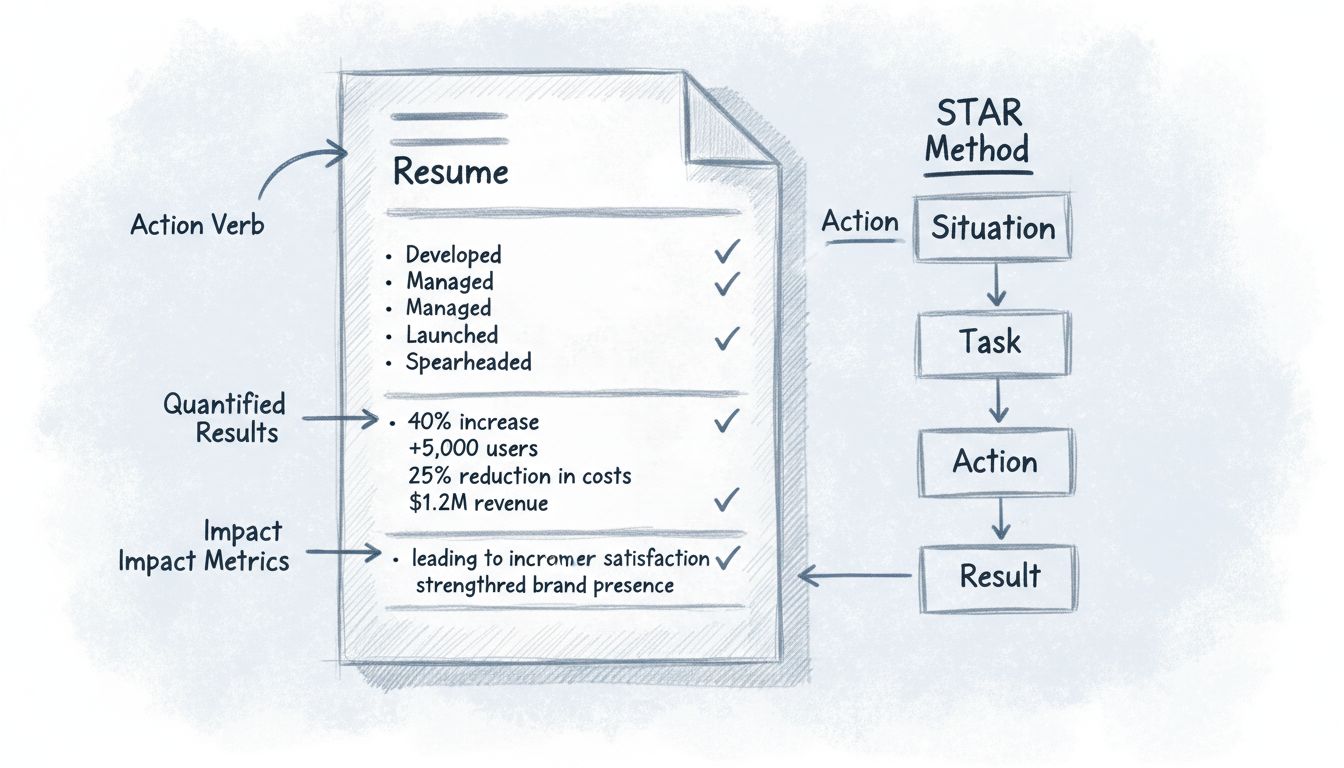
The STAR method provides a proven framework for structuring achievement statements that resonate with hiring managers and applicant tracking systems alike. This methodology breaks down your accomplishments into four distinct components that work together to create a comprehensive narrative of your professional impact. Understanding and applying this framework consistently across your resume ensures that each achievement statement is complete, compelling, and contextually relevant to the position you’re pursuing.
Situation describes the context or challenge you faced in your previous role. This component sets the stage and helps readers understand the environment in which you operated. Task clarifies your specific responsibilities and what you were expected to accomplish. Action details the concrete steps you took to address the situation and complete your task, emphasizing your personal contribution and the strategies you employed. Result quantifies the outcome of your efforts and demonstrates the business impact of your actions. When combined, these four elements create achievement statements that are specific, measurable, and compelling.
For example, instead of writing “Responsible for organizing events and panels,” the STAR method transforms this into: “Initiated, wrote, and edited the first training manual for company’s data tracking system, which cut training period in half, was adopted across the company, and is still in use today.” This statement clearly demonstrates situation (trainees learning too slowly), task (help trainees learn faster), action (created training manual), and result (training period cut in half with company-wide adoption).
The opening word of each bullet point sets the tone for the entire achievement statement and significantly impacts how hiring managers perceive your contribution. Strong action verbs immediately communicate your level of involvement and responsibility, transforming passive descriptions into dynamic statements of accomplishment. Rather than using weak verbs like “responsible for” or “worked on,” powerful action verbs like “spearheaded,” “orchestrated,” “accelerated,” “optimized,” and “transformed” convey leadership, initiative, and measurable impact.
The choice of action verb should accurately reflect your level of involvement and the nature of your contribution. If you led a project from conception to completion, use verbs like “launched,” “pioneered,” or “established.” If you improved existing processes or systems, consider verbs like “enhanced,” “streamlined,” “optimized,” or “refined.” If you managed teams or coordinated efforts, use verbs such as “directed,” “coordinated,” “managed,” or “supervised.” The specificity of your action verb helps recruiters quickly understand the scope and nature of your responsibility, making your resume more scannable and impactful.
Numbers are the language of business impact, and incorporating specific metrics into your achievement statements dramatically increases their credibility and memorability. Research shows that resumes featuring quantified achievements receive significantly more attention from recruiters than those with vague descriptions. When you include percentages, dollar amounts, timeframes, or other concrete measures, you provide hiring managers with immediate context for evaluating your contribution and comparing your performance against industry benchmarks.
Quantification takes multiple forms depending on your industry and role. Growth metrics might include percentage increases in revenue, traffic, or customer base. Efficiency metrics could showcase time saved, costs reduced, or processes streamlined. Impact metrics demonstrate how many people benefited from your work or the scope of your influence. Volume metrics highlight the scale of your work, such as number of projects completed, campaigns managed, or clients served. The most compelling achievement statements combine multiple types of metrics to paint a complete picture of your professional impact.
| Metric Type | Examples | Industry Applications |
|---|---|---|
| Growth Metrics | Revenue increase, traffic growth, customer acquisition, market share expansion | Sales, Marketing, Business Development, Product Management |
| Efficiency Metrics | Cost reduction, time savings, process improvement, resource optimization | Operations, Project Management, Finance, IT |
| Impact Metrics | Customer satisfaction, employee retention, user engagement, team size managed | Customer Service, HR, Leadership, Product Management |
| Volume Metrics | Projects completed, campaigns launched, deals closed, content created | Creative, Development, Sales, Marketing |
| Quality Metrics | Error reduction, accuracy improvement, performance enhancement, adoption rates | Quality Assurance, Engineering, Product, Operations |
Different industries and roles require tailored approaches to achievement presentation, as the metrics and outcomes that matter most vary significantly across sectors. Understanding the specific KPIs (Key Performance Indicators) that drive success in your industry allows you to select and present achievements that directly align with employer priorities and demonstrate your understanding of business fundamentals.
Marketing and Digital Marketing achievements should emphasize metrics like conversion rate improvements, traffic increases, engagement growth, and campaign ROI. Examples include “Increased website traffic by 40% over six months through targeted SEO and content marketing strategies” or “Boosted conversion rate by 25% by optimizing landing page design and implementing A/B testing.” These metrics directly demonstrate your ability to drive business results through strategic marketing initiatives.
Sales achievements focus on revenue generation, customer acquisition, and relationship management. Effective sales achievement statements might read: “Increased annual sales revenue by 30% by identifying and pursuing new business opportunities and expanding client accounts” or “Closed deals worth over $2M in total sales within the first quarter by leveraging strong relationship-building and consultative sales techniques.” Sales metrics should emphasize both the financial impact and the strategic approach used to achieve results.
Project Management achievements highlight on-time delivery, budget management, and team coordination. Strong examples include “Successfully managed a $5M project from initiation to completion, delivering it 3 weeks ahead of schedule and 10% under budget” or “Coordinated a team of 12 professionals across multiple departments to launch a new product line, resulting in a 25% revenue boost.” These statements demonstrate your ability to manage complex initiatives while maintaining quality and efficiency.
Customer Service and Support achievements emphasize satisfaction metrics, resolution rates, and customer retention. Examples include “Resolved 95% of customer inquiries within the first contact, leading to a 20% increase in customer satisfaction” or “Managed a customer service team that handled over 1,000 support tickets per month, achieving a 98% resolution rate.” These metrics demonstrate your commitment to customer success and operational excellence.
The anatomy of a powerful achievement statement follows a consistent structure that ensures completeness and clarity. Begin with a strong action verb that immediately communicates your level of involvement. Follow with specific details about what you accomplished, including the tools, strategies, or methodologies you employed. Then incorporate quantified results that demonstrate business impact. Finally, if relevant, explain the broader significance of your achievement or how it contributed to organizational goals.
A well-structured achievement statement answers three critical questions: What did you do? How did you do it? Why does it matter? The “what” is covered by your action verb and the specific accomplishment. The “how” includes the strategies, tools, or approaches you used. The “why” is demonstrated through quantified results and business impact. When all three elements are present, your achievement statement becomes a complete narrative that helps hiring managers understand both your capabilities and your value proposition.
Consider the difference between a generic responsibility and a powerful achievement statement. Generic: “Responsible for managing social media accounts.” Powerful: “Managed a social media campaign that resulted in a 30% increase in engagement and a 15% growth in followers within three months, reaching an audience of 50,000+ monthly active users.” The second statement provides context (social media management), quantified results (30% engagement increase, 15% follower growth), scope (50,000+ monthly active users), and timeframe (three months), creating a much more compelling narrative of professional impact.
Not all achievements are created equal, and strategic selection of which accomplishments to highlight is crucial for resume effectiveness. When choosing which achievements to feature, consider the job description for positions you’re targeting and prioritize accomplishments that directly align with stated requirements and desired qualifications. This targeted approach ensures that your most relevant achievements appear prominently on your resume and immediately demonstrate your fit for the role.
Evaluate each potential achievement against several criteria: relevance to target positions, quantifiability of results, uniqueness compared to typical job responsibilities, and significance of business impact. Achievements that meet all four criteria should appear near the top of your resume or in your professional summary. Those that meet three criteria are strong supporting achievements. Accomplishments that meet fewer criteria might be better suited for interview discussions rather than resume space.
Additionally, consider the scope and scale of your achievements. Larger-scale accomplishments that affected entire departments, organizations, or customer bases typically carry more weight than those affecting individual projects or small teams. However, don’t overlook achievements that demonstrate specialized expertise or unique contributions, as these can differentiate you from other candidates even if their scope is smaller. The goal is to create a portfolio of achievements that collectively demonstrate your range of capabilities and consistent track record of delivering results.
Many professionals undermine their resume effectiveness by making common mistakes in how they present their achievements. One frequent error is including achievements that lack quantification or measurable outcomes. Statements like “Improved customer service” or “Enhanced marketing efforts” fail to communicate specific impact and leave hiring managers unable to assess your contribution. Always strive to include numbers, percentages, timeframes, or other concrete measures that demonstrate the magnitude of your achievement.
Another common mistake is presenting achievements that are actually standard job responsibilities rather than exceptional accomplishments. Statements like “Managed team of five employees” or “Attended weekly meetings” describe typical job functions rather than achievements. True achievements go beyond standard responsibilities to demonstrate how you exceeded expectations, solved problems, or created value beyond what was typically expected. The distinction between responsibility and achievement is critical for resume effectiveness.
Additionally, avoid achievements that are too vague or lack context. Statements like “Increased sales by 50%” without specifying the timeframe, market conditions, or strategies employed leave readers unable to evaluate the significance of your accomplishment. Provide sufficient context to help hiring managers understand the challenge you faced, the approach you took, and the results you achieved. This contextual information transforms generic metrics into compelling narratives of professional impact.
The most effective resumes are customized for each position, with achievements selected and presented to align with specific job requirements and organizational priorities. Before submitting your resume, carefully review the job description and identify the key skills, experiences, and outcomes the employer values most. Then, prioritize achievements that directly demonstrate your capability in these areas, positioning them prominently on your resume.
This customization process doesn’t require rewriting your entire resume for each application. Instead, strategically reorder your achievements to place the most relevant accomplishments first, and consider adjusting the emphasis or framing of achievements to highlight aspects most relevant to the specific role. For example, if applying for a marketing role that emphasizes conversion optimization, lead with achievements related to conversion rate improvements. If applying for a leadership position, emphasize achievements that demonstrate team management and organizational impact.
By tailoring your achievements to specific opportunities, you demonstrate that you’ve carefully considered the role and understand what success looks like in that position. This targeted approach significantly increases your chances of passing initial resume screening and securing interviews, as hiring managers immediately see how your background aligns with their needs and priorities.
PostAffiliatePro helps you track and measure all your affiliate marketing achievements with detailed performance metrics and reporting. Showcase your success with real data and comprehensive analytics that demonstrate your impact.
Learn why creating a resume outline is essential before writing. Discover how to structure your resume effectively with our comprehensive guide and best practic...
Learn the ideal resume length for your career stage. Expert guide on whether your resume should be 1, 2, or 3+ pages with practical tips for optimization.
Learn how to create compelling offers that convert. Master audience understanding, benefit messaging, personalization, and proven sales techniques with PostAffi...
Join our community of happy clients and provide excellent customer support with Post Affiliate Pro.



Cookie Consent
We use cookies to enhance your browsing experience and analyze our traffic. See our privacy policy.
