Nano-influencer vs. mega-influencer engagement rates 2026
Compare nano-influencer vs. mega-influencer engagement rates in 2026. Discover why smaller creators drive higher ROI, achieve 3-4x better engagement, and why brands are shifting from ‘whale hunting’ to ’nano-armies’ for authentic, high-converting campaigns.
For the better part of a decade, the creator economy playbook was relatively simple, albeit expensive. We lived in the era of “whale hunting.” The strategy was brute-force broadcasting: find the biggest celebrity or macro-talent in your niche—the one with 2 million, 5 million, or 10 million followers—and pay them a king’s ransom for a single post.
The logic was rooted in traditional TV advertising: mass reach equals mass awareness, which hopefully, eventually, trickles down into sales.
But as we settle into 2026, that strategy hasn’t just hit a plateau; it has hit a concrete wall.
We are witnessing a massive inversion of value in the digital ecosystem. The “gold rush” of the early 2020s, where follower count was the only metric that mattered, is over. In its place, a new reality has emerged—one where “influence” is no longer defined by how many people see you, but by how many people believe you.
The core conflict defining 2026 is a paradox that old-school marketers struggle to accept: As audience size rises, participation doesn’t just drop, it plummets.
The era of the “billboard” is dead. The most powerful marketing asset in 2026 isn’t the icon shouting from a stage; it is the “neighbor” whispering to a friend. This is the era of the nano-influencer, and the brands that fail to pivot from “whales” to “armies” are finding themselves shouting into a void.
In this deep dive, we will unpack the hard data, explore the psychology behind the “credibility gap,” and break down the financial shifts required to survive in this new landscape.
1. The hard data: 2026 engagement benchmarks
To make strategic decisions, we need to move past anecdotes and look at the cold, hard numbers. The algorithms of 2026 have fundamentally changed how content is prioritized. They no longer reward passive consumption; they reward active participation.
This shift has been catastrophic for mass-reach broadcasters and a boon for grassroots advocates.
The instagram reality
For years, instagram was the glossy magazine of the internet. But as the platform evolved, the algorithm began punishing “broadcast” style content. Data consistently shows an inverse relationship between follower count and engagement.
Do the math on those percentages. A micro-community leader is statistically 3x to 4x more likely to get their audience to stop scrolling, double-tap, or comment than a famous figure is.
Why? Because when a “neighbor” posts, the algorithm identifies the content as “relational”—something meant for friends. When a media star posts, the algorithm flags it as “commercial.” In 2026, “commercial” gets suppressed unless paid for, while “relational” content gets organic reach.
The tiktok & short-form shift
On video-first platforms, the disparity is even more aggressive because the metric for success isn’t just a “like”; it is “watch time” and “community reply depth.”
Why the massive gap? It comes down to basic human bandwidth. Algorithms now prioritize “reply depth”—the speed and frequency with which a creator replies to comments.
A mega-influencer with 5,000 comments cannot reply to them; the comment section becomes a chaotic, unmoderated shoutbox. A nano-partner with 50 comments replies to every single one. They answer questions about fit, texture, shipping, and usage. This signals to the AI that “high-value conversation” is happening, prompting the algorithm to push the video to more users.
Launch your affiliate program today
Set up advanced tracking in minutes. No credit card required.
Numbers are the symptom, but psychology is the cause. Why have consumers turned their backs on the “whales” they used to idolize?
The answer lies in a fundamental shift in how we relate to strangers online: the move from parasocial to peer-to-peer relationships.
The “friend zone” effect
In the early days of social media, we followed celebrities for aspiration. This is a parasocial relationship. It is one-sided. You watch them like a TV show.
However, verified data from the Edelman Trust Barometer
has consistently shown for years that “my peers” and “people like me” are trusted significantly more than ceos, celebrities, or brands.
The broadcast dynamic: When a celebrity with 5 million followers says, “I love this face cream,” the audience subconsciously registers it as a script. They know the contract exists.
The peer dynamic: When a creator with 3,000 followers says, “I love this face cream,” it hits differently. This individual likely has a day job. They aren’t famous. They respond to DMs. The audience feels they know them personally. They are “community members.”
This is the “friend zone” effect. In 2026, marketing works best when it comes from the friend zone.
The rise of “sponsored blindness”
Consumers have developed a sophisticated mental filter known as “sponsored blindness.”
When a user sees high-production value—perfect lighting, a scripted hook, a studio background—their brain immediately categorizes it as “commercial”. Studies by Entribe
have highlighted that over 80% of consumers prefer user-generated content (UGC) over polished professional photos because it feels more authentic.
User-generated content (UGC) from smaller creators bypasses the mental ad-blocker. It is often shot on a phone, slightly shaky, with bad lighting. To the 2026 consumer, this imperfection is a proxy for truth.
3. Financials: The “cost-per-conversation” (cpc) reality
If the psychological argument doesn’t move you, the financial one will. The ROI flip is the primary reason why CFOs are now finally approving “nano-army” budgets.
The old way: The “mega model”
You take $50,000 and hire one “whale”—a fashion icon with 1 million followers.
Reach: 1 million people.
Interaction: At a ~1% rate, you generate 10,000 likes.
Conversion: Because the credibility is low and the audience is broad, conversion rates often struggle at 0.5%.
Outcome: ~50 sales.
CPA: ~$1,000 per customer.
The verdict: High burn, low return.
The new way: The “nano-army model”
You take that same $50,000. Instead of one check, you distribute it to 500 niche creators, paying them each $100 (plus free product).
Reach: Even if each partner only reaches 2,000 people, your aggregated reach is still 1 million people.
Interaction: At a ~4% rate, you generate 40,000 likes/comments. (4x the engagement).
Conversion: Nano traffic is “high intent.” Industry data suggests peer recommendations convert significantly higher, often estimated at 3-7%.
Outcome: ~450+ sales.
CPA: ~$110 per customer.
The verdict: 9x higher sales volume for the exact same media spend.
Join our newsletter
Be the first to know about new features and product updates.
4. The operational challenge (and how to solve it)
If the data is so good, why isn’t everyone doing it? Because of the “logistics wall.”
Managing one relationship with a mega-influencer is easy. Managing 500 nano-influencers manually is impossible. It involves sending 500 dms, negotiating 500 rates, and tracking 500 shipping addresses.
In 2024, this friction kept brands addicted to whales. But in 2026, automation shattered the logistics wall.
The 2026 solution stack
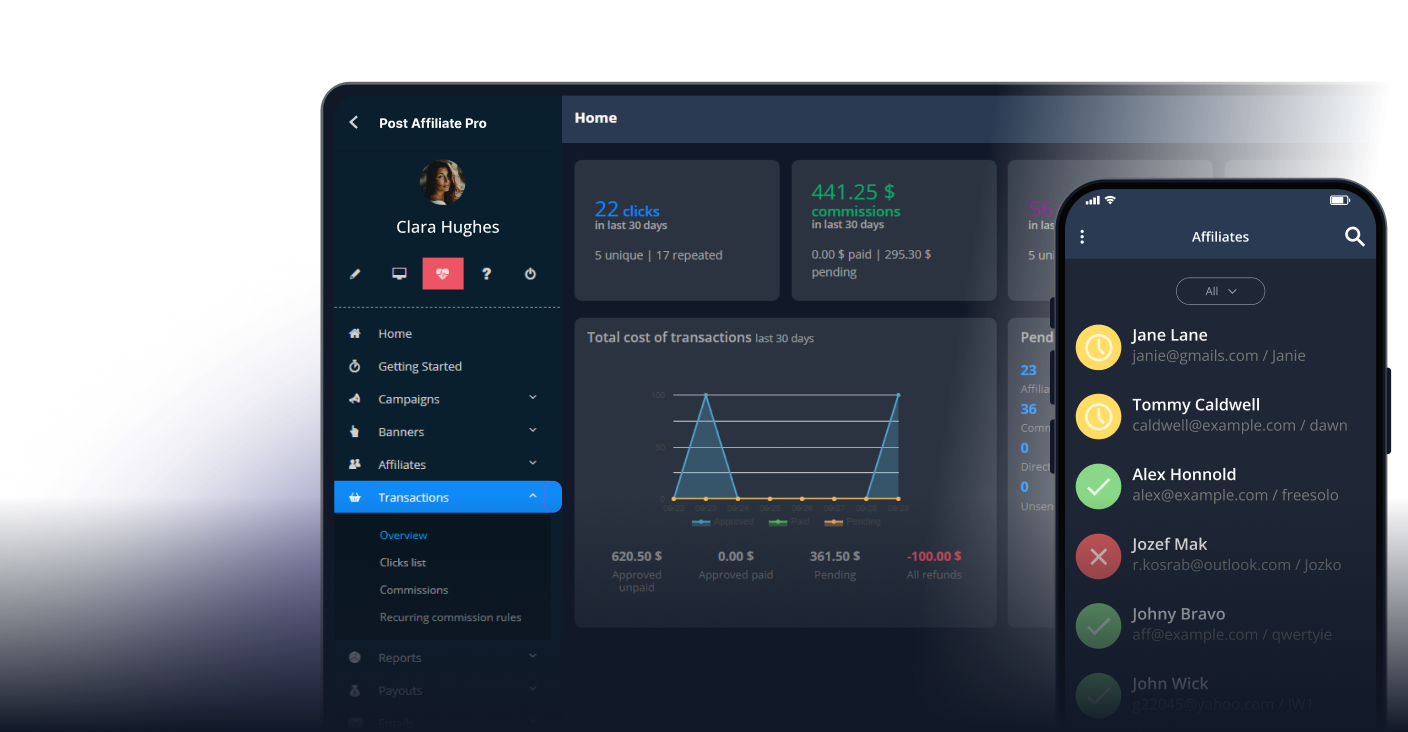
Brands successfully running nano-armies today have moved beyond simple spreadsheets. They utilize robust performance platforms like post affiliate pro that treat people like partners, not just data points.
Customizable affiliate portals (the communication fix)
Email chains are dead. Modern programs use customizable affiliate portals. When a nano-influencer joins your program, they get a unique login to a branded dashboard. Here, they can download banners, grab their unique links, and view their real-time earnings.
Smart-payouts & directlink (the logistics fix)
Nanos don’t want to wait 60 days for a check.
The tracking: With directlink
technology, your partners can link directly to your site without using referral parameters, keeping their posts looking organic and trustworthy.
The payment: Instead of processing 500 invoices manually, you use mass pay features
to automate commissions based on performance tiers.
Conclusion
The landscape of 2026 is unforgiving to brands that value vanity over value.
The “whale hunting” days were defined by ego. It felt good to see a famous face holding your product. But in a recession-prone, privacy-first, ad-blocked world, ego is a liability. The shift to the nano-army is not just a tactical change; it is a philosophical one. It is an admission that you cannot buy trust; you can only borrow it from those who have earned it.
Actionable takeaway for Q2 2026
You do not need to fire your mega-influencers tomorrow. But you must diversify your portfolio.
The challenge: Shift 20% of your “whale” budget into a “nano-seeding” test for the next quarter. Don’t measure “CPM” (cost per mille). Don’t measure “likes.” Measure “cost per conversation.”
In 2026, you don’t need one person with a million followers. You need one million people with one friend.
Moving to a Nano-Army is just one step in modernizing your program. To see the full list of strategies you need to ditch this year, read our guide on 2026 affiliate marketing trends
.
Frequently asked questions
How do engagement rates compare between nano and mega influencers in 2026?
Nano-influencers (1k–10k followers) significantly outperform mega-influencers. On Instagram, nanos see engagement rates of 2.71%–3.86% compared to just 0.8%–1.2% for celebrities. On TikTok, nanos achieve a 10.3% interaction rate versus 7.1% for mega-influencers.
What is the 'friend zone' effect and why does it matter?
The 'friend zone' effect describes the shift from parasocial celebrity worship to peer-to-peer trust. Consumers view nano-influencers as 'neighbors' or community members, making their content feel like a genuine recommendation rather than a scripted ad.
Is the nano-army model financially better than hiring a 'whale'?
Yes. Data shows that for the same $50,000 spend, a 'nano-army' can generate 9x higher sales volume than a single mega-influencer. This is because nano-driven traffic is 'high intent' with conversion rates estimated at 3–7%.
How can brands manage hundreds of nano-influencers without burnout?
By using automation platforms like Post Affiliate Pro. These tools solve the 'logistics wall' by automating critical workflows, like recruitment, communication, and payouts.
Tamara is a copywriter at Post Affiliate Pro. She's passionate about helping businesses and marketers understand how affiliate programs can drive growth, one blog post at a time.
Tamara Macikova
Copywriter
Build Your Nano-Army Today
Stop overpaying for mega-influencers. Learn how to orchestrate high-converting nano-influencer campaigns that deliver better ROI. Automate tracking and payouts with Post Affiliate Pro, the platform built for nano-army scale.