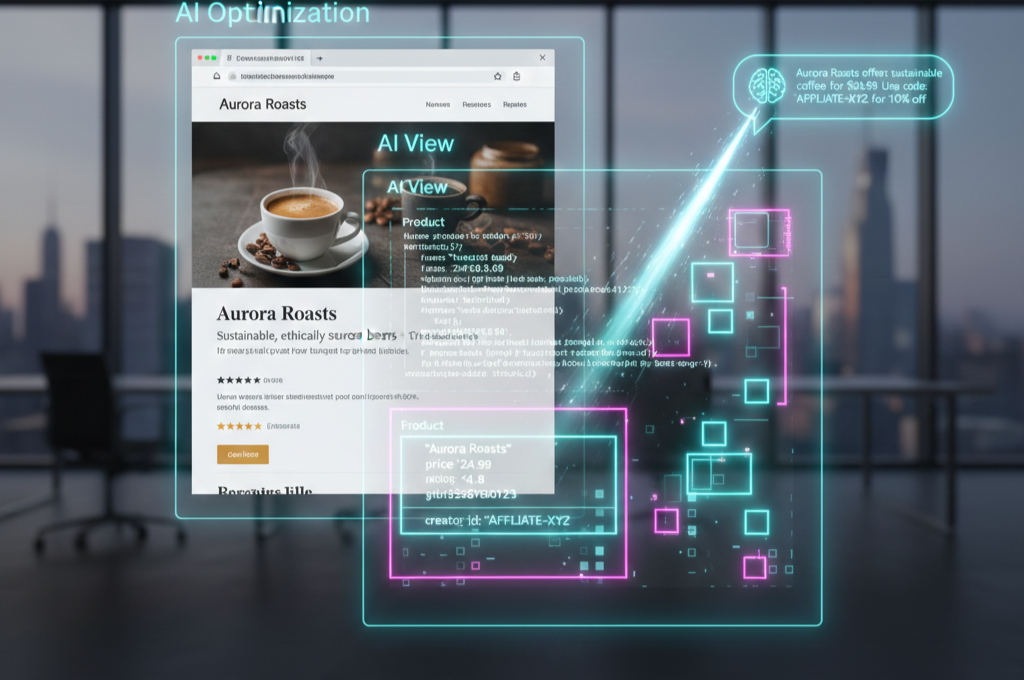
How to attribute revenue from AI agents
Learn how to track and attribute revenue from AI agents, bots, and generative search using attribution tokens, vanity URLs, and intent-matching strategies for m...
7 min read
The strategies that worked in 2025 are now liabilities. From AI agents to ‘Dark Social,’ discover the 5 trends defining the new affiliate economy, and what you must leave behind.
If you are a merchant or a partnership manager reading this in January 2026, let’s be honest: you’re probably tired.
The last twelve months weren’t just “another year” in digital commerce. They felt like a hard reset. In 2025, we watched the “Cookie Apocalypse” finally morph from a vague threat into a messy reality, not because Chrome blocked every tracker, but because people did. We saw the rise of AI agents that can buy products without ever opening a web browser. And we saw the collapse of the “lazy” promoter model that relied on spamming generic links to massive, disengaged audiences.
Now the dust has settled, and we are left staring at a new landscape. The strategies that built million-dollar campaigns in 2025 have become active liabilities. If your performance channel is still running on the “Old Stack”—client-side pixels, last-click measurement, and static payouts—you aren’t just outdated. You are operating with a 30% blind spot .
This isn’t hyperbole. Data from the Q4 2025 shopping season suggests that programs relying on legacy tracking missed attribution on nearly one-third of their actual sales . That’s money you made, but data you lost.
2026 isn’t about scrambling for more traffic. It’s about clarity. It’s about paying for actual value, not just clicks. And it’s about automating the headaches of a fragmented, privacy-first world.
In this guide, we’re going to walk through the graveyard of 2025 to see what we left behind, and then look forward at the 5 movements that will separate the market leaders from the dinosaurs in 2026.
To move forward, we have to let go of the past. These three staples of the referral industry didn’t just fade away last year; they became dangerous. If you are still clutching onto them, you are bleeding revenue without knowing it.
For two decades, the HTTP cookie was the currency of our sector. It was simple: a visitor clicks, a file is saved, a transaction is recorded.
But in 2025, the “User Choice” movement devalued that currency to near zero. When browsers pivoted to a consent-based model, it felt like a reprieve. In reality, it was a guillotine. Presented with a clear, aggressive prompt—“Do you want this website to track you?"—consumers voted with their thumbs.
By late 2025, consent benchmarks showed that opt-out rates in strict regions stabilized between 30% and 50% . Combine that with the fact that 37% of desktop users now utilize ad blockers , and the math is brutal.
The Reality: If you rely on a browser script to tell you when a purchase happens, you are only seeing 60-70% of the picture. Imagine hiring a cashier who falls asleep for 3 out of every 10 transactions. That is your pixel in 2026.
The customer journey used to be a straight line: Click an ad → Buy a shirt. Today, it’s a chaotic scribble.
A typical 2026 path looks like this:
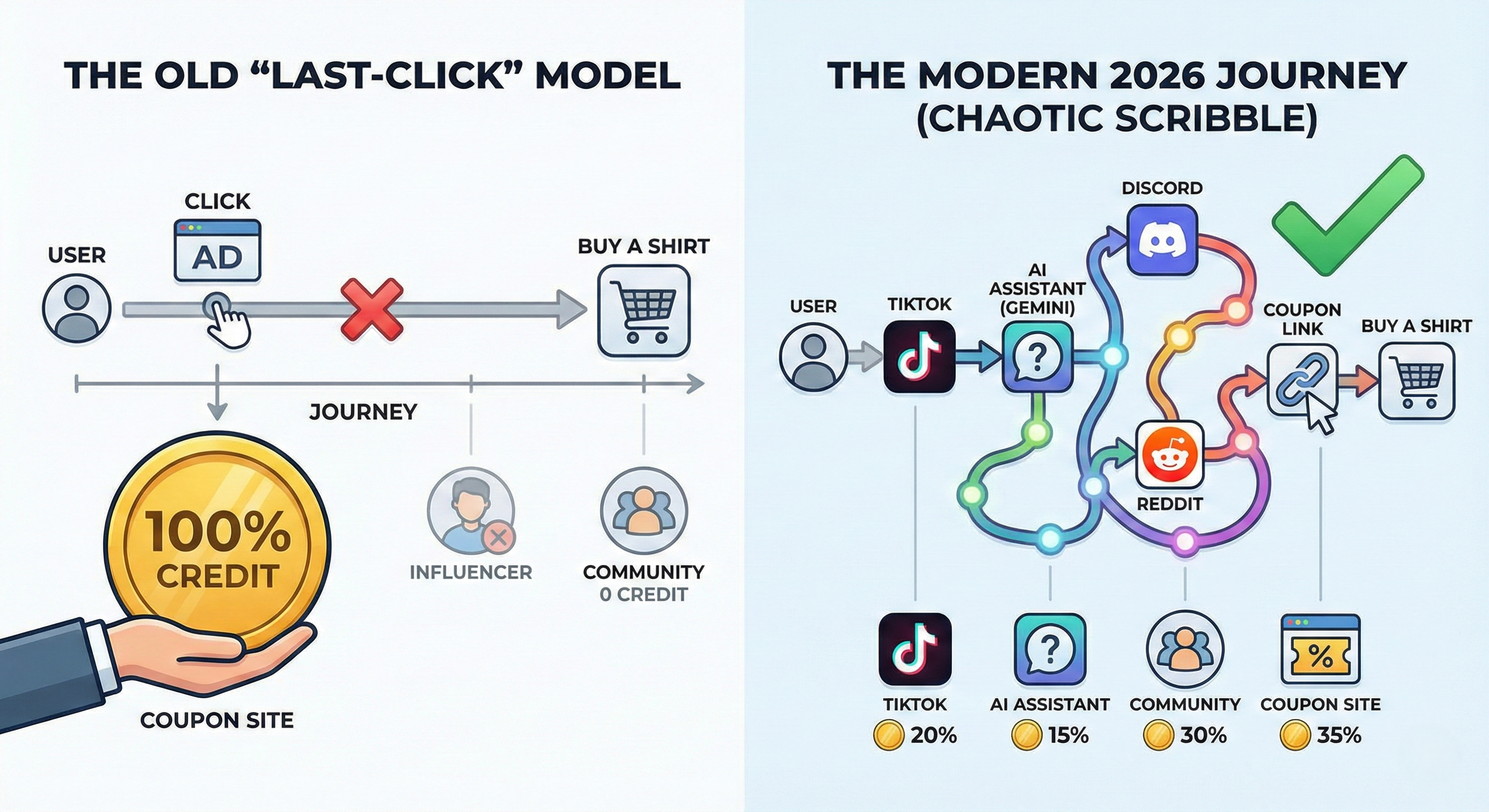
Under the old “Last-Click” model, the coupon site gets 100% of the credit. The Influencer and the community builder get $0.
The Reality: This model cannibalizes your own growth. If you starve the “Top of Funnel” promoters, the educators and entertainers who actually sold the product, they stop creating content about you.
“Join our system and earn 10%!”
It used to be standard. In 2026, it’s an insult. Sophisticated publishers know that all traffic is not created equal. A customer who buys after reading a 2,000-word in-depth review has a higher Lifetime Value (LTV) and lower return rate than a shopper who clicked a “50% OFF” banner.
The Reality: Paying them both the same 10% is bad business. You are overpaying for low-quality visitors and underpaying for your best partners. The market has moved to Dynamic Commissioning—paying for the quality of the customer, not just the sale.

Set up advanced tracking in minutes. No credit card required.
With the old methods dead, what replaces them? The following five developments are not theoretical sci-fi predictions. They are happening right now.
This is the most disruptive shift we’ve ever seen. Back in 2024, Gartner predicted that search engine volume would drop by 25% by 2026 due to AI chatbots. That prediction has come true.
Today, millions of consumers use Answer Engines (like Gemini or ChatGPT). They don’t want a list of URLs; they want a solution.
User: “What is the best running shoe for flat feet under $150?”
AI: “The Brooks Adrenaline GTS 23 is the top choice.
The user might then say, “Order it for me.”
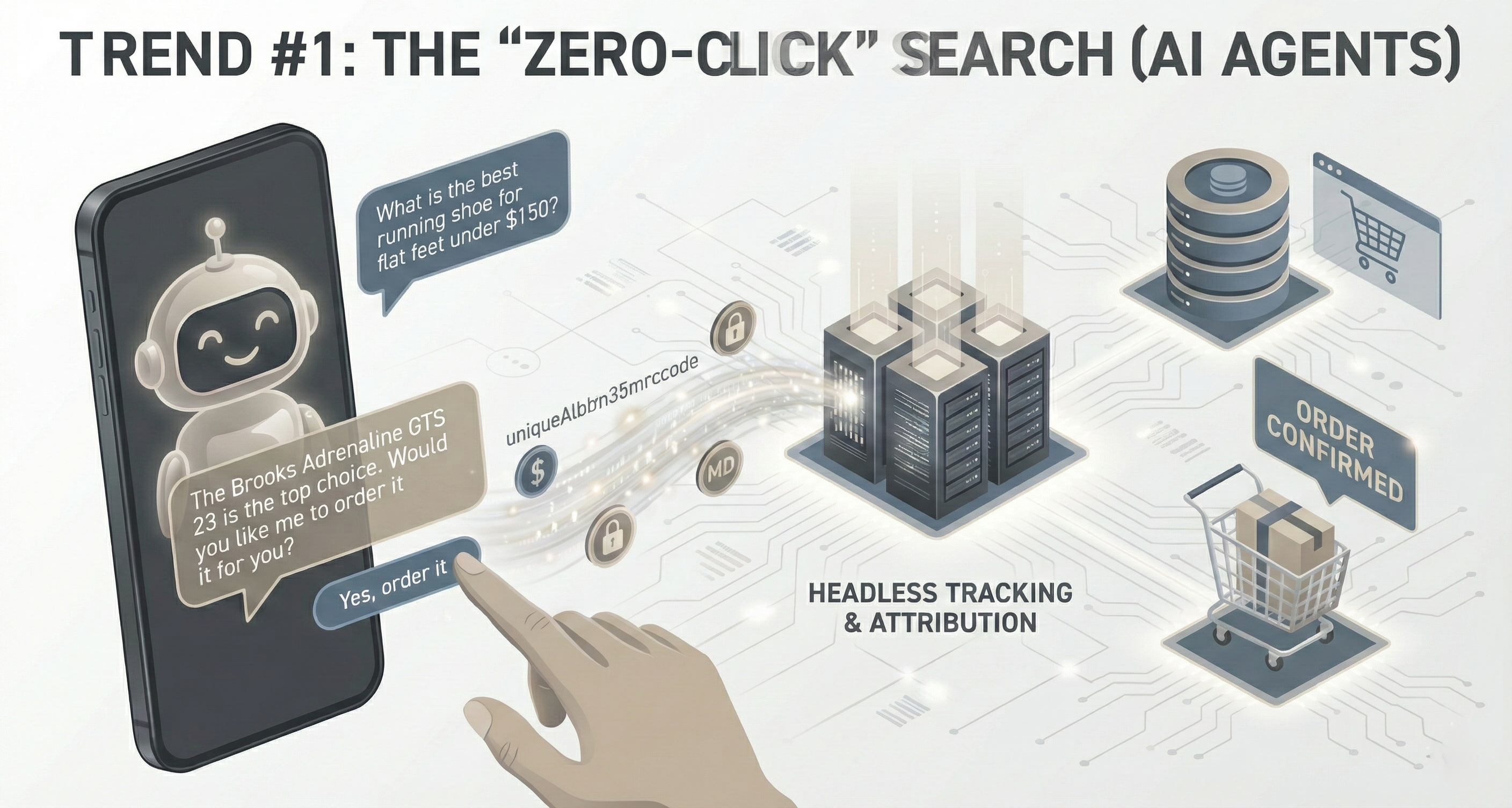
The Strategy: To survive the “Agent Economy,” your framework must support Headless Tracking. You need the ability to issue unique promo codes or “attribution tokens” that can be read by AI models. If an order comes in via an API call, your system must be able to credit the source that trained that AI answer. The “click” is dead; long live the “signal.”
Trust in public social media feeds is at an all-time low. The algorithm is too noisy. In response, high-intent buyers have migrated to “Dark Social”—private, invite-only groups like Discord servers, Telegram channels, and private WhatsApp circles.
These places are “dark” because tracking pixels cannot fire inside them. You cannot see where the traffic came from in Google Analytics; it just looks like “Direct” visits.
The Strategy: In 2026, the smartest promoters are Community Managers. To measure this, you need Anchor Text Tracking (DirectLink). This allows a partner to register their own website or community URL so that any traffic from that domain is tracked automatically, without needing a messy ?ref= parameter. It feels organic, but it’s fully attributed.
Sending referral traffic to your homepage is now considered wasteful. While generic e-commerce pages convert at 2-3%, personalized landing pages can see conversion rates double or even triple that . But you can’t ask a publisher to build a landing page for you.
The Strategy: Enter SmartLinks. These are intelligent URLs that dynamically change the destination based on who clicked them.
Scenario: A creator posts a link to your skincare brand.
It maximizes the Revenue Per Click (RPC) for the partner, making them loyal to your brand because they earn more with the same audience.
For years, the goal was to land the “Whale”—the massive influencer with 2 million followers. But in 2026, brands realized that engagement drops as follower counts rise.
The smart money has moved to the Nano-Army: recruiting 1,000 “Nano-Influencers” (1k-10k followers). Why? Because Nano-influencers boast an engagement rate nearly 3x higher , compared to less than 1% for mega-influencers.
The Problem: Managing 5 partners is easy. Managing 1,000 is a logistical nightmare.
The Strategy: This trend relies entirely on Automation Rules. You need a tool that automatically moves a promoter to a higher commission tier once they hit 10 sales. You need a system that can pay 1,000 people via PayPal/Stripe with a single click.
If you run a SaaS or B2B campaign, the “Cost Per Lead” (CPL) model is dying. Companies are tired of paying for leads that sign up for a free trial and never use the software.
Simultaneously, SaaS pricing has shifted. Reports show that over 60% of SaaS companies have adopted some form of Usage-Based Pricing (UBP).
The Strategy: Associate rewards must mirror this.
This aligns the referrer’s incentive with your goal: finding active users, not just tire-kickers.
The year 2026 is unforgiving to those who refuse to adapt.
The “easy money” era of performance marketing is gone. It has been replaced by the “smart money” era. The winners this year will not be the brands with the biggest budgets, but the ones with the clearest vision. They will be the brands that respect user privacy while ensuring data accuracy via Server-Side Attribution. They will be the ones who use automation to treat 1,000 partners as individuals. They will be the ones who pay for value, not just clicks.
You have a choice. You can keep looking at your dashboard, wondering why your conversion rates are dropping. Or, you can acknowledge that the old playbook is finished.
The technology to navigate this new landscape exists. The “Dark Social” channels, the AI agents, and the Nano-armies are not threats, they are massive opportunities for the brands brave enough to build the infrastructure to capture them.
The future belongs to the prepared. Is your program ready?
Third-party cookies have been largely replaced by 'Server-to-Server (S2S)' attribution and First-Party Data strategies. In S2S, conversion data is sent directly from the merchant's server to the platform via API, bypassing the user's browser. This method is immune to ad blockers and browser privacy restrictions.
Recording orders from AI agents requires 'Headless Tracking' or API-based measurement. Since AI interactions don't always involve a browser click, vendors must issue unique attribution tokens or promo codes. When the purchase is made using that token, the software credits the source via an API call.
Macro-Influencers typically have 100k+ followers. Nano-Influencers have smaller audiences (1k-10k) but significantly higher engagement rates (over 4%). In 2026, trends favor 'Nano-Armies'—groups of hundreds of smaller creators paid on performance (commission) rather than flat fees.
Yes, using 'DirectLink' technology. This feature allows a promoter to register their domain or community URL with the software. When traffic arrives from that specific source, the platform recognizes it and tracks the conversion without requiring a visible parameter (like `?ref=`) in the URL.
Tamara is a copywriter at Post Affiliate Pro. She's passionate about helping businesses and marketers understand how affiliate programs can drive growth, one blog post at a time.

Discover how AI-powered insights and multi-channel affiliate campaigns can increase your revenue and brand reach. Start optimizing your affiliate strategies today with Post Affiliate Pro and expert tools for smarter, data-driven decisions.
Learn how to track and attribute revenue from AI agents, bots, and generative search using attribution tokens, vanity URLs, and intent-matching strategies for m...
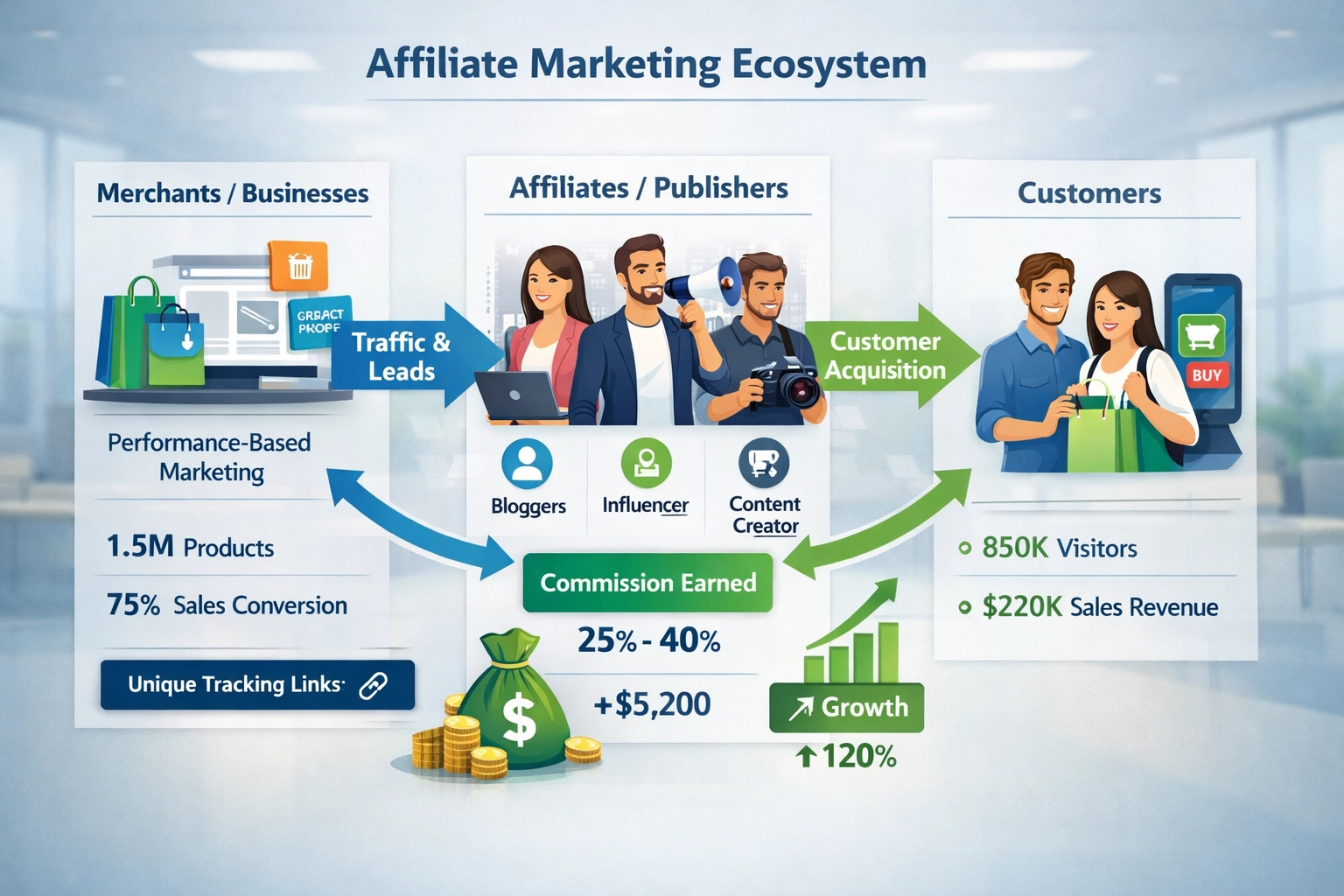
if affiliate marketing is worth your investment in 2026. about ROI, benefits, challenges, and how to maximize your affiliate program success with data-driven
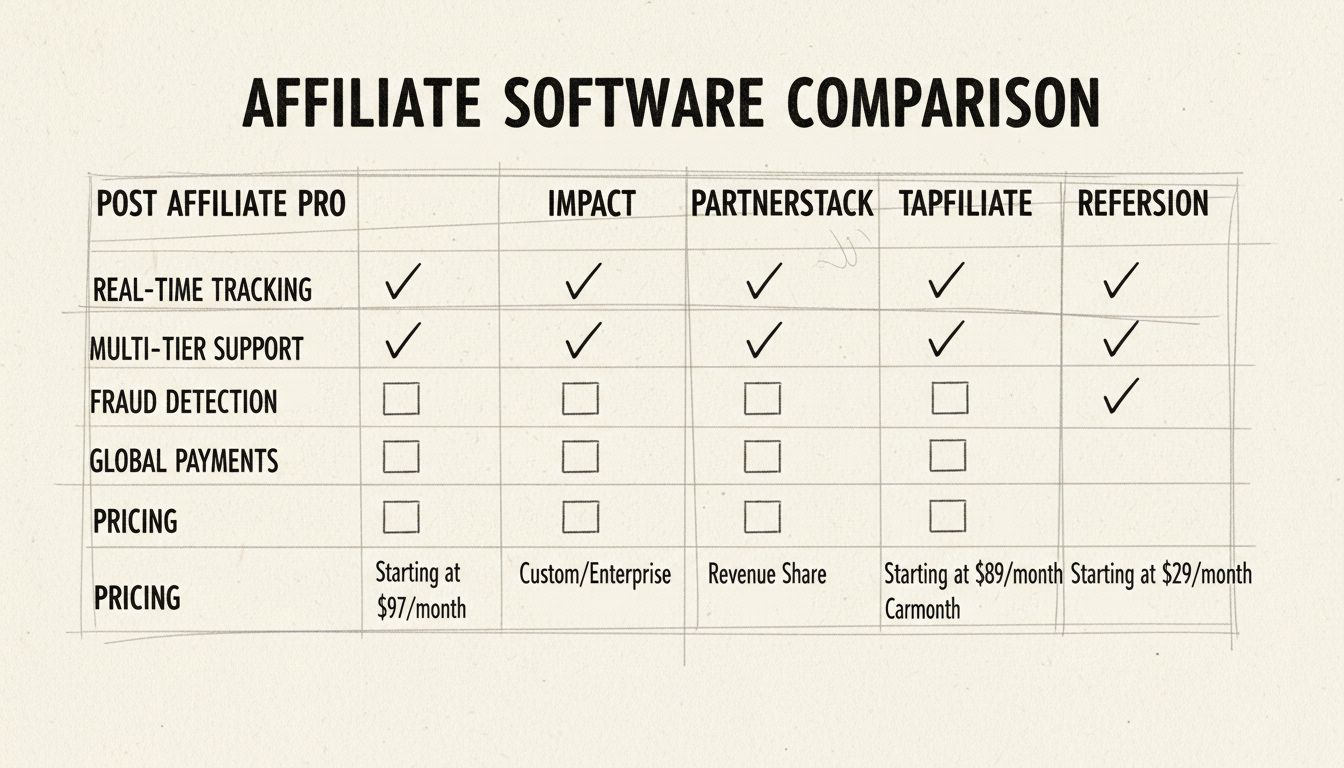
Compare the best affiliate software platforms in Q4 2025. features, pricing, and performance of Post Affiliate Pro, Impact, PartnerStack, Tapfiliate, and more.
Join our community of happy clients and provide excellent customer support with Post Affiliate Pro.