Cookie Duration in Affiliate Marketing: Maximize Earnings
Learn why cookie duration is crucial in affiliate marketing. Discover how tracking windows affect conversions, earnings, and program success.
11 min read
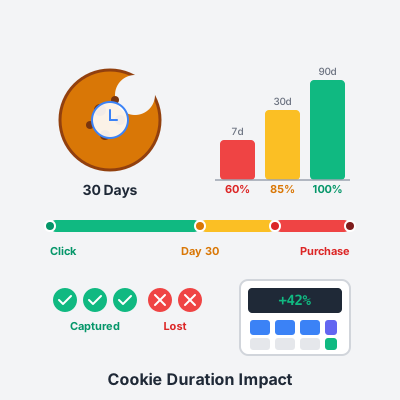
Calculate how affiliate cookie duration affects your commission potential. Compare different tracking windows, visualize conversion capture rates, and understand which affiliate programs maximize your earnings based on customer journey length.
Affiliate cookie duration is one of the most critical—yet often overlooked—factors in affiliate program selection. This calculator helps you quantify exactly how different tracking windows affect your commission potential based on your audience’s buying behavior.
How it works: Input your typical customer journey length (days from first click to purchase), traffic volume, and conversion rate. Compare 2-4 different cookie durations side-by-side to see captured conversions, lost opportunities, and revenue impact. The tool visualizes what percentage of your potential commissions you’ll actually earn under different cookie scenarios.
Why it matters: If your average customer takes 45 days to purchase but your affiliate program has a 30-day cookie, you’re losing 33% of potential commissions to cookie expiration. For 1,000 monthly clicks at 3% conversion rate, that’s 10 lost sales per month. At $50 commission each, that’s $500/month or $6,000/year in lost earnings—just from inadequate cookie duration.
The calculator uses realistic conversion attribution modeling based on customer journey length vs. cookie duration. When journey length exceeds cookie duration, conversions are lost proportionally. For example, if average journey is 60 days and cookie is 30 days, approximately 50% of conversions occur after cookie expiration.
Capture rate formula: If journey length ≤ cookie duration, capture rate = 100%. If journey length > cookie duration, capture rate = (cookie duration / journey length) × 100%. This simplified model assumes uniform distribution of conversion timing, which approximates real-world behavior for most product categories.
Real-world factors: Actual capture rates depend on purchase distribution patterns—some products show exponential decay (most purchases early), others show bell curves (peak mid-journey), and high-consideration items show late-stage concentration. Use your affiliate dashboard’s “days to conversion” data to calibrate journey length input for accurate modeling.
Beyond conversion counts, cookie duration affects total revenue through multiple mechanisms:
Lost high-value customers: Customers who research longer often become higher-value buyers (more items, premium options). Losing them to cookie expiration disproportionately impacts revenue. A 30% conversion loss might mean 40% revenue loss if late converters spend more.
Seasonal considerations: Holiday shopping, back-to-school, and other seasonal campaigns have extended research periods. Your year-round average journey of 14 days might spike to 45 days in November-December. Programs with 30-day cookies underperform during these critical high-revenue periods.
Multi-device journeys: Modern customers click on mobile, research on tablet, and purchase on desktop across weeks. Each device switch risks cookie loss (though many networks now use device fingerprinting and cross-device tracking). Longer cookies provide buffer against multi-device attribution gaps.
Use calculator insights to prioritize affiliate programs:
Cookie duration benchmarks by niche:
Evaluation framework: Don’t evaluate cookie duration in isolation. Calculate Expected Value (EV) = (Commission Rate × Average Order Value × Conversion Rate × Cookie Capture Rate × Click Volume). A program with 5% commission and 90-day cookie may yield higher EV than 10% commission with 14-day cookie for your traffic.
Negotiation leverage: If you’re driving significant volume, negotiate longer cookie duration with merchants. Demonstrate with calculator: “A 90-day cookie vs. current 30-day would capture 40% more conversions. At our volume, that’s $X additional sales for you. Can we extend to 60 days?” Data-driven negotiation works.
Last-click attribution dynamics: With last-click models (most common), later affiliates overwrite earlier ones if customer clicks new link before purchase. Your 90-day cookie doesn’t protect against a competitor’s 7-day cookie clicked 2 days before purchase. Longer cookies reduce risk but don’t eliminate it.
Cookie refresh behavior: Some programs refresh cookie duration on subsequent visits. Customer clicks your link (90-day cookie set), returns 30 days later via organic search, cookie may refresh to 90 days from new visit date. This extends effective attribution window beyond nominal duration.
Multi-touch attribution: Emerging programs use fractional attribution—credit multiple affiliates in customer journey. First-touch models (credit introducer), linear models (equal credit), time-decay models (more credit closer to purchase), or position-based models (credit first and last touches more). These reduce cookie duration importance but remain rare in affiliate marketing.
Leverage your own data: Affiliate dashboards show “click to conversion time” distribution. If 80% of conversions occur within 14 days, a 30-day cookie captures most opportunities. But if conversions spread uniformly across 60 days, you need 90+ day cookies to avoid significant losses.
Seasonal variation analysis: Calculate journey length separately for peak seasons. Q4 holiday shopping often shows 2-3× longer journey than Q1-Q3. Programs with shorter cookies (30 days) may work Q1-Q3 but underperform Q4 when journey extends to 45+ days.
Traffic source segmentation: Different traffic sources show different journey lengths. SEO traffic (informational intent) often takes longer to convert than PPC traffic (transactional intent). Social media traffic may have extended journey with multiple touchpoints. Calculate duration requirements per traffic source to optimize channel-program matching.
Cookie deletion risks: Customers clearing browser cookies, switching browsers/devices, or privacy tools blocking cookies all reset tracking. Longer nominal cookies provide buffer—even if 50% persistence, 90-day cookie = 45-day effective duration. Short cookies (7-14 days) offer no buffer.
Mobile app deep linking: Some networks use device fingerprinting and deep linking instead of traditional cookies, especially for mobile app conversions. These often persist longer than browser cookies. Check if programs offer mobile attribution beyond cookie-based tracking.
First-party vs. third-party cookies: Browser restrictions increasingly block third-party cookies (cross-domain tracking). First-party cookies (same domain) persist better. Programs using first-party tracking or server-side attribution provide more reliable cookie duration than those relying on deprecated third-party methods.
Use this calculator to:
Audit current programs: Input your click volume, conversion rate, and journey length. For each program, compare actual cookie duration vs. optimal. Identify programs where short cookies cost you >20% potential commissions. Consider phasing them out.
Prospect evaluation: Before joining new programs, calculate expected capture rate with their cookie duration vs. your journey length. If capture rate <70%, negotiate longer cookie or deprioritize unless commission rate compensates.
Content strategy alignment: If creating evergreen content (long-tail SEO), prioritize programs with 90+ day cookies to capture delayed conversions. For time-sensitive content (deal alerts, news), shorter cookies acceptable since conversions cluster early.
Diversification planning: Balance portfolio between short-cookie/high-commission and long-cookie/moderate-commission programs. Short cookies work for deal sites and impulse traffic; long cookies essential for review sites and educational content.
Action: Use Google Analytics or affiliate dashboard data to calculate actual average “days from first visit to conversion.” Most dashboards have a “Time to Conversion” report showing distribution of conversion timing (1 day, 2-7 days, 8-14 days, 15-30 days, 31+ days).
Analysis: If 70% of conversions occur within 14 days, a 30-day cookie captures nearly all. But if conversions spread evenly across 60 days, you need 90+ day cookie to avoid 30-50% commission loss. Don’t guess—measure.
Segmentation: Different product types in your niche may have different journeys. Low-ticket accessories convert fast; high-ticket core products take longer. Calculate separately and match programs accordingly.
Traditional EPC: Earnings Per Click = Total Earnings / Total Clicks. This is backward-looking and doesn’t account for cookie limitations.
True EPC calculation: (Commission Rate × AOV × Conversion Rate × Cookie Capture %) = True EPC. A program advertising $10 EPC might only deliver $6 EPC if cookie duration causes 40% conversion loss.
Example: Program A: 10% commission, $100 AOV, 2% conversion, 14-day cookie, 30-day journey = 10% × $100 × 2% × (14/30) = $0.093 true EPC. Program B: 8% commission, $100 AOV, 2% conversion, 90-day cookie, 30-day journey = 8% × $100 × 2% × 100% = $0.16 true EPC. Program B earns 72% more despite lower commission rate!
Leverage data: If you’re driving significant volume, use this calculator as negotiation tool. Show merchant: “Current 30-day cookie captures only 65% of conversions based on my 45-day customer journey. Extending to 90 days would capture 100%, generating $X additional sales for you. Can we extend cookie to 60-90 days?”
Win-win framing: Position longer cookie as merchant benefit, not just affiliate benefit. You’ll promote more aggressively knowing commissions are protected, driving more top-of-funnel awareness. Longer attribution = fair credit = higher affiliate motivation = more sales.
Start with top performers: Request cookie extensions once you’ve proven value. After 90 days of strong performance, approach affiliate manager with data: “I’m driving $Y in monthly sales. To grow this, I need longer cookie duration to match my audience’s buying cycle. Can we discuss extension?”
Short-cookie programs (7-30 days): Reserve for deal sites, coupon codes, flash sales, time-sensitive promotions, impulse purchases. These align with short-decision products and bottom-of-funnel traffic.
Medium-cookie programs (30-90 days): Core portfolio for most affiliates. Suitable for comparison content, product reviews, “best of” lists, standard SaaS promotions. Captures majority of conversions for typical buying cycles.
Long-cookie programs (90-365 days): Essential for high-ticket items, B2B services, luxury goods, major investments, educational content, top-of-funnel awareness. These protect your commission on extended sales cycles and multi-touch journeys.
Balance portfolio: Maintain mix across all three categories. All short-cookie = high conversion loss on extended journeys. All long-cookie = may miss out on high-commission short-cookie opportunities if product aligns. Diversify by product category and content type.
Dashboard metrics: Track “Click to Conversion Time” distribution monthly. Identify seasonal patterns, trending longer or shorter. Adjust program priorities quarterly based on actual conversion timing data.
A/B testing: If promoting similar products via different programs with different cookie durations, track performance separately. Direct traffic to short-cookie program via deal content, long-cookie program via educational content. Measure which combination yields higher EPC.
Lost conversion estimation: For programs providing “days to conversion” data, calculate percentage of conversions occurring after cookie expiration. If 30% of conversions show >30 days to convert but program has 30-day cookie, you’re losing ~30% commissions. Flag for cookie extension request or program replacement.
Last-click dominance: With 95% of programs using last-click attribution, your long cookie doesn’t protect against competitor clicks closer to purchase. Customer journey: Day 1 (your click, 90-day cookie) → Day 20 (competitor click, 7-day cookie) → Day 22 (purchase) = competitor gets commission. Longer cookie reduces risk but doesn’t eliminate it.
Cookie refresh policies: Some programs refresh cookie duration on repeat visits even without clicks. If customer returns via organic search, some networks re-attribute to last affiliate. Check program terms—this effectively extends your attribution window.
Cross-device tracking: Networks with device fingerprinting and probabilistic matching provide attribution even when cookies fail (device switches, cookie deletion). Ask if programs support cross-device. These effectively extend “cookie” duration beyond browser cookie technical limits.
Disclosure strategy: In content, subtly communicate urgency aligned with cookie limitations. For short-cookie programs (14 days): “Limited time tracking—if you’re considering this product, click now to ensure I receive credit for your purchase.” For long-cookie programs (90+ days): “Take your time researching. When you’re ready to buy, I’ll receive credit for up to 90 days.”
Multiple CTAs: On long-form content, place affiliate links throughout. Even if initial click expires, later in-content links may catch customer on return visit. Increases effective cookie capture rate by providing multiple entry points.
Email list advantage: Capturing emails from content allows you to re-engage prospects via email campaigns with fresh affiliate links, effectively bypassing cookie expiration. Build email list to extend attribution beyond cookie technical limits.
Holiday extension: Request temporary cookie extensions for Q4 holiday season. Customer journey extends 2-3× during November-December. If typical journey is 14 days, it may spike to 30-45 days with holiday shopping. A program with 30-day cookie should extend to 60-90 days for Q4 to capture extended journeys.
Back-to-school, Prime Day, Black Friday: Any seasonal high-volume period shows extended customer journey due to research phase before sales event. Negotiate temporary cookie extensions 60-90 days before major seasonal events to capture early research traffic.
Post-holiday contraction: January-February often shows shortest journey lengths (new year purchases, gift card redemption, tax refund spending). Even short-cookie programs perform adequately during this period. Adjust program promotion mix seasonally based on cookie-journey alignment.
Affiliate cookie duration (also called tracking window or cookie lifetime) is the length of time an affiliate tracking cookie remains active after a user clicks your affiliate link. If the customer makes a purchase within this window, you receive the commission. Durations typically range from 7 days to 365 days, with 30-90 days being most common. Longer durations capture more conversions, especially for high-consideration products where customers research before buying.
Cookie duration directly impacts how many conversions you can capture. If your average customer takes 45 days to purchase but the cookie expires after 30 days, you lose that commission. For example, with 1,000 monthly clicks, a 2.5% conversion rate, and a 30-day cookie, you might capture 20 conversions. But if customers average 45-day buying cycles, a 90-day cookie could capture 25 conversions instead—a 25% increase in earnings. Shorter cookies mean lost commissions when customers exceed the tracking window.
Ideal cookie duration depends on your product category and sales cycle. Fast-moving consumer goods and impulse purchases: 7-30 days suffices. Software/SaaS products: 30-60 days captures trial-to-paid conversions. High-ticket items (electronics, furniture): 60-90 days for research phase. B2B services and enterprise software: 90-180 days for long sales cycles. Luxury goods and major investments: 180-365 days for extended consideration. Use this calculator to model your specific scenario based on your audience's typical buying behavior.
Merchants choose shorter cookie durations for several strategic reasons: reducing commission liability (shorter attribution = fewer payouts), preventing commission stacking from multiple affiliates, focusing on affiliates who drive immediate conversions, industry norms (competitive positioning), technical limitations in older tracking systems, and fraud prevention (harder to manipulate short windows). However, shorter cookies disadvantage affiliates promoting high-consideration products. Evaluate programs holistically—a 5% commission with 90-day cookie often beats 10% with 7-day cookie for products with longer sales cycles.
When an affiliate cookie expires, you lose tracking attribution for that customer. If they purchase after expiration, no commission is credited to you. Additionally, with last-click attribution models (most common), if another affiliate's link is clicked before purchase, their cookie overwrites yours and they get the commission—even if your initial introduction was more valuable. This is why cookie duration is critical for products with long consideration cycles, multiple research sessions, or comparison shopping phases.
Use this calculator by inputting: (1) average customer journey length from first click to purchase, (2) your monthly click volume, (3) typical conversion rate, and (4) cookie durations to compare. The calculator shows captured vs. lost conversions per duration. For example, with 50-day journey, 1,000 clicks, 3% conversion rate, and 30-day cookie, you'd capture only 60% of potential conversions (18 of 30). A 90-day cookie captures 100% (all 30). Lost conversions = (Expected conversions) × (1 - capture rate). This helps you prioritize programs with adequate cookie durations.
Generally yes, but with diminishing returns. Going from 7 to 30 days significantly increases captured conversions for most products. But 180 vs. 365 days shows minimal difference unless you're in ultra-long sales cycles (real estate, enterprise software). Consider: (1) product research time, (2) price point (higher = longer consideration), (3) purchase frequency (recurring vs. one-time), (4) competition (last-click attribution means later affiliate wins). Balance cookie duration with commission rate, conversion rate, and EPC (earnings per click). A program with 60-day cookie and 8% commission may outperform one with 90-day cookie and 5% commission.
Yes! Check: (1) affiliate program terms of service or FAQ page, (2) affiliate network details (ShareASale, CJ, Impact show duration), (3) program's affiliate information page, (4) affiliate manager during application, (5) program comparison sites. If not disclosed, contact their affiliate support before joining. Reputable programs clearly state cookie duration upfront. If hidden, it's often short (7-14 days) and they're avoiding scrutiny. Track your own conversion lag time using affiliate dashboard data to verify claimed durations match actual attribution windows.
Terms are often used interchangeably, but technically: Cookie duration is the technical lifespan of the tracking cookie file stored in the browser. Attribution window is the business rule for how long a merchant credits commissions after a click. They're usually identical, but some programs have complexity: (1) longer cookie but shorter attribution (cookie lasts 90 days, but only first 30 days count for commissions), (2) view-through windows (credit impressions, not just clicks), (3) multi-touch attribution (credit multiple touchpoints). Always verify both technical cookie lifetime and commission attribution rules in program terms.
Last-click attribution means the most recent affiliate whose cookie is active at purchase time receives 100% commission—even if an earlier affiliate introduced the product. This creates 'cookie stuffing' incentives and disadvantages top-of-funnel affiliates. Example: You write a detailed review (customer clicks, 90-day cookie set). They research for 30 days. A coupon site (7-day cookie) is clicked 2 days before purchase. Coupon affiliate gets commission despite your greater value contribution. Longer cookie durations partially mitigate this by extending your attribution window, but don't prevent other affiliates from overwriting. Some networks now offer multi-touch attribution models.
Manage multiple affiliate programs and improve your affiliate partner performance with Post Affiliate Pro.
Learn why cookie duration is crucial in affiliate marketing. Discover how tracking windows affect conversions, earnings, and program success.
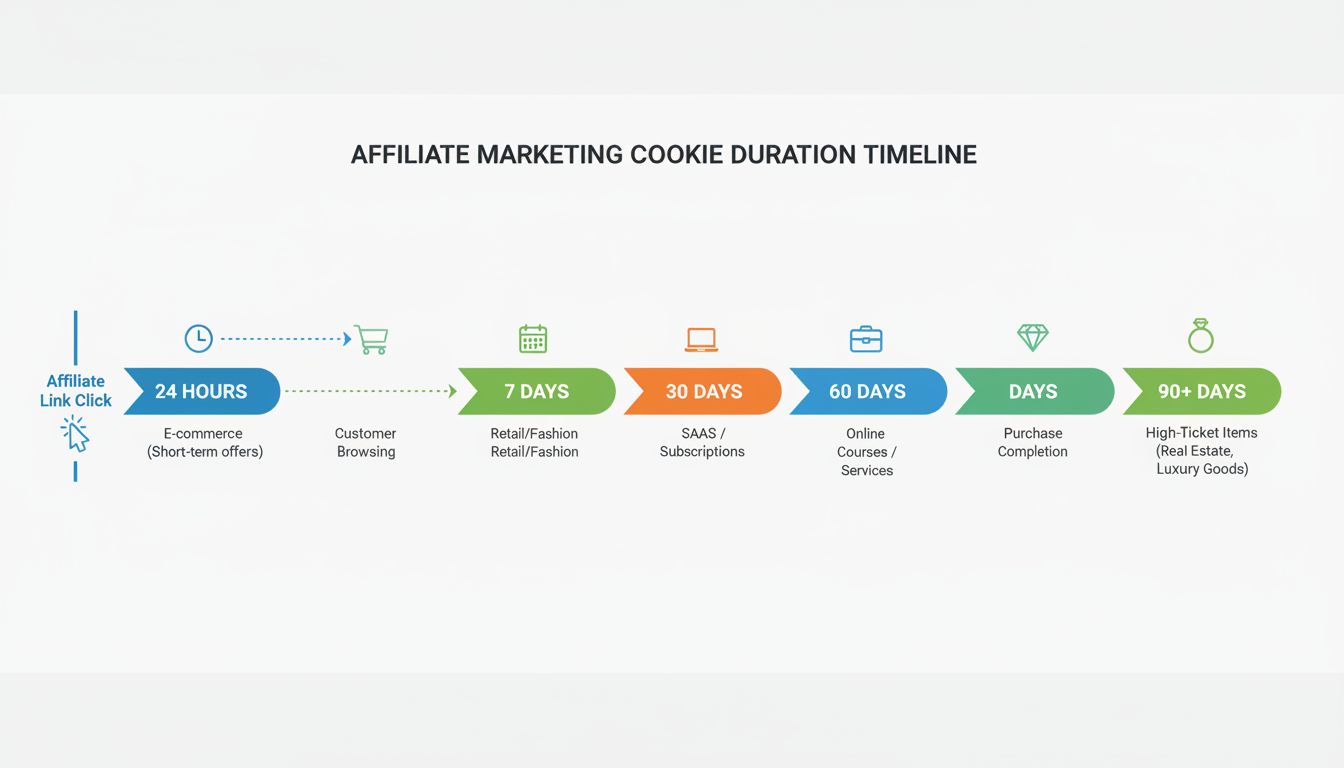
Discover why cookie duration is crucial for affiliate marketing success. Learn how tracking windows impact earnings, conversions, and program profitability with...
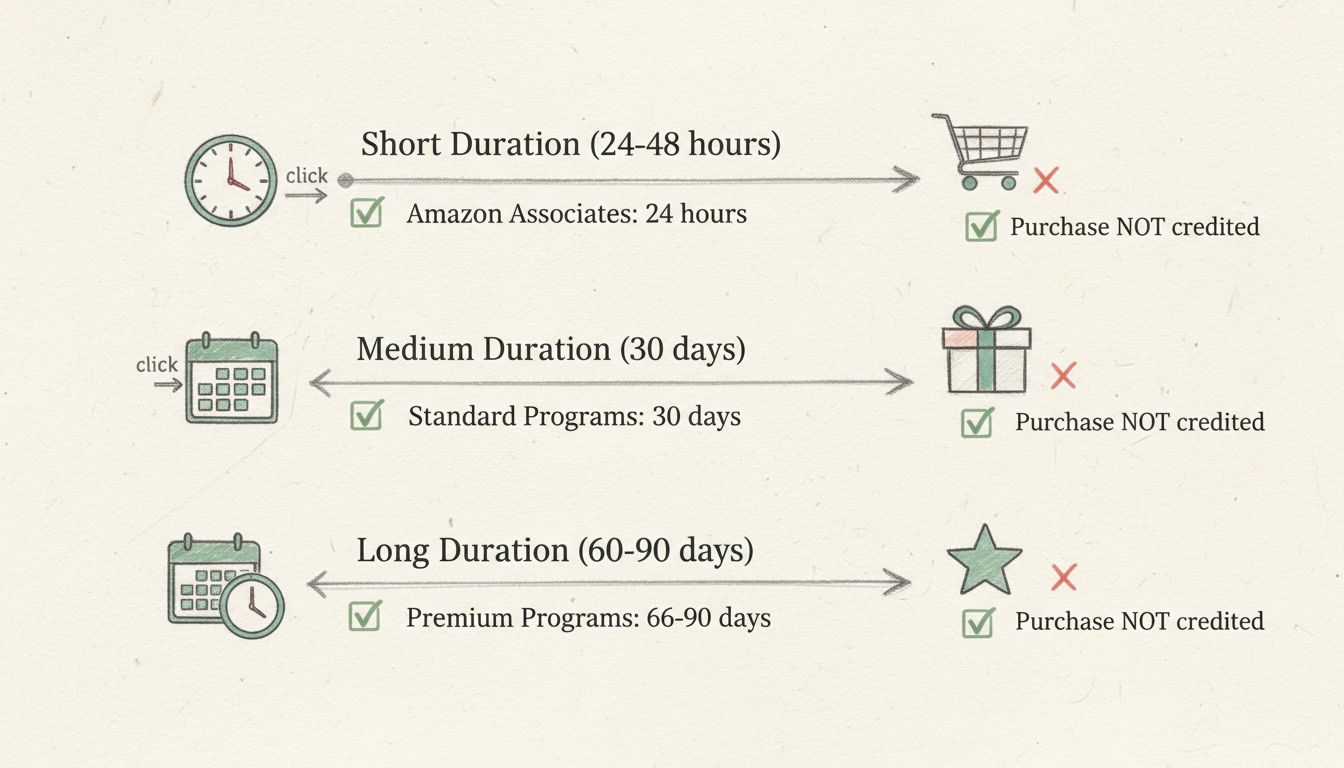
Learn about affiliate cookie duration, how long cookies last (24 hours to 90+ days), and how to maximize earnings with PostAffiliatePro's advanced tracking syst...
Join our community of happy clients and provide excellent customer support with Post Affiliate Pro.